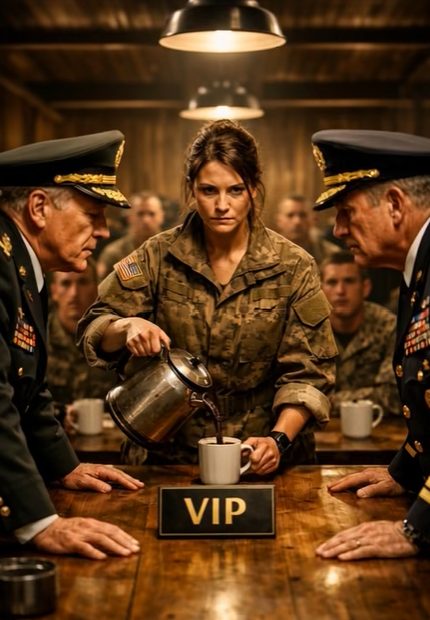

🎖️ 🇺🇲 HE ORDERED THE “CLERK” TO SERVE COFFEE TO THE VIPS – UNTIL THE COMMANDER WALKED IN
“You just told a retired SEAL commander to serve coffee at the VIP table,” a corporal whispered.
But it was far too late.
When Claire arrived at Redridge Forward Operating Post that morning, she wore unmarked camouflage and carried a heavily worn duffel. The guard’s manifest simply listed her as “Logistics Observation.” To the soldiers cycling through, she was a nobody.
Sergeant Wayne noticed her quiet demeanor and instantly labeled her a target. He barked at her to haul an impossible stack of heavy supply crates across the motor pool. She didn’t argue. She just lifted them with terrifying ease, dead silent.
Wayne smirked. “At least someone here knows how to follow orders.”
That evening was the mandatory VIP dinner. Wanting to throw his weight around in front of his squad, Wayne shoved a silver coffee pitcher into Claire’s hands. “Go pour for the brass at the head table,” he snapped. “And don’t speak.”
Claire just nodded. She quietly approached the head table right as the Base Commander arrived.
Wayne watched from the doorway, arms crossed, waiting for the “clerk” to embarrass herself.
But when the Commander looked up and saw who was pouring his coffee, his jaw dropped. He didn’t ask for sugar. He instantly shot out of his chair, knocking his water glass over, and snapped a perfect, rigid salute.
The entire mess hall went dead silent.
The Commander slowly turned toward Sergeant Wayne, his face turning completely pale, and said…
Nobody Reads the Manifest
Redridge wasn’t a glamorous post. It sat two hours from anything resembling a town, pressed up against a flat stretch of high desert that smelled like dust and diesel no matter what direction the wind came from. The soldiers there had a particular kind of boredom going, the kind that turns some people inward and other people mean.
Wayne Pruitt was the latter.
He’d been a sergeant for six years. Good enough at his job to keep the rank, not good enough at anything else to move past it. He had the kind of authority that only exists inside a very small room, and he knew it, which made him worse. His squad had learned to stay two steps ahead of his moods. They watched where he was looking. They adjusted accordingly.
When Claire walked through the gate at 0630 that Tuesday, she didn’t register as anything. That was the whole point. She had the kind of face that your eyes slide off of, not unattractive, just unremarkable in the way of someone who has spent years making sure you don’t remember them. Her camouflage was the older pattern, faded at the elbows and knees. The duffel she carried looked like it had been dragged through about four different continents, and probably had.
Private First Class Donna Reyes was on gate duty. She checked the manifest, found “Logistics Observation – C. Hatch,” and waved her through without a second look. Standard rotation. They got observers through Redridge a few times a month. Usually DoD contractors, sometimes junior analysts, once a very lost journalist who’d taken a wrong turn off the highway and panicked his way through three checkpoints before anyone noticed.
Nobody asked Claire who she was. She didn’t offer.
The Crates
Wayne spotted her twenty minutes later.
She was standing near the motor pool, reading something on a small laminated card. Not her phone, not a tablet. An actual card, like a reference sheet. He took that in, filed it under civilian, and walked over.
“You with the logistics observation group?”
She looked up. “That’s right.”
“Good. We’ve got a pallet situation.” He pointed to a stack of supply crates near the east wall. Forty-pound boxes, maybe fifteen of them, stacked wrong by the night crew. They needed to move twenty yards to the correct staging area. It was work for two people with a hand truck, or one person with a forklift. He had neither available, which was a lie, but the forklift was right there and he wasn’t offering it.
He wanted to see what she’d do. Ask for help. Complain. Make a call. Something soft.
She looked at the stack. Looked back at him. Then she put the laminated card in her breast pocket, walked to the crates, and started moving them.
No hand truck. One at a time, two at a time when she could get a grip on them. She moved with the kind of efficiency that doesn’t come from a gym. It comes from having moved heavy things in bad conditions for a long time. Her breathing stayed even. She didn’t grunt, didn’t adjust her posture dramatically, didn’t look back at Wayne for acknowledgment.
Fifteen crates in about eleven minutes.
She stacked them correctly in the staging area, brushed her palms on her thighs, and walked back to where she’d been standing.
Wayne watched the whole thing from the doorway of the supply office. Corporal Dale Simmons was next to him, also watching.
“Huh,” Simmons said.
“Don’t,” Wayne said.
“I didn’t say anything.”
“I know what you were going to say.”
He walked away before Simmons could answer.
The VIP Dinner
The mandatory VIP dinner happened four times a year at Redridge. It was exactly what it sounded like: brass from various commands, a few civilians from DoD, the occasional contractor with a clearance level nobody talked about out loud. The mess hall got a tablecloth treatment. Someone always burned the rolls.
Wayne’s squad had mess duty that evening, which meant Wayne had a small kingdom for approximately three hours. He could direct people. He could make decisions. He could, if he was feeling theatrical about it, demonstrate his authority in front of an audience that actually outranked him.
He found Claire near the kitchen staging area at 1745. She’d been handed a clipboard by someone and was going through what looked like a supply checklist. She was doing it quietly, standing off to the side, not in anyone’s way.
Wayne took the silver coffee pitcher off the counter next to her and held it out.
“You,” he said. “Head table. Pour for the brass. Don’t introduce yourself, don’t make conversation, don’t speak unless they ask you something directly.” He paused. “You understand?”
She looked at the pitcher. Then at him.
“Sure,” she said.
He’d wanted some pushback. Some sign that she knew she was being handled. He got nothing. Just that flat, even look, and then she took the pitcher and turned toward the dining area.
Simmons appeared at Wayne’s elbow as she walked away.
“Sarge, do you know who that is?”
“Logistics observer. Hatch, C.”
Simmons had a particular expression on his face. The one he got when he was trying to decide how much trouble it was worth to say the next sentence. “I looked her up in the secondary manifest. The one from Division.”
“And?”
Simmons opened his mouth. Closed it. Tried again.
Wayne waved him off. “Just make sure the rolls don’t burn again.”
What the Commander Saw
Colonel Dennis Farrow had been running Redridge for eight months. He was a careful man, methodical, the kind of officer who read briefing packets twice and remembered names. He’d had a long drive from the sector command meeting and he was tired in the specific way of someone who’d spent four hours in a car listening to people disagree about logistics.
He came through the side entrance, shook two hands at the door, and moved toward the head table.
He saw the coffee pitcher first. Then the hand holding it. Then he looked up.
He stopped walking.
For about a second and a half, his brain did the thing brains do when they see something that doesn’t fit the context. The little processing stutter. The wait.
Then it resolved and his body moved before his thinking caught up.
He came out of his chair so fast the edge of it caught the table. His water glass went sideways, rolled, hit the floor. He didn’t look at it. He was already at attention, right hand snapping to his temple in a salute so crisp it looked like a reflex, because it was.
The mess hall had been at a low hum. Forty-odd people, silverware, the muffled sound of the kitchen. All of it stopped.
Claire set the pitcher down on the table. She returned the salute with the kind of ease that meant she’d done it ten thousand times. Then she said, quietly enough that only the head table could hear, “At ease, Dennis. I’m just pouring coffee.”
Farrow lowered his hand. His face had gone the color of old chalk.
“Commander Hatch,” he said. “I didn’t – the manifest had you as – “
“Logistics observation,” she said. “That’s accurate enough.”
He looked like he wanted to say about fifteen things. He settled for: “Yes, ma’am.”
What Wayne Heard
Simmons found him in the doorway.
Wayne had been watching from across the room with his arms crossed, waiting for the moment the “clerk” fumbled the pitcher or said something wrong. He’d been half-smiling about it, the anticipatory version, the smile before the thing you’re expecting happens.
The smile was gone now.
He’d seen the salute. He’d seen Farrow’s face. He could see, even from fifty feet away, that Farrow was not annoyed. Farrow was not condescending. Farrow was standing slightly differently than he’d been standing a minute ago, the way soldiers stand when the person across from them has a longer shadow.
Simmons was right next to his ear.
“You just told a retired SEAL commander to serve coffee at the VIP table,” Simmons said.
Wayne said nothing.
“Commander Claire Hatch. Three combat deployments. Two Silver Stars. She ran the SEAL team that pulled Colonel Farrow’s predecessor out of a situation in – you know what, it doesn’t matter where. She’s here doing a readiness review for Division. She has the authority to reassign personnel, flag conduct for review, and submit operational assessments directly to the Joint Chiefs.”
Wayne’s arms were still crossed. He didn’t move them. He wasn’t sure he could.
Farrow had turned from the head table. He was looking across the mess hall now, scanning. His eyes found Wayne in the doorway.
He said something to the person next to him. Then he started walking over.
The room was still quiet. Not the normal quiet of people minding their own business. The other kind.
Wayne thought about the crates. Eleven minutes. Not a word of complaint.
Farrow stopped in front of him. Up close, his face wasn’t pale anymore. It had settled into something more deliberate.
“Sergeant Pruitt,” he said.
“Sir.”
“Commander Hatch tells me you’ve been helpful today.”
Wayne blinked. That was not what he’d expected.
“She said you gave her a thorough look at how the motor pool staging operates.” Farrow’s voice was level. Informational. “She also mentioned she’s been observing leadership dynamics across the post. For the readiness review.”
A pause.
“I imagine that’s been educational for her,” Farrow said.
He held Wayne’s eyes for a beat longer than was comfortable. Then he turned and walked back to the head table, where Claire had poured his coffee and was now sitting two chairs down, talking to a lieutenant colonel who looked extremely alert all of a sudden.
Simmons exhaled next to Wayne’s ear.
Wayne stood in the doorway for another minute. He watched Claire gesture at something on the lieutenant colonel’s tablet. Watched the lieutenant colonel nod, fast, twice. Watched Farrow glance over once, then go back to his meal.
He thought about don’t speak.
He thought about at least someone here knows how to follow orders.
His arms finally uncrossed. He turned and walked back toward the kitchen.
The rolls were burning again.
Nobody mentioned it.
—
If this one got you, pass it along to someone who’d appreciate it.
If you love a good comeuppance, you’ll want to read about how this father sold his company for $3 billion and fired his own son in front of the buyer, or the time he demanded she empty her bag, not knowing what was inside. And for another story of someone who messed with the wrong person, check out how he poured hot water on a female soldier, not knowing who her father was.