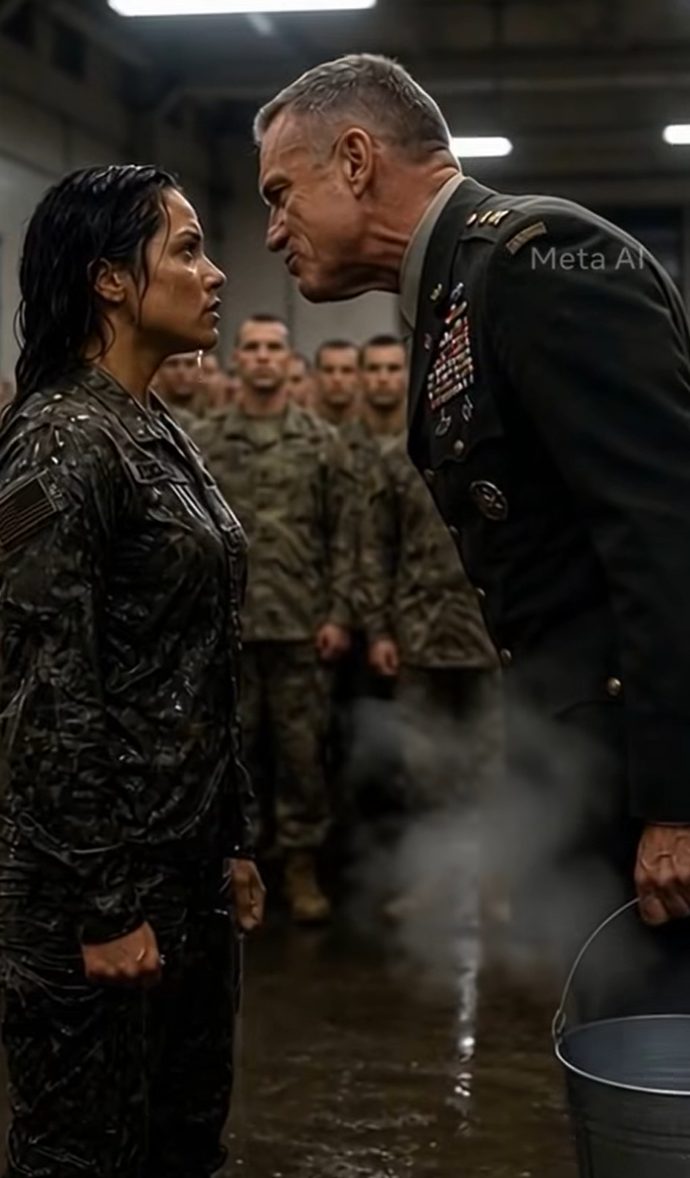

The water was still dripping from Ava’s collar when the first sound reached the hall.
Boots.
Not one pair. Not two. A rhythm. Heavy, synchronized, military-grade boots moving in formation down a corridor that wasn’t supposed to have visitors today.
General Thorne didn’t hear it yet. He was still pacing, still performing, still telling a junior officer near the door to “fetch a mop before the Specialist drowns in her own failure.” A few soldiers laughed because they had to. The rest stared at the floor.
Sergeant Grant heard the boots first. His head snapped toward the double doors at the far end of the training hall.
Then he went pale.
“Sir,” Grant said quietly.
Thorne ignored him.
“Sir,” Grant repeated, louder.
“What, Sergeant?”
Grant didn’t answer. He just took one slow step backward, the way a man steps away from a live wire.
The doors opened.
Three men in dress uniform walked in first. Not soldiers. Aides. The kind of aides who only walked ahead of one specific category of human being. Their shoulders were squared, their faces blank, their eyes already scanning the room and locking onto General Thorne like targets being painted.
Behind them came a fourth man.
He didn’t rush. He didn’t shout. He walked into that training hall the way weather walks into a valley – slow, inevitable, and impossible to argue with.
He was tall. Older. His uniform was darker than Thorne’s, and the stars on his shoulders caught the fluorescent light in a way that made the closest row of privates instinctively straighten their spines.
Four stars.
Thorne turned around, irritated at the interruption, and the color drained out of his face so fast that the medals on his chest suddenly looked too heavy for him to carry.
“General… Cordero,” he whispered.
The room stopped breathing.
Ava didn’t move. Water still ran down her jaw. She just watched her father cross the training hall, his eyes passing over the puddle at her boots, the empty metal bucket, the red burn blooming across her collarbone, the fifty soldiers frozen in place.
He stopped two feet from Thorne.
He didn’t look at Thorne.
He looked at Ava.
“Specialist Cordero,” he said, his voice quiet enough that the back of the room had to lean in. “Are you injured?”
“Minor burns, sir.”
“Did you receive medical attention?”
“No, sir.”
“Were you given the opportunity?”
“No, sir.”
A muscle moved in General Cordero’s jaw. That was the only thing on his face that moved.
Then, slowly, he turned to Thorne.
And what he said next made a four-star general’s aide actually pull out a notepad – because every word was about to become evidence.
“Harris,” General Cordero said softly, “do you remember what I told you in Kandahar in 2011?”
Thorne’s mouth opened. Nothing came out.
“I told you,” Cordero continued, “that one day your mouth was going to walk you into a room you couldn’t walk out of.”
He took one step closer.
“Today is that day.”
Then he turned to the aide on his left and said six words that made every soldier in that training hall realize they were about to witness something that would never appear in any official report – but would be whispered across every base in the country by morning.
Six Words
Get me Judge Advocate General Hines.
That was it. No raised voice. No theater. Just six words delivered the way you’d order coffee, and the aide had his phone out before the last syllable landed.
Thorne found his voice somewhere around then. Bad timing.
“Rafael, listen, this was a training exercise, there’s context here you don’t – “
“Harris.” Cordero didn’t turn around. “Don’t.”
One word. Thorne’s mouth closed.
Ava had served under men who could silence a room by walking into it. She’d thought she understood what command presence meant. She’d grown up watching her father across dinner tables, at graduations, at her mother’s funeral three years ago where he’d stood in his dress blues and not cried because he was still, in some bone-deep way, always on duty.
She’d never seen him at work. Not like this.
The aide with the notepad, a young captain named Willoughby, was already moving toward the far wall, phone pressed to his ear, scribbling things down with the focused energy of a man who understood that what he was documenting today would follow Harris Thorne for whatever remained of his career. Which, based on the arithmetic of the moment, wasn’t long.
Sergeant Grant had put about twelve feet between himself and Thorne. Smart.
The other soldiers hadn’t moved. Couldn’t, really. This wasn’t the kind of moment you shuffled out of. You stood there and you let it happen to you.
What Thorne Did Next
He tried to explain. That was his mistake, and it was a bad one, and everyone in the room knew it except Thorne.
“Sir, with respect, Specialist Cordero was non-compliant during a stress drill. The water was warm, not – “
“Warm.” Cordero repeated the word the way you repeat something a child has said that doesn’t make sense.
“It was a controlled – “
“Captain Willoughby.” Cordero’s eyes hadn’t left Thorne’s face.
“Sir.”
“Note that General Thorne has described scalding a subordinate as a controlled exercise.”
Willoughby wrote it down.
Thorne went a color that didn’t have a good name.
Ava felt the burn across her collarbone pulse. She’d been standing at attention since her father walked in, which was the correct thing to do and also the only thing keeping her from sitting down on the floor. Her neck hurt. The skin under her collar felt tight and wrong. She’d had worse. She’d also had better days.
She kept her eyes forward and her face still, because that’s what you did when your father was a four-star general and he’d just walked into your training hall and you were standing in a puddle and you needed him to see a soldier first, not a daughter.
She didn’t know if it was working.
The Part Nobody Talks About
What most people got wrong, later, when the story spread the way these things do – base to base, mess hall to mess hall, told over bad coffee and worse food – was that they made it sound like a rescue.
Like her father had swooped in and saved her.
That’s not what happened.
Rafael Cordero hadn’t come to that base for Ava. He’d been scheduled for a regional inspection tour that had been on the books for six weeks. Fort Calloway was third stop on a four-base circuit. He was supposed to observe readiness drills in Building C, get briefed by Colonel Marsh on infrastructure concerns, eat a lunch he wouldn’t taste, and fly out by 1600.
He hadn’t known his daughter was going to be standing in a puddle when he walked through those doors.
The aide who’d been coordinating the inspection, a lieutenant colonel named Prentiss who’d been doing this job for eleven years, told someone later that when Cordero saw Ava, the general’s face did something Prentiss had never seen it do in over a decade. Just for a second. Maybe two.
Then it went back to stone.
And that was actually the scariest part.
Thorne’s History
Harris Thorne had been a problem for a long time. Not officially. Officially he had a record full of commendations and a reputation for producing soldiers who passed their evaluations. Unofficially, there were three formal complaints filed in the last eight years, all of which had been quietly resolved, which is a way of saying buried.
He’d served with Rafael Cordero once. Kandahar, 2011, eight months that had forged a specific kind of history between them. The kind where you see what a man does under pressure and you don’t forget it.
What Cordero had seen Thorne do in Kandahar wasn’t something he’d filed a report about. But he’d remembered it. He’d told Thorne, in the specific, direct way that Cordero communicated things, that there would be a limit. That the rank would only carry so far.
Thorne had apparently decided, somewhere in the years between then and now, that Cordero had been bluffing.
He had not been bluffing.
The Burn
A medic was in the hall within four minutes. Cordero had sent Willoughby for one before he’d even spoken to Thorne, which was the detail Ava didn’t notice until later, when she replayed it.
He’d looked at her collarbone and sent for a medic before he’d said a single word to anyone.
The medic, a young woman named Specialist Okafor, worked quickly and didn’t ask unnecessary questions. Second-degree, she said. Not deep, but real. It would blister. It needed to be kept clean.
Ava said yes, ma’am. She kept her voice flat.
Her father watched from across the room without expression while Willoughby continued making notes and Thorne stood very still in the way that a man stands still when he’s calculating whether there’s anything left to say and coming up empty.
There wasn’t.
The six soldiers who’d laughed at Thorne’s mop comment were staring at the floor so hard you’d think the answer to something was down there.
What He Said to Her
The inspection tour continued. That was the thing. Cordero didn’t cancel it, didn’t cut it short. He walked Building C. He sat through Colonel Marsh’s briefing. He ate the lunch.
He found Ava afterward, outside the medical bay, sitting on a bench with a bandage across her collarbone and her jacket folded in her lap.
He sat down next to her.
Not across from her. Not standing over her. Next to her, on the same bench, close enough that their sleeves almost touched.
He didn’t say anything for a while.
Then: “Your mother would’ve had a better poker face.”
Ava looked at the ground. “I had a fine poker face.”
“You were counting ceiling tiles.”
“That’s just attention to detail.”
He made a sound. Not quite a laugh. Something adjacent.
They sat there for another minute. The base sounds moved around them – vehicles, distant commands, the specific white noise of a military installation that never fully goes quiet.
“You didn’t call me,” he said.
“No, sir.”
“Why?”
She thought about it. Gave him the honest answer. “Because I didn’t want you to.”
He nodded. Like that was the right answer. Like he’d expected it and it still cost him something to hear it.
“Thorne’s been suspended pending review,” he said. “Marsh has the hall. There’ll be an investigation.”
“I know.”
“You’ll be asked to give a statement.”
“I know that too.”
He looked at her then. Really looked. The way he used to when she was small and he was trying to figure out whether she was actually fine or just performing fine, and she’d never been sure which answer he preferred.
“Are you all right?” he asked. Not sir this time. Not rank. Just the question.
Ava looked at the bandage on her collarbone.
“I’ve been better,” she said.
“Yeah.” He put his hand on her shoulder, the unbandaged one, briefly. The way you touch something you’re relieved is still there. “Yeah, you have.”
He stood up. Straightened his jacket. Became, again, the man who’d walked through those doors.
“Fly safe going home, Specialist.”
“Yes, sir.”
He walked back toward the main building, and she watched him go, and the base kept making its noise, and her collarbone kept its slow burn, and somewhere inside Building A, Harris Thorne was sitting in a room with Judge Advocate General Hines and a very thorough set of notes taken by Captain Willoughby.
The bench was warm from where her father had been sitting.
She stayed on it a while longer.
—
If this one got under your skin, send it to someone who’d get it.