
AT MY 40TH BIRTHDAY PROMOTION DINNER, MY FATHER CALLED ME “A PAPER PUSHER” IN FRONT OF 27 SENIOR OFFICERS, THEN SLAPPED ME ACROSS THE FACE. “DON’T OVERREACT,” HE SAID, STILL SMILING. BUT WHEN COLONEL JAKE MERCER STOOD UP AND ASKED ONE QUIET QUESTION, MY FATHER STOPPED SMILING.
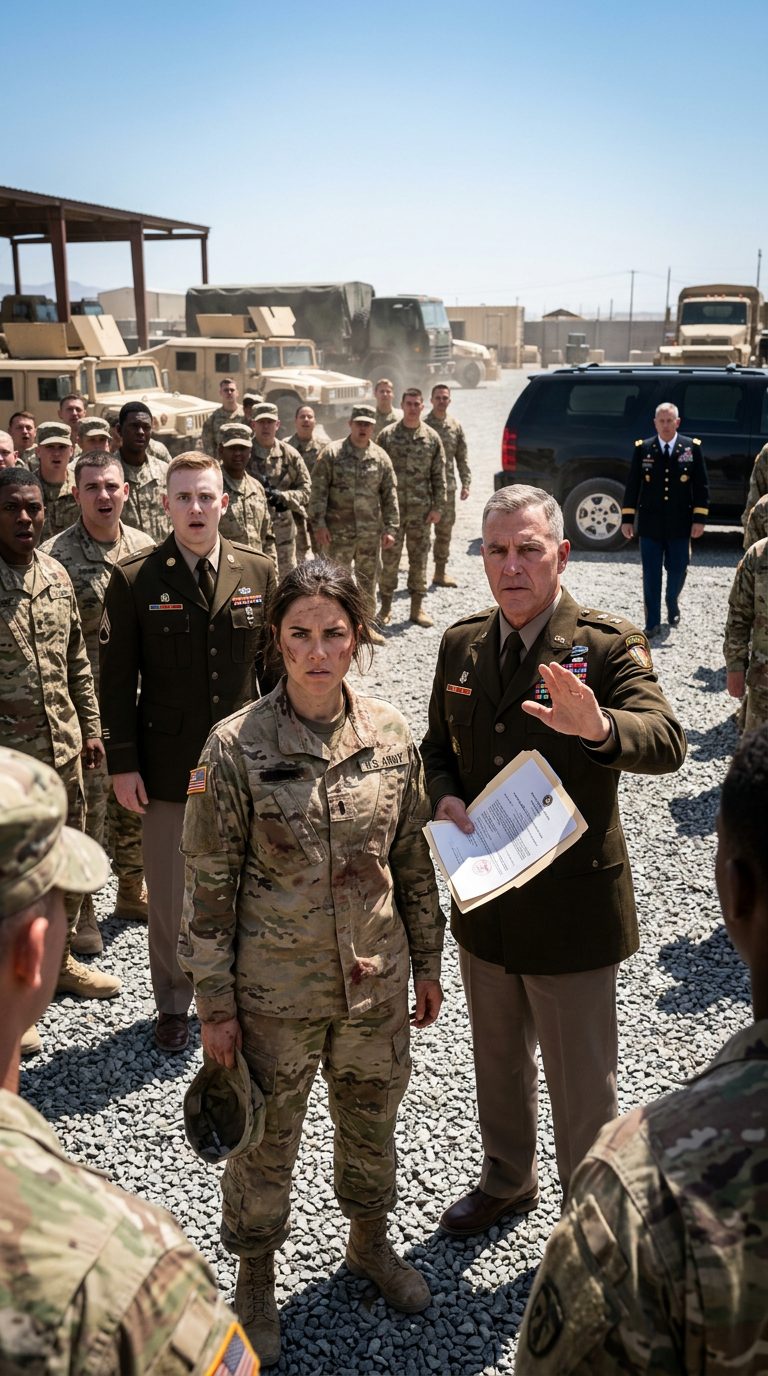
The officers’ club at Fort Bannister smelled like old bourbon, lemon polish, and the cologne of men who’d stopped needing to impress anyone a long time ago.
Twenty-seven senior officers. My promotion dinner. My fortieth birthday.
🎖️ 🇺🇲 And my father, Lieutenant General Raymond Walsh, sitting at the head of the long oak table like it was built for him. Maybe it was. He’d been eating in this room since before I could walk.
I’d just made full Colonel.
Intelligence Division. Fifteen years of classified work I couldn’t talk about at Thanksgiving. Work that kept kids in Kandahar from stepping on the wrong patch of dirt. Work that saved a hostage team in Yemen last spring, though nobody in this room would ever know it.
Nobody except Jake Mercer, sitting three seats down from me. Quiet. Watching.
“A toast,” my father said, standing up with his crystal glass.
The room went still. That polite military still. Forks down. Eyes up.
“To my daughter, Sarah,” he said, smiling that TV-general smile of his. “Who made Colonel today. Despite the fact that, as far as I can tell, she’s never actually been shot at.”
A few uncomfortable laughs. The kind you do when your boss makes a joke that isn’t a joke.
I kept my face flat. I’d been training for this face since I was twelve.
“Intelligence, right? That’s what they’re calling it now.” He swirled his bourbon. “In my day we called it being a paper pusher. Sitting in a building in Virginia while real soldiers did the bleeding.”
Somebody coughed.
I felt my cheeks go hot but I kept my hands folded on the white tablecloth. Nails trimmed short. Wedding ring I still wore even though Tom had been gone four years.
“Thank you, sir,” I said. Quiet. Steady.
He didn’t like that.
He never liked it when I wouldn’t bleed for him.
“Stand up, Colonel.” His voice dropped into that parade-ground register. “Let the real soldiers get a good look at what the Army’s become.”
I stood.
The chair scraping back sounded like a gunshot in that quiet room.
He walked around the table. Slow. Eighty-two years old and still built like a bunker. He stopped in front of me. Close enough I could smell the bourbon on him and the peppermint he’d used to hide it.
“You know what your mother used to say about you?” He was smiling. Still smiling. “She said you had your father’s mind but your grandmother’s spine. Too soft. Too emotional.”
“Sir.”
“Do you know how embarrassing it is? Having a daughter who plays computer games for the Army?”
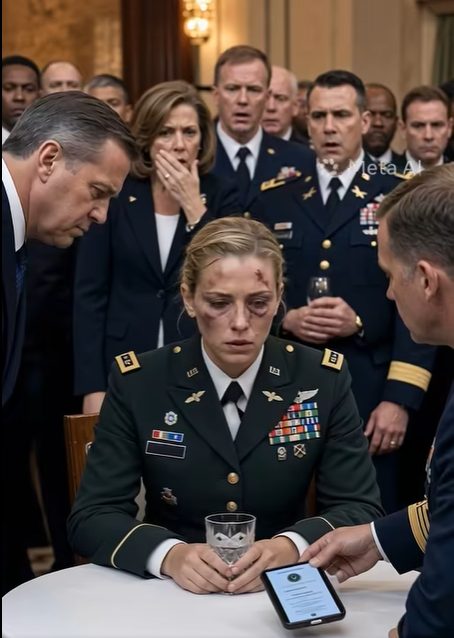
And then he slapped me.
Open hand. Right across my face. Hard enough to turn my head. Hard enough that my earring came loose and tinked onto the china plate.
Not one officer moved.
Twenty-seven men. Silver on their collars. Stars on some of them. And every single one stared into their soup like it held the nuclear codes.
My ear was ringing. My cheek was on fire. I could taste copper where my teeth had cut the inside of my lip.
“Don’t overreact,” my father said, still smiling. Still using that dad voice like he’d just flicked a fly off me. “Sit down, sweetheart. Dinner’s getting cold.”
I didn’t sit down.
I couldn’t.
Behind him, at seat number nine, Colonel Jake Mercer set down his napkin.
Folded it. Careful. Like he had all the time in the world.
Jake was my deputy. Six foot four. Third-generation Army. Two tours in the Sandbox, one he’d come back from and one he’d never really talked about. The scar through his left eyebrow happened on a night I’d pulled him out of, by satellite, from a desk in Virginia.
He stood up.
The legs of his chair barely made a sound. He was that careful.
Every head in the room turned.
“General Walsh.” Jake’s voice was calm. Almost polite. “Permission to speak, sir.”
My father turned. Irritated. “Not now, Colonel.”
“With respect, sir.” Jake’s eyes went to me. Then back to my father. “General, do you want me to tell this room what Operation Pinecrest was?”
The smile fell off my father’s face like somebody unplugged him.
Because he knew what that name meant. And he knew that I knew. And he knew that Jake knew exactly what file was sitting in a locked drawer in my office – the one with his name on it, his signature on it, and a date from 1987 that didn’t match the story he’d been telling for thirty-five years.
Jake didn’t blink.
“Because I can, sir. Right now. In front of every officer in this room.” He tilted his head, just slightly. “Or you can apologize to your daughter. The one who found it. And buried it. For you.”
The silence in that room wasn’t polite anymore.
It was the silence before a detonation.
My father’s hand – the same hand that had just struck me – was shaking.
He looked at me.
And for the first time in forty years, I saw something in his eyes I’d never seen before.
It wasn’t respect.
It was fear.
He opened his mouth. Closed it. Opened it again.
And what he said next made twenty-seven officers push back from the table.
What Came Out of His Mouth
“I need a moment.”
That was it. That was all he had.
Lieutenant General Raymond Walsh, two stars, thirty-nine years of service, the man who’d once stared down a Senate subcommittee for four hours without blinking – he needed a moment.
Brigadier General Don Hatch, sitting at the far end of the table, pushed his chair back first. Then Major General Phil Cobb. Then the rest, one by one, finding sudden reasons to need the restroom, the bar, the parking lot. They didn’t run. They were too trained for that. But they moved.
Inside two minutes, the room held four people.
Me. My father. Jake. And Sergeant First Class Donna Pruitt, the club steward, who stood in the doorway holding a bread basket and clearly deciding whether to leave it or take it with her.
She left it.
Smart woman.
What Pinecrest Was
I need to back up.
I found the file fourteen months ago. March. A Tuesday, I think, because I remember the coffee was bad and I’d been on a call with Langley since six in the morning and everything had that gray, ground-down feel that Tuesdays in Virginia specialize in.
It came up in a search I wasn’t running for him. I was pulling historical mission records from an 80s-era operation in Central America, cross-referencing some signals intelligence for a current case. Pinecrest came up as a cross-reference. A footnote, basically.
Except the footnote didn’t match the record.
The official record said a four-man reconnaissance team had been lost to enemy contact in Guatemala in November 1987. Hostile fire. Tragic. Lieutenant General Walsh had commended them posthumously. He’d given the speech at the memorial. I’d seen a photograph of it once – him in dress uniform, my mother beside him in black, me in a red coat that I apparently cried through because I was three and didn’t understand what was happening.
The footnote said something different.
It said the team hadn’t died in hostile contact. It said they’d been deliberately left. That the extraction window had been called off on Walsh’s direct order, forty minutes before the team reached the pickup point. That Walsh had cited mission compromise as the reason. That the four men had been captured. That two of them had eventually come home in a prisoner exchange in 1991 and had signed non-disclosure agreements so thick they probably still had paper cuts.
That two of them had not come home at all.
I sat with that file for a long time.
I thought about my father at that memorial. My mother in black. Me in my red coat.
Then I locked it in a drawer and I didn’t touch it for six weeks.
When I finally told Jake – because Jake had a right to know, because two of the men on that team had been from his father’s old battalion and he’d grown up hearing their names – he went very quiet. He sat in my office for almost ten minutes without saying anything. Then he said: what do you want to do with it?
I said I didn’t know yet.
He said: you buried it for him. You know that, right? The second you locked that drawer, you buried it for him.
I did know that.
I wasn’t sure how I felt about it.
The Shaking Hand
My father was still standing at the head of that empty table.
The bourbon was still in his glass. He hadn’t taken another sip. The ice had melted down to nothing.
“Sarah.” His voice was different. The parade ground was gone. What was left was something older and smaller that I didn’t have a name for. “Sarah, I didn’t know you’d – how long have you – “
“Fourteen months,” I said.
He closed his eyes.
Jake was still standing too, three seats down, hands loose at his sides. He wasn’t going anywhere.
“You should sit down, sir,” Jake said. Not unkind. Just factual.
My father sat down. Like a building settling.
I touched my cheek. Still hot. The copper taste was still there too, faint, at the back of my throat.
“I want to understand something,” I said. “Before you say anything else, I want to understand one thing.” I waited until he looked at me. “At the memorial. When you gave that speech. When you talked about their sacrifice. Did you feel anything?”
A long time passed.
“Yes,” he said.
“What?”
He looked at his hands. “Relief. Mostly relief. That it had held together. That the story had held.”
Donna Pruitt had disappeared from the doorway. The bread basket sat on the edge of the table. Somewhere down the hall, I could hear the low murmur of twenty-seven officers pretending to be somewhere else.
What He Said Next
He didn’t apologize. Not right away. Not the way I’d imagined it, not that clean.
What he did was start talking.
He talked about 1987. About the mission going wrong from day one, bad intelligence, a compromised contact, the kind of cascading failure that happens when you trust people you shouldn’t. He talked about the call he’d made. The math he’d done. Four men against the operation. Against what the operation protected. He said he’d believed it was the right call.
“And now?” Jake said.
My father looked at him. “I’ve believed it for thirty-five years. That’s a long time to believe something.”
“That’s not an answer.”
“No,” my father said. “It’s not.”
I watched him sit there with that. I watched his hands, the one that had hit me still trembling faintly against the white tablecloth.
My mother had died eight years ago. She’d never known. Or maybe she’d known and had done her own version of locking it in a drawer. I’d never be able to ask her.
“The two men who came back,” I said. “Kowalski and Reyes. Do you know where they are?”
He nodded slowly.
“Have you ever contacted them?”
A pause. “No.”
Jake made a sound. Just a small one. But my father heard it.
“Colonel Walsh.” My father’s voice was almost inaudible. Using my rank. I’d never heard him use my rank before, not seriously, not without the edge of mockery he always put on it. “I struck you. In front of your officers.” He stopped. “There’s no – there isn’t a word I have for that.”
“No,” I agreed. “There isn’t.”
“I’ve been – ” He stopped again. Tried a different way in. “You look like her. Your mother. More now than when you were young. And sometimes when I look at you I feel – ” He pressed his mouth shut.
I didn’t help him.
He deserved to sit in that sentence until he found the end of it himself.
“Angry,” he said finally. “I feel angry. Which makes no sense. Which I know makes no sense.”
Jake quietly picked up his jacket from the back of his chair.
“I’m going to give you two the room,” he said. He looked at me. One look. Asking.
I gave him a small nod. I’m fine. Go.
He walked out. His footsteps were quiet down the hall. A door opened somewhere. Closed.
Just the Two of Us
My father and I sat at that long oak table in the officers’ club at Fort Bannister, and the candles were burning down, and the bread was getting cold in the basket, and neither of us said anything for a while.
I thought about being twelve. About learning to keep my face flat. About all the years I’d spent perfecting that specific stillness, the one that looked like composure but was really just a bunker I’d built to survive him.
I thought about Tom, who’d been patient with me in ways I’d never fully earned, and who’d died on a Tuesday morning four years ago from a heart thing nobody had caught in time, and who had been the only person besides Jake who’d ever really understood what I did and why I did it.
I thought about a three-year-old in a red coat, crying at a memorial for men she didn’t know.
“I’m not going to burn it,” I said.
My father looked up.
“The file. I’m not going to burn it and I’m not going to surface it.” I folded my hands on the tablecloth, same way I’d had them folded an hour ago when this dinner was still just a bad dinner. “But I’m going to find Kowalski and Reyes. And I’m going to make sure they’re taken care of. Benefits, records, whatever they’re owed. Quietly. Through channels I know how to use.”
“Sarah – “
“I’m not finished.” I looked at him straight. “You don’t get to have a voice in that. You don’t get to weigh in or advise or manage it. You just have to let me do it.”
He was quiet for a long time.
“Okay,” he said.
Just that. Okay.
I stood up. Picked up my jacket. My earring was still on the china plate and I picked that up too, dropped it into my pocket.
“I’m going to go find my officers,” I said. “Because it’s my promotion dinner and I’m going to finish it.”
He didn’t say anything.
I got to the doorway. Stopped.
I don’t know why I stopped. I’d been trying to leave this man’s orbit for thirty years. But I stopped.
“She was wrong, by the way,” I said. “Mom. About the spine.”
I didn’t wait to see his face.
I walked down the hall toward the sound of voices, toward the bar where twenty-seven senior officers were drinking too fast and pretending the last twenty minutes hadn’t happened.
Jake was leaning against the wall just outside the door. Waiting. He handed me a glass of water without being asked.
I drank half of it.
“You good?” he said.
“Ask me in a year.”
He nodded. That was the right answer and he knew it.
We walked in together.
—
If this one got under your skin, pass it on to someone who’d understand why.
For more tales of unexpected twists and turns, you might enjoy reading about The “Clerk” Was Pouring Coffee When the Base Commander Shot Out of His Chair or even My Father Sold the Company I Built for $3 Billion and Fired Me in the Room With the Buyer. And for another story where someone’s assumptions get turned upside down, check out He Told Me to Empty My Bag. He Didn’t Know What Was Inside It..