
They laughed when Olivia Mitchell rolled through the gates of Fort Raventon in a pickup that coughed black smoke and shuddered to a stop like it was apologizing for the trip. By noon, those same cadets stood in absolute silence in the combat hall – because the tattoo on her back bore the mark of Black Viper, a unit the camp had been taught to call disgraced, and Colonel Adrian Pierce had gone the color of ash the moment he saw it.
—
She stepped out at 5:40 a.m. with a faded backpack, a duffel with a broken zipper, and boots so worn the leather had gone gray at the toes. Recruits in pressed shirts and glossy watches looked her over the way people look at something that wandered in through the wrong door.
Lance Morrison made it physical first. He slammed his shoulder into hers hard enough to knock the duffel off her arm.
It hit the concrete. She picked it up without a word.
That silence made them cruel.
“Who let the janitor through intake?” Madison called out, grinning wide enough for three rows to hear.
A few people laughed. A few looked away. Olivia adjusted the strap, tucked a loose strand of dark hair behind her ear, and walked toward Barracks C like none of them had earned a response.
So they turned her into camp entertainment.
At breakfast, someone dumped gravy across her shirt and laughed while it soaked through to the name tape. During endurance drills, a boot clipped her ankle and sent her face-first into the mud. In navigation training, her map came back torn, her compass had been switched, and her canteen was already half-empty before the trail even started.
She never complained. Never ran to an instructor. Never asked anyone to stop.
She wiped off the mud, wrung out the shirt in the sink, and kept moving with the same steady expression that made every insult feel smaller than she was.
That should have made them back off.
It made Lance worse.
He started stepping in front of her at formation, speaking just loud enough for everyone nearby to hear.
“Some people come here to serve,” he said one morning, staring pointedly at her scuffed boots. “Some come because nowhere else would take them.”
Madison smiled and held up her phone like she was waiting for the moment Olivia finally broke.
—
But the drills began telling a different story.
In rifle breakdown practice, top cadets were still wrestling with springs and pins when Olivia finished. Under a minute. Smooth hands. No hesitation. No showboating. It looked less like skill than something burned permanently into muscle.
At the range, the shift became undeniable.
Five shots. Four hundred yards. Small target. Crosswind from the east.
Madison missed two wide. Lance bragged before his last shot and clipped the edge.
Then Olivia stepped to the line.
Her sleeves were still damp from the wash sink. Dried mud sat at the seam of one knee. She settled her breathing, checked the horizon once, and fired five times.
Five perfect bullseyes.
When the instructor examined her rifle, his mouth tightened. The rear sight had been knocked off-center – deliberately, by the look of it. Olivia had corrected for the sabotage without requesting another weapon and without saying a single word.
Nobody laughed after that.
Not really. They still smirked. They still whispered. But it sounded thinner now, and nervous – like everyone was beginning to understand they had been kicking at someone who knew exactly how to bleed without falling apart.
Lance Morrison was the only one too proud to stop.
—
Hand-to-hand was held in the south combat hall just after lunch. The mats smelled like disinfectant and old sweat. Olivia had barely taken her position when Lance rushed before the signal, driving both hands into her shoulders.
She hit the padded wall hard enough to rattle the frame.
The room erupted.
“Too slow, Mitchell,” Lance snapped, closing the distance. “This isn’t a daycare. Pack your things and go home.”
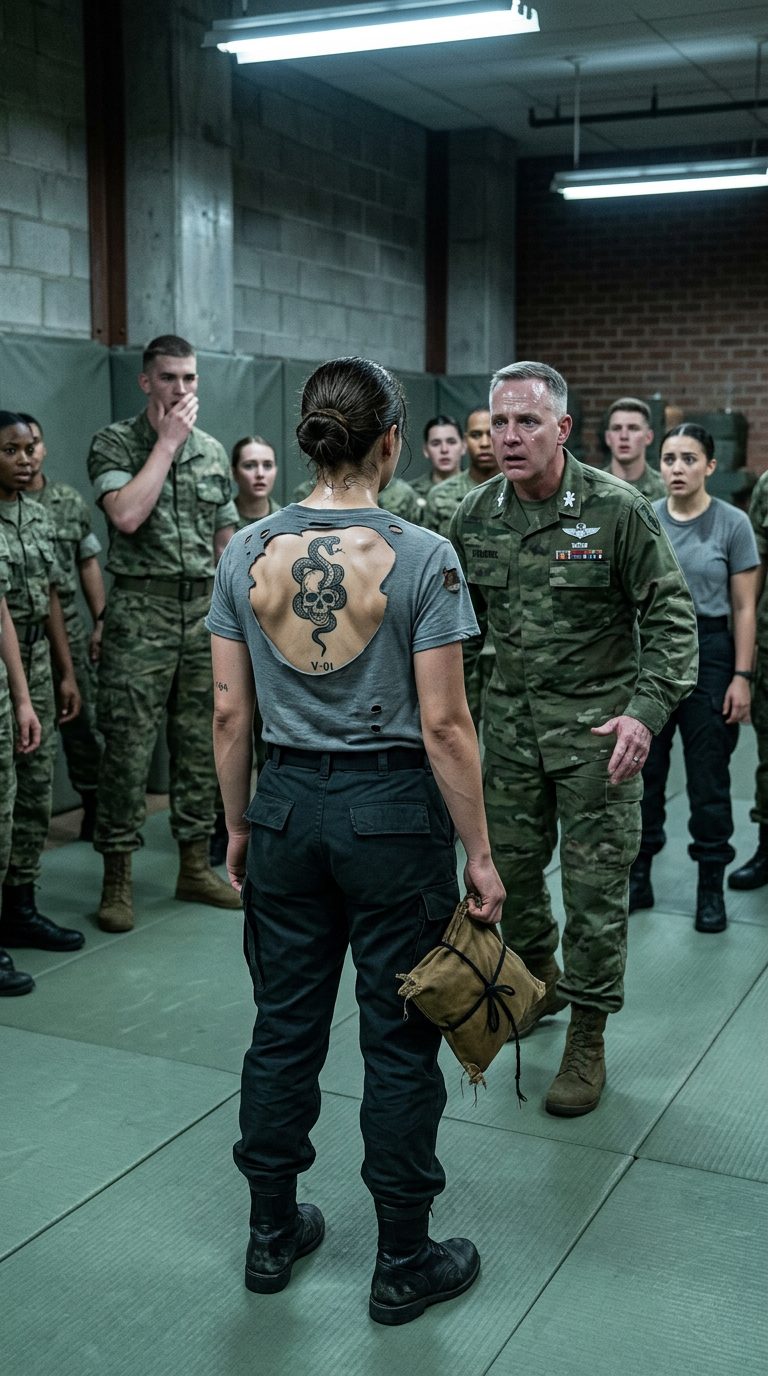
His grip twisted her shirt as he shoved again. The fabric tore from shoulder to mid-back.
Madison already had her phone out. “Oh, look at that,” she said, laughing. “She even has tattoos.”
Olivia’s eyes came up to Lance’s face. For the first time since she had arrived, there was nothing soft in them.
“Let go of me.”
He actually loosened his grip.
Maybe it was her voice. Maybe it was something beneath her voice – something that sounded less like a cadet and more like a warning delivered from a very long distance.
The torn fabric slipped lower.
And the hall went silent.
Across Olivia’s back, between her shoulder blades, a black viper coiled around a shattered skull. Not decorative. Not flashy. It carried the brutal symmetry of an official combat mark – the kind that isn’t chosen but earned. Beneath the tail, almost hidden near her spine, a small stamped number sat in faded ink.
V-01.
Madison’s smile disappeared first.
Then Lance stepped back.
At the far end of the hall, Colonel Adrian Pierce had been watching drills with his arms folded. The second he saw that mark, all the color left his face.
He moved toward Olivia so quickly it no longer looked like authority. It looked like fear.
Boots struck concrete. Conversations died mid-sentence. Even the instructors fell silent.
Pierce stopped inches from her, staring at the tattoo the way a man stares at something he was certain he had buried. His hands were trembling.
“Who gave you the right to wear that mark?”
His voice had changed. Not angry.
Shaken.
Olivia didn’t blink. “The man you called a traitor.”
The air seemed to leave the room all at once.
No one moved. Lance looked from the tattoo to the colonel and back again, suddenly unsure what to do with his hands. Madison lowered her phone – but not before the red live light pulsed once across the screen.
Pierce noticed the number beneath the viper and went even whiter.
“Where did you get that?” he said, barely above a whisper.
Olivia bent, calmly picked up the duffel Lance had knocked aside, and unzipped the broken corner pocket everyone had been mocking since dawn.
From inside, she pulled a flat oilskin envelope tied with black thread. Old. Warped at the corners. Preserved with the careful attention of someone who understood that some things matter more than everything else you own.
Pierce stared at it and took a step backward.
One of the instructors swallowed audibly. “Sir?”
Pierce didn’t answer. His eyes were fixed on the thread, the wax seal, and the name written across the front in thick black ink.
Colonel Adrian Pierce.
Lance found his voice first, and it came out cruel because cruelty was the only currency he had left. “So what? Your dead traitor father left you arts and crafts?”
Olivia turned her head just enough to look at him.
“No,” she said quietly. “He left me your colonel’s real name.”
That landed harder than any punch in the room.
Madison’s phone came back up.
“Put that down,” Pierce said sharply.
Olivia’s hand tightened around the envelope. “No, sir.” Her voice was calm and absolute. “Let her record.”
For the first time since Olivia Mitchell had rolled through his gates, it was the colonel who looked cornered.
The hall held its breath. Mud still drying on her cuff. Sweat darkening Lance’s collar. Madison’s camera trembling in her grip. And in the center of all of it, Olivia standing perfectly still – torn shirt, Black Viper mark, and an envelope that had just made the commander of Fort Raventon forget how to breathe.
Pierce stared at the seal like he already knew what was inside.
Then he spoke the one name no one at Fort Raventon had heard aloud in years.
“Mitchell.”
Not Olivia.
The other one.
And when his hand finally reached for the envelope, everyone in that room saw it shaking.
What Was Inside
Pierce didn’t open it there.
He couldn’t. That much was obvious from the way he looked at it – the way a man looks at something he’s been dreading for a long time and has finally run out of road to avoid.
“My office,” he said. Not loud. Not a command, exactly. More like a man talking to himself.
Olivia followed him.
The hall stayed frozen until the door swung shut behind them. Then it erupted – not in laughter this time, but in the low, urgent sound of twenty people trying to figure out what they had just watched. Lance stood with his arms loose at his sides, that familiar smirk gone so completely it was hard to remember it had ever been there. Madison was staring at her phone screen. The live indicator had gone dark. She’d kept recording anyway.
Inside Pierce’s office, the blinds were already half-closed against the afternoon sun. A framed citation on the wall. A coffee mug with a cracked handle. The kind of room that hadn’t changed in years because the man in it had stopped noticing it.
Pierce sat down behind his desk. Olivia didn’t sit.
He turned the envelope over once, then again. Ran his thumb across the wax seal without breaking it.
“How long have you had this?”
“Since I was twelve,” she said. “He gave it to me the week before the tribunal.”
Pierce’s jaw tightened. “He knew.”
“He knew.”
A long pause. Outside, someone shouted a drill count. Boots on gravel. The ordinary sound of a camp that had no idea what was happening thirty feet away.
“Your father was the best operator I ever ran,” Pierce said. His voice had gone flat. “Before.”
“Before you testified against him.”
He didn’t deny it.
That was the thing Olivia had spent nine years bracing for – the denial, the justification, the carefully constructed version of events that powerful men keep polished and ready. She had rehearsed her responses to all of it. The counter-arguments. The documents she’d had authenticated by two separate retired JAG officers. The recorded phone call her father had made to a congressional staffer forty-eight hours before his arrest, in which he named Pierce specifically.
She hadn’t needed any of it.
Pierce just sat there, turning the envelope in his hands, and didn’t deny it.
“Open it,” she said.
He broke the seal.
What Her Father Knew
James Mitchell, call sign Viper-One, had been the founding member and field commander of Black Viper – a six-person direct action unit operating under a classified mandate that officially didn’t exist. No patch. No ceremony. The tattoo was the only acknowledgment the unit had ever given itself, done in a hotel room in Gdansk by a retired Polish paratrooper named Henryk who charged two hundred euros and asked no questions.
They ran twelve operations over three years. All successful. All deniable.
The thirteenth was supposed to be the same.
It wasn’t.
What came out at the tribunal – what Pierce testified to – was that James Mitchell had deviated from orders, exposed allied assets, and compromised the mission through what the official record called “reckless independent action.” The unit was disbanded. The other five members were reassigned to postings so remote and administrative that it amounted to professional burial. Mitchell was stripped of rank, discharged, and left to watch his name get dismantled in a room full of people who had once called him sir.
He died fourteen months later. Heart attack, the death certificate said. Olivia had stopped arguing with that particular document a long time ago. Some fights cost more than they return.
What Pierce was reading now was a fourteen-page handwritten account of the thirteenth operation. Every order. Every communication. Every deviation – including the one that had saved the lives of three allied intelligence officers whose existence the official record had quietly omitted.
And at the bottom of page fourteen, a single line in her father’s handwriting:
Adrian authorized the abort. Then he denied it. I have the signal log.
The signal log was folded behind the letter. Two pages. Dated. Timestamped. Authenticated with a code that only two people in the world had ever possessed.
Pierce set it down on the desk.
His hands were still.
“Where’s the original log?” he said.
“Somewhere you can’t reach it.”
He looked up at her.
“I’m not here to destroy you,” she said. “I’m here because I want one thing.”
The One Thing
She told him what it was.
Not money. Not a formal apology, though she said that would be a start. Not even a posthumous reinstatement, though she’d already filed the paperwork through three separate channels and expected it to go through with or without his cooperation.
She wanted Black Viper’s designation removed from the disgraced list.
Five people still alive had carried that mark. Two of them had been denied veteran’s benefits because of it. One had lost a security clearance. One hadn’t spoken to his family in six years because the shame of the discharge had eaten through everything else he had.
“That’s it?” Pierce said.
“That’s it.”
He stared at the signal log for a long time.
Outside, the afternoon drill had ended. The camp had gone to the strange quiet it got between sessions – footsteps, distant voices, the clank of equipment being racked. Normal sounds. The kind that had nothing to do with what was happening in this room.
“I’ll need time,” Pierce said.
“You’ve had nine years.”
He looked at her then. Really looked, maybe for the first time since she’d walked into his hall that morning. She was twenty-three years old. She’d driven six hundred miles in a truck held together by stubbornness and old wire. She had mud on her knee and a torn shirt and a duffel with a broken zipper, and she had walked into his camp carrying the one thing he’d been afraid of since the day he signed his name to a lie.
“Your father,” Pierce started.
“Don’t,” she said.
He stopped.
She picked up the oilskin envelope, folded it closed, and tucked it back under her arm. The signal log she left on the desk.
“That’s a copy,” she said. “In case you were wondering.”
She turned to go.
“Mitchell.”
She stopped but didn’t turn back.
“He was right,” Pierce said. “About the abort. He was right, and I – ” He stopped. Tried again. Couldn’t finish it.
She stood there for three seconds. Four.
Then she walked out.
After
The hallway was empty.
She pushed through the exterior door and stood in the afternoon sun with the envelope pressed against her ribs and her eyes on the middle distance, where the drill field ran out to a tree line and the trees went dark and still.
Her hands were steady.
She’d expected them to shake. Had spent years imagining this moment and imagining herself shaking through it – the relief, the grief, the complicated wreckage of finally getting the thing you’d been carrying for so long you’d stopped being able to feel its weight.
But her hands were steady. Her breathing was even.
She thought about her father in a hotel room in Gdansk, sitting still while Henryk worked the needle, not making a sound. She thought about him handing her the envelope across a kitchen table, his voice matter-of-fact, like he was reminding her where he kept the spare key. Don’t open it. Don’t lose it. You’ll know when.
She’d known.
Behind her, through the walls of the combat hall, she could hear voices picking back up. The camp reassembling itself. Lance Morrison, somewhere in there, trying to figure out how to carry the afternoon. Madison, probably still holding her phone and deciding what to do with whatever she’d recorded.
Olivia adjusted the strap of her duffel.
Started walking.
The pickup was where she’d left it, listing slightly to the passenger side, a long crack running from the bottom corner of the windshield up toward the rearview mirror. She got in. Sat for a moment with both hands on the wheel.
Then she started the engine – it coughed once, shuddered, caught – and drove back out through the gates of Fort Raventon without looking in the mirror.
—
If this one got to you, pass it on to someone who needs it.
For more tales of unexpected heroes and powerful moments, check out She Pressed a Folded Paper Into My Hand and Said “Destroy This Before They Find It”, or perhaps you’d appreciate The Colonel Handed Her the Rifle and Nobody Laughed After That and My Own Lieutenant Dragged Me Through the Dirt in Front of the Whole Unit.