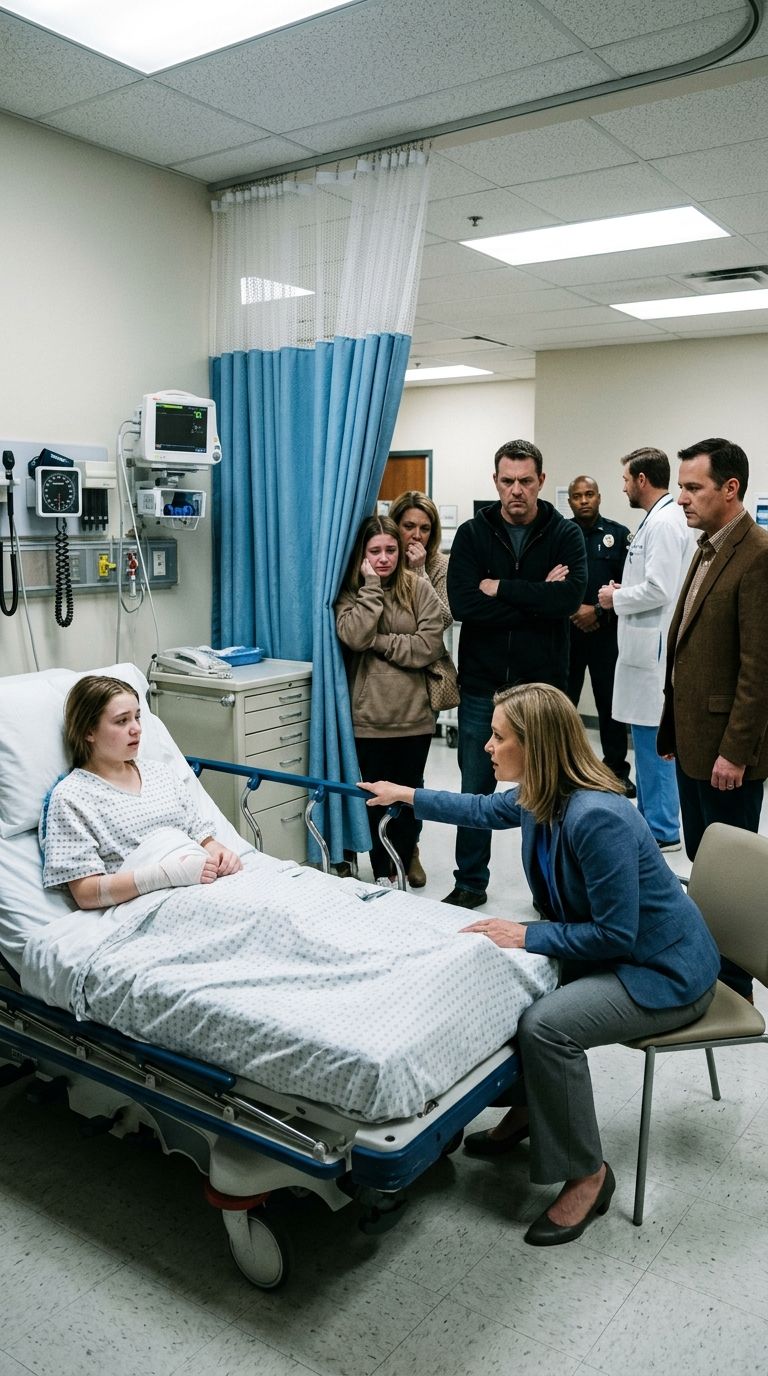

“We’ll handle this at home,” my father said, and the emergency room went quiet around him.
His voice dropped the way it always did when he wanted people to stop asking questions – low, steady, final. My mother stood beside him, twisting the strap of her purse until her knuckles bleached white. Brittany sat three chairs away with her arms crossed, staring at the vending machine as though she were waiting for a bus.
I was sixteen. Brittany was nineteen.
My parents had always described her as difficult. Moody. Sensitive. Under pressure. Those words had explained away a lot of things over the years, but they couldn’t explain what had happened that afternoon. They couldn’t explain why I was sitting in an emergency room with pain radiating through my left side every time I tried to lift my arm.
Dr. Marisol Grant stepped through the curtain carrying my X-rays, and I watched something shift in her face before she said a single word.
“Mr. and Mrs. Whitaker.” She paused. “I’d like to speak with you outside.”
My father shook his head. “She’s my daughter. You can talk here.”
Dr. Grant glanced at me, then back at him.
“Your daughter has several injuries that need treatment,” she said. “I’ve also found signs that suggest this may not be an isolated incident.”
The silence that followed was different from ordinary silence. It had weight to it.
My mother’s lips parted slightly. My father’s expression didn’t crumble – it hardened, which was what it always did when he felt cornered.
“Kids get hurt,” he said. “She’s always been clumsy.”
Dr. Grant didn’t argue, didn’t flinch.
“Some of these injuries appear to have occurred at different times,” she said. “As a physician, I’m required to report concerns like these.”
Brittany turned from the vending machine. “What does that mean?”
“It means I’m required by law to contact Child Protective Services.”
My father took one step forward. “You are not calling anyone.”
He never finished whatever came next, because a hospital security officer appeared at the edge of the curtain. That was when I understood she had already made the call. My stomach dropped and steadied itself at the same time – two feelings I hadn’t expected to have together.
Twenty minutes later, two women walked into the room.
One introduced herself as Angela Moore, a CPS investigator. The other was Detective Claire Nolan. The moment they stepped through the door, something happened to my father that I had never witnessed before: his confidence left him. Not gradually. All at once.
Angela asked if she could speak with me alone.
My father answered before I could open my mouth. “No.”
Detective Nolan looked directly at him. “Sir, step back.”
I had never heard anyone speak to my father that way. Not once in sixteen years.
Behind them, Brittany started to cry. “I didn’t mean for anyone to get hurt,” she said, her voice unraveling. “She provoked me.”
Angela quietly drew the curtain closed.
Then she pulled a chair to the side of my bed, sat down, and spoke in a voice that was unhurried and careful, the way you’d speak to someone you didn’t want to startle.
“Emily,” she said, “I need you to tell me what happens in your house when no one else is watching.”
My family was three feet away, separated from me by a thin curtain and nothing else.
For the first time in my life, that was close enough.
I told her everything.
What I Meant By Everything
Not just that afternoon. Not just Brittany.
I told her about the Christmas when I was twelve and Brittany threw a ceramic mug at my head because I’d touched her phone charger. I told her how it clipped my ear and my mother handed me a paper towel and said Brittany was going through something. I told her about the staircase incident when I was fourteen, which my parents logged mentally as an accident, which I never believed for a single second.
I told her about the pattern of it. The way Brittany would be fine for weeks, sometimes months, and then something small would trip a wire in her that I could never identify in advance. A wrong look. A noise I made eating. Being in the kitchen when she wanted the kitchen empty. The triggers were random enough that I’d spent years believing I was the problem.
Angela wrote things down. She didn’t react visibly to any of it. She just kept writing and asking the next question, steady as someone doing paperwork, except her eyes were paying close attention the whole time.
She asked about my parents.
I hesitated on that one. Because my parents had never hit me. My parents had never done anything you could point to and name cleanly. What they’d done was harder to explain: they’d looked away. Consistently, specifically, every single time. They’d built an entire architecture of looking away and called it keeping the peace.
I told her that too.
She wrote it down.
The Hallway, Twenty Feet Away
While Angela was talking to me, Detective Nolan was in the hallway with my parents and Brittany. I couldn’t hear specifics through the curtain but I could hear tone. My father’s voice went from controlled to strained to something I’d never heard from him before: a kind of tight, clipped politeness that meant he was scared.
My mother cried. I could tell from the quality of the silence that followed certain exchanges. The muffled, wet kind.
Brittany said something that made my father’s voice spike briefly before Detective Nolan cut him off.
I lay there with two cracked ribs and a bruised shoulder, listening to my family negotiate the story from twenty feet away, and I felt something I hadn’t anticipated. Not relief exactly. More like the particular stillness that comes after a very long noise stops.
Angela asked if I had anyone outside my immediate family. A teacher. A friend’s parent. A relative.
I thought about my Aunt Cheryl, my dad’s older sister, who lived forty minutes north in a town called Belford and who had stopped coming to holidays around the time I was ten. I’d never known exactly why. I had a theory now.
I gave Angela her name and phone number. I still had it memorized from when I used to call her when I was small, before calling her became a thing that required explaining afterward.
What the X-Rays Said
Dr. Grant came back in while Angela was still with me. She explained the injuries in plain language, the way you’d talk to an adult. Two ribs. The shoulder. And then she mentioned, carefully, that the scan had shown an older healed fracture in my right wrist that had never been treated properly.
I was nine when I hurt that wrist. I’d fallen down the back steps, or that was the story, and my mother had wrapped it tight and said we’d see how it felt in a week. It had felt bad for about two months and then it just became the wrist that bent a little wrong.
I’d forgotten about it, mostly. My body apparently hadn’t.
Dr. Grant didn’t say anything editorial about that. She just told me what the scan showed. But she put her hand briefly on my forearm before she left, and I think she knew I understood what it meant that a nine-year-old’s broken wrist had just shown up in a file with tonight’s injuries.
Angela looked at her notes.
“Is there anything else you want to tell me?” she asked.
There was. There always is, when someone finally asks that question with enough patience to wait for the actual answer.
I told her about the time Brittany locked me in the basement for four hours during a thunderstorm when I was eleven, and how when my parents got home she said I’d gone down there myself to find something and the door had jammed. I told her how my parents had believed it, or acted like they believed it, which by then I understood were not different things.
I told her I didn’t know if Brittany was sick or mean or both. I told her I didn’t know if that distinction mattered.
Angela said, “It matters for how we help her. It doesn’t change what happened to you.”
I hadn’t thought of those as separate questions before.
After the Curtain Opened
They didn’t arrest anyone that night. I didn’t fully understand why until later. Brittany was nineteen, an adult, but the process moved slower than I’d imagined. There were interviews. There was paperwork. There was a conversation between Angela and Detective Nolan that happened outside my line of sight and produced some outcome I wasn’t told about immediately.
What I was told: I would not be going home that night.
A nurse named Donna helped me into a gown and got me set up in a proper room. She had the kind of face that had seen a lot and didn’t perform sympathy, just did things efficiently and occasionally touched my shoulder when she was moving past. I liked her for that.
My father asked to see me before they moved me upstairs. Angela said she’d pass along the message.
He didn’t get to come in.
I heard his voice in the hallway, once, asking a question I couldn’t fully make out. Then quiet.
Aunt Cheryl arrived at eleven-seventeen at night. I know the exact time because I’d been watching the clock on the wall across from my bed for the last hour, counting ceiling tiles, doing the kind of pointless math your brain runs when it’s too wrung out to think in sentences.
She walked in and looked at me for a long moment without saying anything.
Then she said, “I should have pushed harder.”
I didn’t tell her it was okay. It wasn’t, and she knew it, and I think she needed me not to say it was.
She pulled the chair close and stayed until two in the morning. We didn’t talk the whole time. Some of it we just sat.
The Months After
Brittany was charged. The process took a long time and I won’t compress it into something cleaner than it was. There were meetings with lawyers and a victim advocate named Sandra Pruitt who had a very small office and very good coffee and who explained things to me in a way that assumed I could handle the information, which I appreciated.
My parents hired an attorney. For Brittany, not for me. I want to be precise about that.
I lived with Aunt Cheryl in Belford for seven months while everything moved through the system. She had a spare room with a window that faced east, and I woke up to actual light every morning, which sounds small and wasn’t.
I went to a different school. I made one friend, a girl named Karen Hatch who sat next to me in junior English and who had her own whole situation at home that she never fully explained and I never pressed. We ate lunch together every day for the rest of that year and texted constantly and talked about everything except the things that had gotten us both to that cafeteria.
Brittany pleaded guilty to a reduced charge. She got probation and mandatory treatment. I wasn’t in the room when the sentence came down. Sandra had asked if I wanted to be and I’d said no, and she’d said that was a completely valid choice, and I’d been grateful she didn’t try to sell me on closure.
My parents and I have a relationship now that I’d describe as careful. We talk. Holidays, sometimes. They’ve said they’re sorry in the way people say it when they mean it and also when they’re hoping it ends the conversation. I don’t know what they are to me at this point. Something that doesn’t have a clean name.
Brittany I haven’t spoken to in four years. That might change. It might not.
The Thing I Think About
Dr. Grant retired two years ago. I know because I looked her up. She spent twenty-six years in that emergency room. I have no idea how many curtains she pulled closed, how many chairs she pulled up next to how many beds. I have no idea if she remembers me specifically.
She wouldn’t know that the girl with the cracked ribs went back to school, finished, left Belford, built something. She wouldn’t know about the apartment with the east-facing windows I specifically looked for, or the job, or the fact that I can lift my left arm now without thinking about it.
She made one phone call before my father could stop her.
That’s the whole thing, really. That’s the entire hinge of it.
One person who didn’t look away.
—
If this one stayed with you, pass it along. Someone out there needs to know that one phone call can be the whole thing.
For more stories that make you question everything, read about My Father Held Me Back While My Daughter Was Drowning.