
I was having dinner at an upscale restaurant with my daughter and her husband when the waiter stepped closer, his voice barely above a breath.
“Ma’am… please don’t drink what they ordered for you.”
His fingers trembled as he set down my crystal glass. He didn’t look at me. “Please,” he whispered, “let me replace that drink before you take another sip.”
Across the dining room, my daughter Claire was slipping into her white coat while her husband Evan settled the bill. They had already said their goodbyes, claiming they were late for a charity reception. Claire kissed my cheek. Evan squeezed my shoulder and smiled the way a man smiles when he believes he already owns something.
“Finish your wine, Margaret,” he said. “It’ll help you sleep.”
Then they disappeared through the gilded doors.
I looked at the pale amber drink beside my plate. It was not the wine I had ordered. The waiter – a young man named Daniel – leaned close while pretending to clear the table.
“I heard your son-in-law talking near the service station,” he murmured. “He handed something to another server and said it had to go into your drink. That server refused. So Mr. Vale did it himself.”
My heart cracked clean through. My face did not move.
Only hours earlier, Claire had called me forgetful and laughed when Evan suggested I needed someone to manage my finances. I had mistaken cruelty for impatience. Now I understood it for what it was – preparation.
“How much did you see?”
“Enough to be scared.”
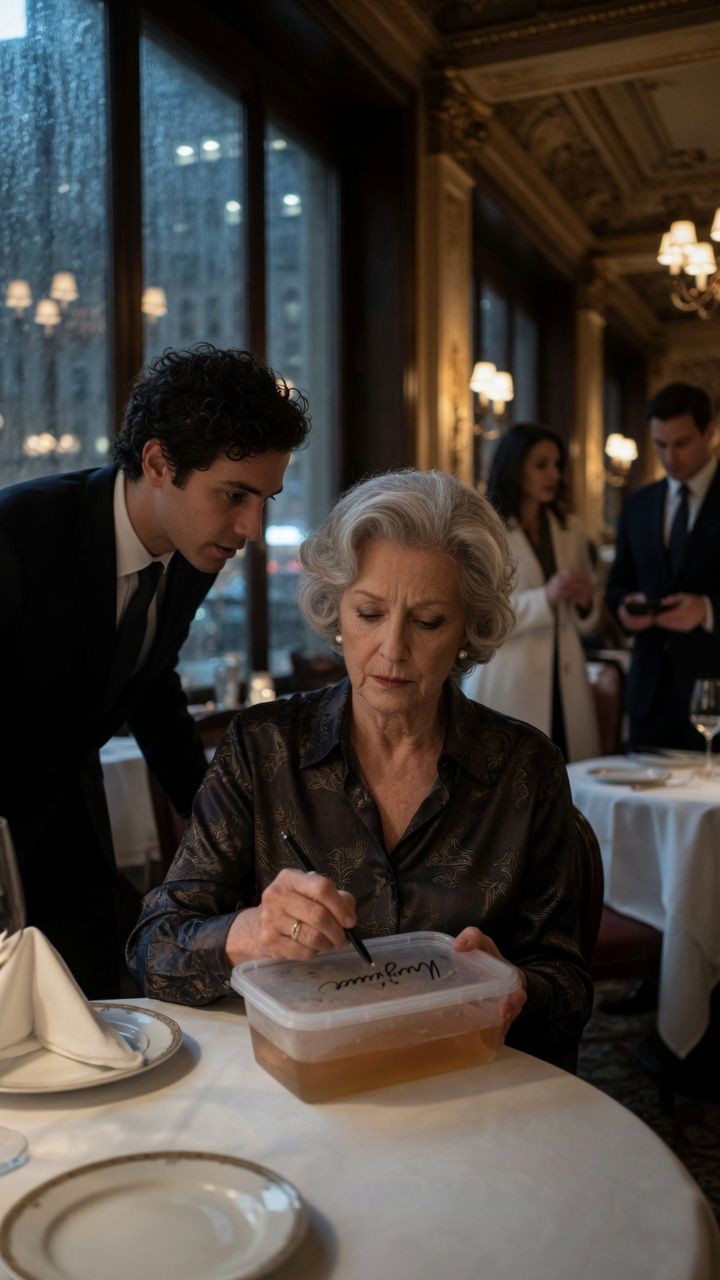
I slid the glass away. “Bring me a clean napkin, a sealed container, and your manager. Quietly.”
Daniel stared. He had expected panic. Perhaps tears. Instead he found himself looking at the woman I had been long before Claire decided that age had made me harmless.
For thirty-two years I had worked as a forensic scientist for the state. I had testified in major trials, dismantled false explanations, and taught prosecutors how the most dangerous intentions can hide behind the most ordinary symptoms. Claire knew I had retired. Evan knew only that I was a lonely widow with a valuable estate.
The manager brought a sterile food container from the kitchen. I poured the drink into it, sealed the lid, signed across the seal, and asked Daniel and the manager to witness it with their own signatures. Then I called Detective Lena Ortiz – an old colleague who owed me nothing but trusted my judgment completely.
While I waited, my phone buzzed.
CLAIRE: Did you finish your drink, Mom?
A second message followed before I could set the phone down.
CLAIRE: Please answer. We’re worried.
I stared at the words until they blurred at the edges.
Then I typed: Delicious. Feeling sleepy already.
Three dots appeared immediately.
CLAIRE: Good. Go home and rest. We’ll handle everything tomorrow.
I locked the screen.
Daniel leaned in. “What exactly are they planning?”
I looked past him toward the rain streaking the windows, and I thought about the power-of-attorney papers Evan had slid across my breakfast table that very morning, casual as a napkin, as though I were already gone.
“They think tomorrow belongs to them,” I said.
I set my phone face-down on the white linen.
“Let’s make sure it doesn’t.”
The Morning It Actually Started
The power-of-attorney papers had shown up with the scrambled eggs.
That’s what I keep coming back to. Evan had tucked them under the edge of my breakfast plate like a restaurant check, smiling while Claire refilled my coffee. “Just a formality,” he said. “In case anything ever happens to you, Margaret. You know how things can get complicated.”
I had read every line. Slowly. Evan’s smile had gotten tighter with each page I turned.
The document was thorough. My estate – the house on Birchwood, the investment accounts, the portfolio my husband Gerald had spent forty years building – would pass to Claire’s management, with Evan named as co-administrator. There was a clause about my “diminished capacity.” There was language about a physician’s evaluation already being scheduled.
I had folded the papers in half and handed them back without a word.
“Mom,” Claire said, and her voice had that particular softness she uses when she wants something. “We’re not trying to take anything from you. We’re trying to protect you.”
I drank my coffee.
“I’ll have my attorney look it over,” I said.
Something passed across Evan’s face. Quick. Gone before Claire could see it.
He had poured himself more orange juice and changed the subject to the weather.
That had been nine-thirty in the morning. By seven that evening, someone had put something in my drink.
I don’t know exactly when I started adding things up. Maybe on the drive to the restaurant, when Claire mentioned for the third time that I’d left the stove on last week. I hadn’t. I knew I hadn’t. But she said it so gently, so worriedly, that I had almost believed her for a second. That’s the thing about a lie repeated with love in the voice. It gets into you sideways.
What Daniel Saw
Lena arrived in forty minutes. No uniform, no marked car. She came in through the side entrance in a gray cardigan and ordered a club soda, and if you didn’t know her you’d think she was somebody’s aunt stopping in after a late meeting.
She sat across from me and looked at the sealed container for a long moment.
“You’re sure,” she said. It wasn’t a question.
“I’m sure of what Daniel saw. I’m sure of what I saw on Evan’s face this morning. The container tells us what was actually in the glass.”
Daniel had already written out a statement on the back of two order tickets, because Lena had asked him to and he’d done it without hesitating. His handwriting was careful and small. He’d included the time, the server who had initially refused, the server’s name, and the exact words he’d heard Evan say. He’d even noted which pocket Evan had reached into.
Lena read it twice. “The other server. The one who refused.”
“Marcus,” Daniel said. “He’s in the back. He’s scared.”
“Get him.”
Marcus was twenty-three, maybe twenty-four. He stood with his hands in his apron and wouldn’t look at any of us directly. But he talked. He said Evan had approached him near the service station during the appetizer course, slipped him a folded bill, and asked him to add a powder to the older woman’s drink at table nine. Marcus had thought it was some kind of prank at first, a joke supplement, something stupid. Then something about the way Evan watched him had made his stomach turn, and he’d said no and walked away.
He hadn’t said anything because he didn’t know what he’d seen.
“You know now,” Lena told him. She wasn’t unkind about it.
She bagged the container, photographed the seal and our signatures, and made two calls from the parking lot. I watched her through the window. The rain had slowed to a drizzle. The restaurant had mostly emptied out.
Daniel sat across from me and didn’t say anything for a while.
“Are you okay?” he finally asked.
It was such a plain question. Not are you shocked, not how are you feeling, not what does this mean. Just: are you okay.
“Not entirely,” I said. “But I’ve been worse.”
What Evan Didn’t Know About Me
I retired from the state forensics lab six years ago. I did it quietly, with a small party and a sheet cake and a card everyone signed. Claire came. She wore a blue dress and hugged me and said she was proud of me.
She was thirty-four then. Evan was already in the picture, already doing that thing he does where he stands a little too close to your financial documents.
What I had never done, in all my years of working, was bring the job home. Gerald knew in broad strokes what I did. Claire knew I worked with police and that it involved chemistry and that sometimes I couldn’t talk about my cases. That was the shape of it for her. Mom had a lab job. Mom worked long hours. Mom retired.
She did not know that I had worked the Beaumont case, which put a man away for poisoning his business partner over a real estate dispute. She did not know I had consulted on three separate elder financial abuse investigations in my last four years, or that I had co-authored a paper on the pharmacology of sedative compounds used in incapacitation crimes. She did not know that I could identify seventeen substances by their effect profile that would render a woman my age unconscious, compliant, or simply unavailable to object to paperwork being filed in her name.
Evan had looked at me and seen a sixty-seven-year-old widow who got confused about the stove.
He had not done his homework.
The toxicology report came back four days later. Zolpidem. Enough to put me down for eight hours, maybe more, depending on my tolerance. The kind of sleep where you don’t wake up if someone moves you. Where you sign things without knowing you’ve signed them. Where, if something happened to you in the night, it would look like the sad, quiet end of a woman who’d been struggling.
Lena called me when she got the results. I was in my garden, which is where I go when I need to think without thinking.
“It’s enough,” she said. “Combined with the witness statements, the paper you refused to sign this morning, the text messages. It’s enough, Margaret.”
I looked at my roses. Gerald had planted them the year we moved in, before Claire was born. They’re the wrong variety for this climate, technically, but they’ve survived thirty-nine winters anyway.
“When?” I asked.
“Thursday morning. Early.”
Thursday
I made coffee at six. Sat with it at the kitchen table, the same table where Evan had slid those papers under my plate four days ago.
At six-forty-eight, Claire’s car pulled into the driveway.
She knocked. She had a key but she knocked, which meant she was being careful, which meant she knew something was off. I watched through the window for a moment before I opened the door. She was alone. That surprised me.
“Evan’s parking,” she said. “Mom, we need to talk about the papers.”
“Come in,” I said.
She sat at the table. I poured her coffee she didn’t ask for, because that’s what I do, and she wrapped her hands around the mug, and for a second she looked so much like the child she’d been that my chest did something I wasn’t prepared for.
Then Evan came through the door and the moment ended.
He was already talking before he’d fully stepped inside. Something about my attorney, something about a delay, something about how this was really for my benefit. He had a folder under his arm. He set it on the table.
Lena’s car pulled up outside before he reached the second sentence.
She brought two other detectives. She was professional and clear and she did not look at me once, which was exactly right. She told Evan what he was being charged with. She told Claire she’d need to come in and answer some questions.
Claire looked at me. I don’t know what she was looking for. An explanation, maybe. Or a rescue. Or just confirmation that this was real.
I didn’t give her any of those things.
I looked at her the way you look at someone when you’ve run out of the right words and you know it. When there’s nothing left to say that would do either of you any good.
Evan said her name once, sharp, a warning. She flinched. I noticed that. I had been noticing things like that for two years and filing them away in the part of my brain that never fully retired.
They walked out through my front door. Gerald’s roses were starting to bud along the fence.
I poured the rest of my coffee down the drain. Made a fresh pot.
Daniel had given me his number that night at the restaurant, in case I needed a witness statement or just wanted to let him know how things turned out. I sent him a text that morning. Two words.
It’s done.
He replied with a single thumbs-up, and I thought: good kid. Tired kid. The kind of person who does the right thing because the wrong thing would have kept him up at night. There are fewer of those than you’d think, and more than you’d expect.
I took my coffee to the garden.
The roses didn’t care about any of it, which I found, that morning, to be exactly the right company.
—
If this one got under your skin, pass it along to someone who needs to hear it.
For more tales of family drama and unexpected twists, read about My Daughter Showed Up Without Her Luggage, Her Ring, or a Real Smile or see what happened when I Let My Daughter and Her Husband Think I Was Broke at My Own Dinner Table.