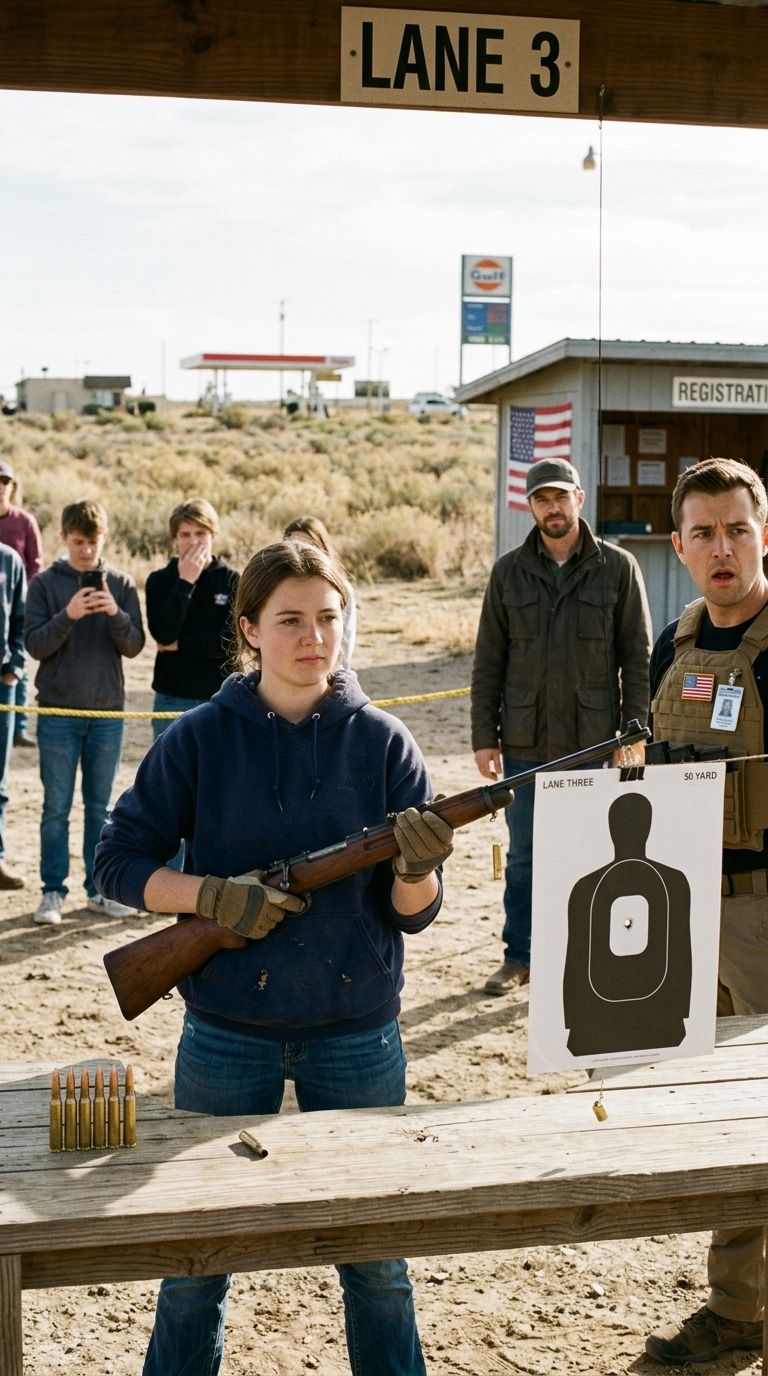

“Seven rounds,” Ryan Cole said, shoving the old rifle case across the bench. “Show us you belong on this firing line.”
The case hit the wood hard enough to make every phone behind the rope rise higher.
Emma Carter looked at it, then at him. She didn’t blink.
Nobody laughed outright. They only smiled in that careful way people smile when they want humiliation to look harmless.
The Texas sun burned down on the dusty outdoor range. Heat shimmered over the lanes, turning steel frames and paper targets into wavering shapes. A faded American flag snapped near the registration shed. Beyond the fence, scrubland stretched toward a flat road and a gas station sign too bleached to read.
Ryan stood close enough for Emma to smell coffee on his breath. His tan tactical vest carried a range badge, a radio, and too much confidence.
“You hear me?” he asked.
Emma rested one hand on the case zipper.
“I heard you.”
The answer came out too calm. That irritated him more than fear would have.
Behind the safety rope, young competitive shooters shifted in their clean jackets. Some wore sponsor patches. Some wore matching caps. A girl in red shooting glasses whispered something and covered her mouth. A boy beside her angled his phone for a better shot.
Ryan heard the whispers and let them continue. He liked an audience. He liked lessons that landed. He liked reminding people exactly where they stood.
Emma stood in Lane Three wearing a plain navy hoodie, faded jeans, and worn shooting gloves. No team logo on her chest. No sponsor tag on her bag. No engraved case beside her. She looked like someone who had come from a hardware store, not a qualifying range.
That was enough for most of them to decide.
Ryan tapped the case with two fingers. “Open it.”
Emma pulled the zipper slowly. The sound cut through the murmurs like a small saw.
Inside lay an old bolt-action rifle, cleaned but clearly aged. Its wood stock carried small dents. The scope looked practical, not expensive. The sling was faded from years of use.
Ryan’s smile widened. “That thing legal?”
A few shooters chuckled.
Emma lifted the rifle with both hands, careful and unshowy. She checked the muzzle direction before anything else.
Daniel Brooks watched from several yards back, standing near the rear barrier in a dark field jacket and faded cap. His safety glasses hid part of his face, but nothing hid the stillness in him. He hadn’t laughed once.
Ryan noticed him watching and dismissed it. Daniel had been quiet all morning. Quiet men didn’t make good scenes.
Ryan did.
“Lane Three is live when I say it is,” Ryan said.
Emma nodded.
The shooters behind her nudged each other. A boy in a white cap whispered, “This is going online.” Another answered, “She won’t even hit paper.”
Emma set seven rounds on the bench. They formed a neat line beside the rifle – seven small brass points in the dust and light.
Ryan looked down at them. “You brought hunting rounds to a precision lane?”
“They match the rifle,” Emma said.
“That’s not what I asked.”
“It’s the answer.”
That tightened his jaw. He turned toward the line and raised his voice. “Everybody clear behind the rope.”
They were already clear. He said it anyway. He wanted the moment to feel official. He wanted the humiliation to look like training.
Ryan walked a slow circle around Emma, letting his boots grind against the gravel. “Careful,” he said. “That rifle kicks harder than it looks.”
The line chuckled again.
Emma didn’t answer. She placed one round beside the chamber. Her hair was tied back neatly – not one strand crossed her face. Dust moved across the lane in thin curls.
At fifty yards sat a paper silhouette target. The printed chest mark was black and bold, large enough for beginners, easy enough for children during summer classes. Behind it, beyond the target frame, a tiny brass casing hung from a string.
Nobody had mentioned it.
It was part of an old trick challenge used during private demonstrations. Ryan had hung it there that morning for his advanced shooters. It was not meant for her. The casing swayed almost invisibly in the wind.
Ryan saw Emma’s eyes move past the paper. Just a fraction. He stepped closer.
“Center mass,” he said, louder. “If you can find it.”
A few shooters laughed harder.
Emma took the rifle and settled behind it. The laughter thinned.
Her shoulder found the stock without searching. Her cheek dropped to the same point instantly. Her left hand rested under the fore-end with controlled pressure. Her breathing slowed. Her finger didn’t rush toward the trigger.
She looked like someone entering a room she had built herself.
The boy with the phone stopped smiling. The girl in red glasses lowered her hand from her mouth. Ryan’s smile held, but his eyes changed. He had spent all morning correcting elbows, grip, stance, breathing, and arrogance.
Emma needed no correction.
That bothered him.
“Don’t get fancy,” he said.
Emma didn’t move.
Ryan folded his arms. The range felt suddenly wider. Wind tapped the paper targets along the line. Metal stands clinked in a soft, irregular rhythm. A crow called once from the fence.
Daniel Brooks shifted his weight for the first time. His gaze fixed on Emma’s hands.
Emma slid the bolt forward. The sound was clean – no scrape, no hesitation.
Ryan turned toward Daniel and gave a small shrug. Watch this.
Daniel gave nothing back.
“Lane Three,” Ryan called. “Ready.”
Emma inhaled. The front half of her body went still. The rest of the range seemed to lean toward her.
“Fire.”
The rifle cracked. The paper target snapped backward. A clean black hole appeared in the exact center of the printed chest mark.
Before anyone could react, a bright ping rang out beyond it. The tiny brass casing jumped on its string, then swung wildly in the sunlight.
Nobody spoke.
The rifle’s echo rolled out into the open field and disappeared. One phone stayed raised, forgotten in midair. The boy in the white cap blinked. The girl in red glasses whispered, “She hit both?”
Her voice carried because the line had gone completely silent.
Ryan stared past the target. His mouth had parted slightly. He closed it fast.
Emma lifted her cheek from the stock and cycled the bolt. The empty casing popped free, bounced once on the bench, and rolled against the line of remaining rounds.
Ryan looked at the paper. Then past it. Then at Emma.
“That was luck.”
Nobody laughed this time.
Emma picked up the second round and placed it beside the chamber without hurry.
Ryan stepped closer. His boots crossed into the edge of her lane.
Daniel noticed. So did Emma. She kept the rifle pointed downrange.
“Stay behind the line,” she said.
The words were quiet. They landed harder than anything Ryan had said all morning.
His face flushed. “I run this line.”
“Then follow your own rules.”
A murmur moved through the crowd behind the rope. Ryan’s eyes flicked toward the phones. He hated that more than the shot. He hated that people might replay this later. He hated that her voice hadn’t risen once.
Authority sounds strongest when it doesn’t need volume.
Ryan forced a laugh. “Cute.”
Emma turned the second round slowly between her gloved fingers. Ryan leaned in, keeping his voice sharp. “I told you to shoot the paper target.”
Emma glanced at the clean center hole in the silhouette. Then at the hanging casing, still swaying gently behind it.
“You gave me seven rounds,” she said.
Not defiant. Worse than that.
Exact.
Ryan’s smile disappeared completely.
She had five rounds left, a silent range, and nowhere near enough reasons to stop.
What Ryan Didn’t Know About That Rifle
The rifle was a Remington 700. 1974. Her father had bought it secondhand from a man named Pruitt who ran a feed store outside Abilene. Paid two hundred and forty dollars for it and a box of shells. Drove home on a Friday afternoon, cleaned it at the kitchen table while Emma’s mother complained about the smell of solvent, and set it in the hall closet beside the winter coats.
Emma was four years old.
She didn’t shoot it until she was nine. She wasn’t allowed to touch it until she was seven. For two years she just looked at it in the closet, the way kids look at things they know are serious.
Her father, Doug Carter, was not a competitive shooter. He wasn’t a hunter either, not in any organized way. He went out twice a year, once in fall, once in late winter, and usually came home with nothing and seemed fine about it. The rifle was not a trophy. It was a tool he respected enough to clean and not use carelessly.
He taught Emma four things before she ever touched it.
First: it is always loaded until you prove otherwise.
Second: the muzzle goes nowhere you wouldn’t point your hand.
Third: your finger stays out of the guard until you’re ready.
Fourth: know what’s behind your target.
He didn’t teach her to win. He didn’t teach her to impress anyone. He taught her to be safe and accurate, in that order, and he never once suggested those two things were in conflict.
Doug Carter died on a Tuesday in February, eleven years ago. A blood clot. He was fifty-three and had no history of anything. Emma was twenty-one and home from her second semester of college, visiting for a long weekend. She was sitting in the next room when it happened.
She kept the rifle.
She kept it cleaned and stored the way he showed her. She shot it maybe six times a year, usually alone, usually early on weekend mornings at a public range outside San Marcos where nobody knew her name and the lanes stayed mostly empty before nine.
She wasn’t trying to honor him. She wasn’t performing grief. She just liked the rifle. It fit her hands. It shot true. The scope had a small nick on the left turret cover and she’d never had it fixed because she’d learned the adjustment by feel, the way you learn a door that sticks.
Ryan Cole had never seen it before today. He’d seen plenty of rifles. He’d seen expensive ones, new ones, custom-built ones with adjustable cheekpieces and muzzle brakes that cost more than a used car. He knew what serious equipment looked like.
He’d decided this wasn’t it.
That was his first mistake.
Round Two
Emma loaded the second round. Her movements were the same as before – same pace, same economy, nothing added and nothing missing.
Ryan stood just outside her lane now, arms still folded, jaw set. His voice had dropped. The performance was over. What was left was something quieter and worse.
“You got lucky with a hanging target,” he said. “That doesn’t mean anything on a precision course.”
Emma didn’t answer.
“There are shooters on this line who’ve been training for three years,” Ryan said. “You walked in here with a hunting rifle and no credentials and expected to – “
“You set the conditions,” Emma said.
He stopped.
She hadn’t looked at him. She was still looking downrange, working the bolt, settling her breathing.
“Seven rounds,” she said. “Your words.”
Ryan’s eyes cut toward Daniel again. Daniel had moved slightly closer to the line. Not crowding, not aggressive. Just present. His hands were in his jacket pockets and his face was reading nothing.
Ryan knew Daniel Brooks by reputation. Former Army, long service, not one for talking about it. He’d been brought in as an observer for the junior competitive program, some kind of advisory role, the details of which Ryan had never fully pinned down. He’d seemed like background furniture all morning.
He didn’t seem like background furniture now.
Ryan lowered his voice. “Where’d you train?”
“My father’s backyard,” Emma said. “Then wherever I could find a lane.”
“No formal instruction.”
“No.”
He said it like it should embarrass her. It didn’t.
The second shot broke clean. Another center hit, same hole almost, the paper tearing a little wider. And beyond it, that brass casing jumped again. Swung hard. A couple of the kids behind the rope made sounds they couldn’t help making.
Ryan looked at the target for a long moment.
He walked away from her lane without a word and stood near the scoring table with his back to the line. His radio crackled. He didn’t answer it.
The Girl in the Red Glasses
Her name was Jessie Holt. Sixteen years old, from Fredericksburg, shooting in her third qualifying season. She had a custom-fitted jacket in her team’s blue and white, a rifle her parents had saved fourteen months to buy, and a coach who drove her two hours each way every Saturday.
She was good. Genuinely good. She’d placed fourth in her division the prior spring and had spent the summer fixing the technical problems that cost her the third-place spot.
She had watched Emma Carter from the moment Emma unzipped that case.
Not with contempt. With something closer to recognition. Jessie had been the kid at the first range she ever visited who showed up with the wrong equipment and the wrong clothes and got the same careful smiles. She’d been eleven then and it had taken her a year to stop apologizing for herself on a firing line.
She pulled down her red glasses and looked at the boy beside her, the one with the phone still raised.
“You getting all of this?” she asked.
He nodded, too focused to speak.
“Good,” Jessie said.
She wasn’t sure what she meant by it. She just meant: good.
Five Rounds
Emma worked through them without rushing.
Each shot was the same. Settle, breathe, still. The bolt cycling between shots with that clean mechanical sound that meant everything was functioning the way it was supposed to. The empty casings collecting on the bench in a small warm row.
Round three: center paper, brass casing spinning.
Round four: she moved the point of impact two inches left without explanation. The paper showed it. The brass casing still caught, because the casing was on a string and the string had a range of motion and Emma had done the geometry in her head before she loaded round one.
Ryan turned back to watch. He couldn’t help it.
Round five: she paused longer than usual. The wind had shifted a fraction. She waited it out, four seconds, five, then fired. Same result.
The boy in the white cap had stopped trying to look casual. He was just watching now, phone down, both eyes open.
Round six: Emma ejected the casing, placed it in her palm, set it on the bench beside the others. She picked up the seventh round and held it.
She looked at Ryan.
He was standing twelve feet away. His arms had come unfolded somewhere around round four. His hands were at his sides now, thumbs hooked in his vest pockets.
“Last one,” Emma said.
Not a question. Not a challenge.
Just stating the fact.
Ryan said nothing.
Emma loaded the seventh round, settled behind the rifle one final time, and the range went so quiet that Jessie Holt would later say she could hear the flag snapping near the shed, which was forty yards back, behind all of them.
The shot broke.
Paper. Brass. Both.
Emma cycled the bolt, cleared the chamber, set the rifle down with the action open and the muzzle pointed safely at the dirt berm. She straightened up and pulled off her shooting gloves one finger at a time.
Seven rounds. Seven shots. The brass casing on its string was still moving.
After
Daniel Brooks walked up to the bench. Not hurrying. He looked at the rifle, then at Emma, then at the target downrange.
“That your father’s?” he asked.
“Yes,” Emma said.
He nodded once. He seemed like he was going to say something else and then decided not to. Instead he picked up the empty brass casings from the bench and handed them to her, one by one, the way you hand someone something they’ve earned.
Ryan Cole had moved to the far end of the scoring table. He was filling out paperwork he hadn’t been filling out ten minutes ago. His pen was moving. His eyes were on the page.
Jessie Holt ducked under the safety rope and walked straight to Lane Three. She stopped in front of Emma and looked at the open rifle case.
“Can I ask you something?” Jessie said.
“Sure,” Emma said.
“How long did it take you to get that consistent?”
Emma thought about it. Not performing the thinking, actually doing it.
“I’m still getting there,” she said.
Jessie looked at her for a second. Then she nodded, like that was the right answer, like she’d been hoping it would be that one.
She went back behind the rope. The boy with the phone was already looking at his screen, scrolling back through the footage, his expression doing something complicated.
Emma zipped the case closed. The sound was the same as when she’d opened it. Small saw through the quiet.
She picked up the case, slung it over her shoulder, and walked toward the registration shed to sign out her lane time.
She didn’t look at Ryan on the way past.
She didn’t need to.
—
If this one stayed with you, pass it on to someone who’d get it.
For more stories about proving yourself when the odds are stacked against you, check out how My SEAL Team Tied Me to a Tree. I Walked Back and Outshot All of Them., or read about what happened when My Sergeant Shoved Her in Front of the Whole Formation. Then Reyes Saw What Was on Her Shoulder. And for a tale of unexpected encounters, read She Told Me to Forget Her Name. Then I Walked Into Her Briefing..