
My husband made me run every morning because he said I needed to drop the baby weight. Then his mother discovered what he’d been doing – and what happened next left him on his knees, begging in the middle of the street.
Our son was only six weeks old. Nothing about the delivery had been easy.
After twenty-three hours of labor, the doctors performed an emergency C-section. Before I was discharged, my OB looked me directly in the eye and told me to avoid any intense exercise for at least eight weeks. No exceptions.
Ryan sat beside my hospital bed and nodded like he understood every word.
He didn’t.
Once we were home, he treated the doctor’s instructions like a suggestion from someone being overly cautious.
“She’s just covering herself,” he said. “You’ve already gained enough. The faster you lose it, the faster you’ll look normal again.”
I stared at him, waiting for him to smile and admit he was joking.
He didn’t do that either.
“You don’t want the other wives talking about how badly you’ve let yourself go, do you?”
The next morning, he woke me at 5:30.
“Put on your running shoes.”
I had barely slept. Our newborn had kept me up most of the night, and every sudden movement still pulled at my incision like a warning. Ryan handed me the baby long enough to nurse, then took him back the moment I finished. He woke our teenage daughter and told her to watch her brother while we were gone.
Then he pointed at the front door.
“Move.”
Every step hurt.
My body still felt fragile and unfinished, like something that needed quiet and time rather than pavement and pressure. But Ryan drove slowly behind me in his BMW, watching every move I made. When I slowed, he honked. When I stopped, he rolled down the window.
“You’re not quitting after two minutes.”
And that became my life.
Every single morning.
When I begged him to let me rest, he took pictures of my body and held them up like evidence.
“Look,” he said, scrolling between days. “Your stomach is already going down. It’s working.”
After a while, I started to believe him. Maybe I was being dramatic. Maybe other women healed faster. Maybe I was simply weak.
Then everything changed last Friday.
I was turning onto the next street when I noticed a silver sedan parked along the curb ahead. I didn’t recognize it. Ryan didn’t seem to notice it at all. When I slowed my pace, he honked again, right on cue.
That was when the driver’s door opened.
A woman stepped out. She walked straight past me without a word and moved directly toward Ryan’s window with the kind of calm that doesn’t need to announce itself.
He rolled the window down, already irritated.
Then he looked up.
The color drained from his face all at once.
“Mom?” he whispered.
She didn’t answer. She simply raised her phone and turned the screen toward him.
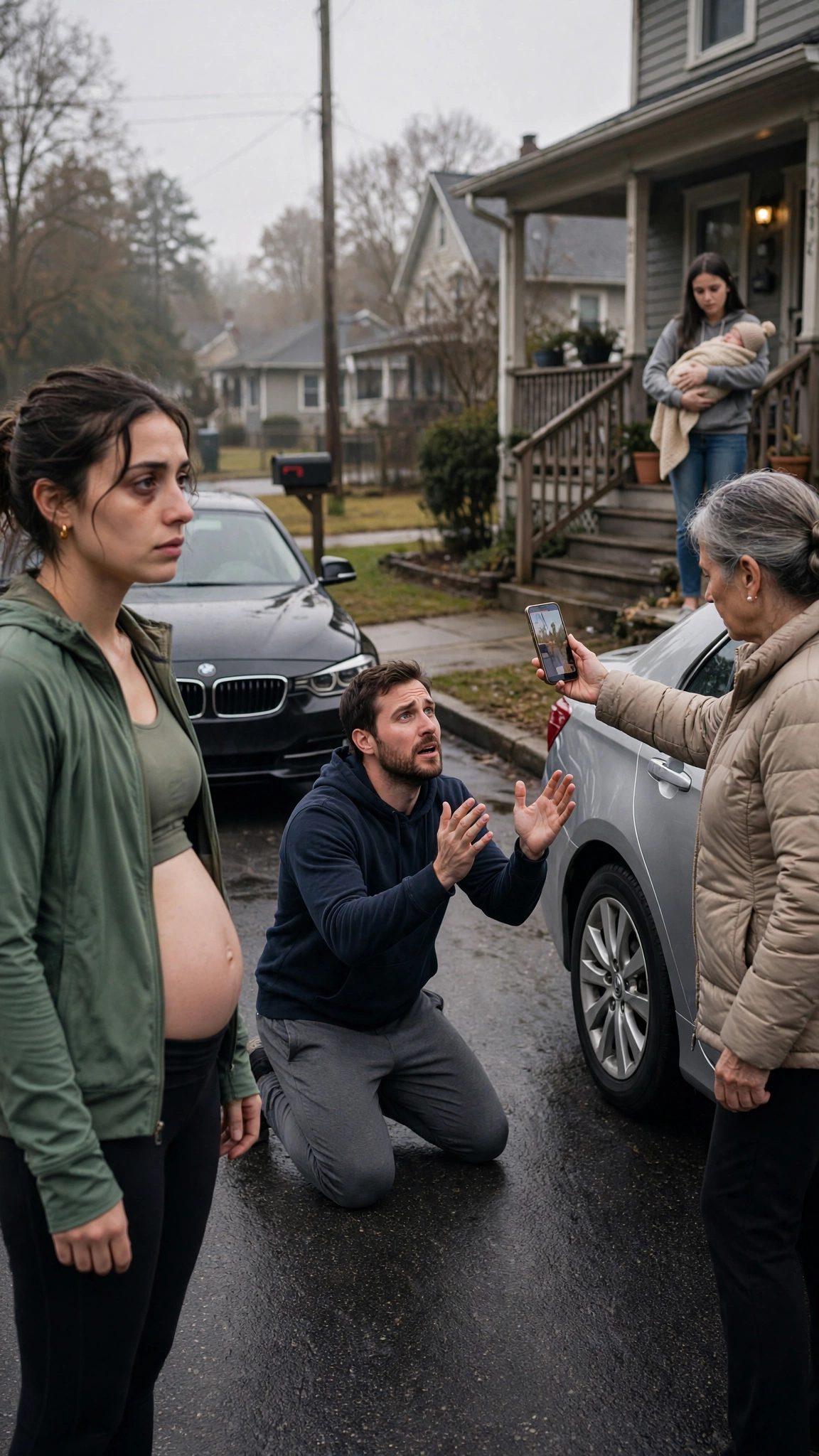
Ryan stared at it for three long seconds. Then he opened the door, stepped out onto the pavement, and sank to his knees. He looked up at her with something I had never seen on his face before.
Genuine fear.
“Mom… please,” he said. “Don’t do this.”
What Was on That Phone
I had stopped running entirely by then. I was standing maybe twenty feet away, hands on my knees, trying to catch my breath, watching my husband kneel on the asphalt in his pressed khakis like something had cut his legs out from under him.
His mother, Deb, didn’t look at me. Not yet.
She’s sixty-three years old. Retired school administrator. The kind of woman who irons her pillowcases and still sends handwritten thank-you notes. I had always been a little afraid of her, honestly. Not because she was mean. Because she was precise. She noticed everything and said nothing until she had decided what to do about it.
She kept the phone in front of his face.
“Explain this,” she said.
Ryan’s mouth opened. Nothing came out.
I still didn’t know what was on the screen. I found out later. Our daughter, Kayla, seventeen and sharp as a tack, had been watching from the upstairs window every single morning. She hadn’t said anything to me because she didn’t know what to do. She was a kid watching her father drive behind her mother like a warden and she didn’t have words for it yet.
But she had a phone.
She’d been filming it. Not every day, but enough. Short clips. Ryan honking. Ryan rolling down the window. Me slowing to a walk, hunched slightly to one side because of the incision, and Ryan’s voice carrying up the block: keep moving, you’re not done. Kayla had stitched the clips together into one video. Two minutes and fourteen seconds.
She sent it to Deb on Thursday night with a message that said: Grandma I don’t know what to do. Is this normal?
Deb drove four hours from Roanoke the next morning.
The Street
Ryan was still on his knees when she finally looked over at me.
She took me in the way a doctor does, head to toe, quick and clinical. I was six weeks postpartum and I’d been running on bad sleep and anxiety and not enough food for weeks. I know what I looked like. Pale. Hollowed out. Still moving a little carefully, favoring my right side without meaning to.
Something shifted in her face.
She turned back to Ryan.
“Get up,” she said. “You look ridiculous.”
He stood. He was taller than her by a foot but he looked smaller somehow, standing there on the curb with his hands loose at his sides.
“It’s not what it looks like,” he started.
“I watched the video four times on the drive here,” she said. “Don’t.”
A car passed us. The driver slowed, looked, kept going.
Ryan tried a different angle. He told her the doctor had cleared me for light activity. Deb asked him which doctor said that, specifically. He said it was implied. She asked him what the discharge paperwork said. He said he didn’t remember the exact wording.
“I do,” she said. “Because I called the hospital this morning and asked them to walk me through standard post-cesarean recovery guidelines.”
She had actually called the hospital.
Ryan went quiet.
What She Said to Me
Deb walked over to where I was standing. She put one hand on my arm, not grabbing, just resting.
“Are you in pain right now?” she asked.
I almost said no. That’s the reflex. You’re fine, you’re fine, don’t make it a thing.
But I was tired. Six weeks of tired. And she was looking at me like my answer actually mattered, and I couldn’t do the reflex.
“My incision pulls sometimes,” I said. “When I go too fast.”
She closed her eyes for about two seconds.
Then she took the car keys out of my hand, the ones Ryan had handed me at some point in the confusion, and she walked me to her sedan and put me in the passenger seat. She went back to Ryan and they talked for a few minutes with their voices low. I couldn’t hear most of it. I heard her say I raised you better than this and I heard him say something about stress at work, like that was a sentence that finished itself.
She got in the driver’s side and took me home.
Kayla was at the front window when we pulled up. She came outside before we even reached the porch, and Deb hugged her for a long time without saying anything.
Inside, she made me sit on the couch. She took the baby, our son Marcus, and walked him around the kitchen while she talked.
She told me Ryan had been difficult in ways she recognized. That she’d seen it start in his second year of marriage to his first wife, before they divorced. That she’d told herself it would be different this time. That she was sorry she’d told herself that.
She wasn’t performing. She wasn’t crying. She was just saying it plainly, rocking a six-week-old and looking at her kitchen tile.
“You don’t have to stay,” she said. “That’s not me telling you what to do. That’s me telling you the option exists.”
After He Came Home
Ryan didn’t come home until almost noon.
When he walked in, Deb was still there. He hadn’t known she would stay. He stopped in the doorway to the living room and looked between us.
She told him to sit down.
What followed was not a fight. It was more like a reckoning, which is a different thing. A fight has heat. This was cold and thorough. Deb went through the timeline. The hospital discharge instructions. The six weeks of morning runs. The photos he took of my body. The things he said to me about the other wives, about looking normal again.
Ryan tried, twice, to explain. The second time she held up a hand and he stopped mid-sentence.
“I’m not here to hear you explain,” she said. “I’m here because your daughter filmed you doing this to her mother and sent it to me because she didn’t know who else to call. Do you understand how bad it has to be for a seventeen-year-old to go looking for a grown-up?”
Ryan looked at Kayla, who was sitting at the kitchen table with Marcus in the bouncy seat beside her.
Kayla didn’t look away.
He put his face in his hands.
I don’t know what that moment meant. Whether it was real or whether it was just the particular shame of being caught by your own kid. I’ve thought about it since and I still don’t know.
Where Things Stand
That was five days ago.
Deb stayed through the weekend. She slept in the guest room and in the mornings she got up with Marcus so I could sleep past six for the first time since we brought him home. She made actual meals, not just toast and whatever was in the fridge. She drove Kayla to her Saturday shift at the smoothie place and picked her up after.
Ryan was quiet the whole weekend. Helpful in a stiff, self-conscious way, like a man completing community service.
On Sunday night, before Deb left, she sat across from both of us at the kitchen table and said that she wanted Ryan to see someone. A therapist, specifically. Not couples therapy, not yet. Just him, alone, working out whatever was happening in his head that made this seem acceptable.
Ryan said he would think about it.
Deb said: “That’s not a yes.”
He said yes.
Whether he means it, I genuinely don’t know. I’ve been wrong about what Ryan means before.
What I do know is that I haven’t run since Friday. My incision doesn’t pull anymore when I walk to the kitchen. I slept seven hours straight on Saturday and woke up and cried a little, not from sadness exactly, just from the shock of feeling rested.
Marcus is six weeks and four days old. He has Ryan’s ears and my mother’s forehead and he smells like something I can’t describe without sounding ridiculous.
I’m not running tomorrow.
I’m not running the day after that either.
—
If this one hit somewhere real, pass it to someone who needs to read it.
For more wild tales about family drama, check out how one woman’s husband asked her to take the fall for his pregnant mistress or read about the mother who sent her child away so she wouldn’t ruin the Christmas portrait. And for a touching story of unexpected connections, discover what happened when two little girls were waiting on the porch for a grieving visitor.