
No one in my family came to my basic training graduation.
Weeks passed before my father finally reached out – not to congratulate me, not to apologize, but to make a demand.
“I need $8,000 for your sister’s wedding.”
I sent him eight dollars with a single note:
Best wishes.
Then I turned to my husband.
“Change the locks.”
My father’s response was to call the police.
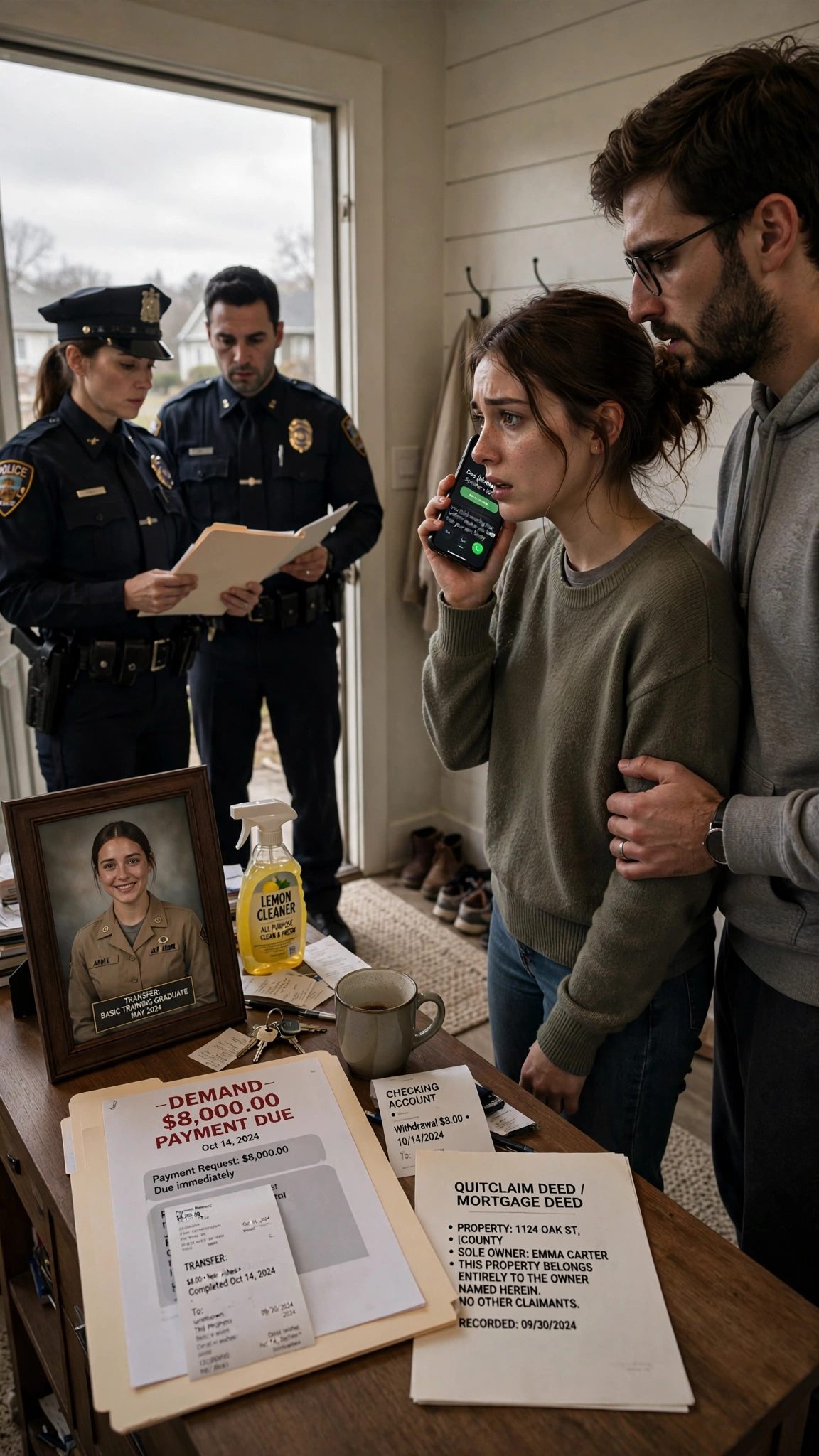
His voice erupted through my phone speaker while two officers stood in my doorway. The entryway smelled of cold coffee and lemon cleaner. Afternoon light stretched across the framed graduation photo on the console table – me, standing alone in uniform. No parents beside me. No sister. No one.
“You think wearing that uniform makes you better than your own family?”
One of the officers glanced toward my husband, who stood quietly at my side.
“Ma’am, is the man on the phone your father?”
“Yes.”
The second officer consulted his notes. “He claims he has belongings inside this residence and a financial interest in the property.”
“I do,” my father cut in. “I put money into that house.”
The words settled heavily in the room.
The Empty Bleachers
Only weeks earlier, I had stood on the graduation field scanning crowded bleachers until my eyes burned.
Parents waved handmade signs. Mothers cried openly. Fathers pressed forward with phones raised, jostling for the best angle. I had sent my family everything they needed – the date, the location, the ceremony time, even a map with parking marked clearly.
Nobody came. Not my mother. Not my father. Not Emily, the sister whose wedding had somehow become my financial responsibility.
I’d been up since 4 a.m. that day. We all had. The barracks smelled like shoe polish and nerves, and by the time we marched out onto that field, the sun was already cutting hard across the grass. I kept thinking I’d spot them. My mother’s blue coat. My father’s gray Carhartt. Something.
Nothing.
After the ceremony, another graduate’s mother noticed me standing alone. She pulled me into a hug and said, I’m proud of you.
Three words from a stranger gave me more than years of chasing my family’s approval ever had.
I drove back to base housing with my dress uniform still on because I didn’t want to take it off. My husband, Carl, had driven four hours to be there. He was the only one. He held my hand in the parking lot and didn’t say anything about the empty seats because he didn’t need to. He’d watched me grow up around those people. He already knew.
Then my father’s message arrived. No congratulations. No explanation. No apology.
Only: I need $8,000 for your sister’s wedding.
Carl read it over my shoulder but said nothing. That was one of the reasons I trusted him – he knew when to give me silence instead of direction.
For a moment, the old version of me surfaced. The daughter who worked double shifts. The daughter who emptied her savings on command. The daughter expected to sacrifice while Emily simply received.
Emily, who had never once held a job longer than four months. Emily, who borrowed money and reframed it as a gift after the fact. Emily, who had called me exactly twice in the past year: once to ask for help moving, once to tell me about her engagement.
She hadn’t asked me to be in the wedding. She’d asked me to fund it.
Then I remembered the empty seats.
I opened the payment app and transferred eight dollars. Not eight thousand. Eight. In the memo line, I wrote: Best wishes.
Then I looked at Carl. “Change the locks.”
He nodded without asking me to explain.
What Family Is Family Actually Means
The next morning, my father called four times before I answered.
“Eight dollars?” he shouted. “I asked for eight thousand.”
“You received what I chose to send.”
“You think this is funny?”
“No,” I said. “I think it reflects our relationship perfectly.”
He tried guilt first. Family is family. That phrase had followed me my whole life, and what it always meant, when you stripped away the warmth people assume comes with it, was this: you give, they take, and if you ever stop, you’re the one who broke something.
I’d bought Emily’s school supplies in high school because my parents said they were short. I’d covered my mother’s car insurance for two years. I’d lent my father $3,400 when he said the business was struggling, then watched him spend part of it on a fishing trip to Georgia. Every time I asked about repayment, he pivoted to something I’d done wrong, some way I’d been selfish, some debt I owed the family for reasons that were never quite explained.
And I had kept paying. Because I thought that was what love looked like.
When the guilt failed, his voice hardened.
“That house has my money in it. You cannot lock us out.”
“It’s my house.”
“I helped you buy it.”
“And I repaid every dollar.”
“No, you didn’t.”
“I have the bank records.”
That was the first silence. Not long. Maybe three seconds. But I’d known my father for thirty-one years and I had never heard him go quiet mid-argument. He always had something. Another angle, another grievance, another version of events where he was owed.
Three seconds of silence was practically a confession.
“You’re going to regret treating us this way.”
I hung up. Carl was in the kitchen making eggs. I sat down at the table and he put a mug of coffee in front of me without being asked.
“He’s going to escalate,” I said.
“Probably,” Carl said.
“I’m not backing down.”
“I know,” he said. He flipped the eggs. “You want toast?”
Two Officers at the Door
I was folding laundry when the knock came. Carl answered first, and I heard the tone before I heard the words – that careful, measured voice police use when they’re not sure what they’re walking into.
Two officers. One tall with a short beard, maybe mid-thirties. The other younger, taking notes on a small pad. They were polite. They always are, at first.
My phone buzzed in my pocket. My father, calling again. I answered it because I wanted him to hear what happened next.
That was the part I hadn’t planned. It was instinct.
His voice came through the speaker immediately. Loud, sure of itself, aimed at the uniforms in my doorway like they were tools he’d borrowed.
“Tell them the truth,” he said. “Tell them I have every right to enter that house.”
The first officer looked at me. “Ma’am, do you feel unsafe?”
Carl moved closer. Not in front of me. Beside me.
“I’m all right,” I said. Then, into the phone: “No, Dad. You don’t have the right to enter my home simply because I finally stopped paying for your life.”
The line went quiet.
Then his voice came back louder, and the control he’d been working to maintain slipped just enough that I could hear what was underneath it. Not authority. Not righteousness.
Fear.
“She’s lying. She puts on a uniform and suddenly decides family rules don’t apply to her anymore.”
I almost smiled. He still thought shame could reach me. He’d been using it for so long he hadn’t noticed it stopped working somewhere around the time I was standing alone on a graduation field, scanning bleachers, finally understanding that no amount of sacrifice was going to make these people show up.
The Folder
I opened the narrow cabinet beside the door.
I’d put the folder together three days after his first threat, when I realized he wasn’t going to let this go. Carl had watched me print the documents and slide them into sleeves without commenting, the way he watches me do most things – present, not hovering.
Inside the folder: screenshots of the $8,000 demand. Proof of the eight-dollar transfer. Receipts showing full repayment of every dollar he had ever contributed to this house. Bank statements going back four years. The mortgage records. And the deed.
Just my name on the deed. Mine and Carl’s. My father’s name: nowhere.
I handed it to the taller officer. He looked at the first page. Then the second. His partner leaned in. Neither of them said anything for a moment, and the entryway felt different, the way a room feels when the thing everyone was pretending wasn’t obvious becomes obvious.
My father was still talking through the speaker. I’d stopped listening to the specific words. It had become background noise, like a TV left on in another room.
The officer with the notepad looked up. “Ma’am, do you have documentation showing the loan was repaid in full?”
I pointed to the third page.
He nodded slowly.
“Sir,” the taller officer said toward the phone, “based on what we’re looking at here, there’s no legal basis for entry. The property appears to be solely in your daughter’s name and the financial obligation you’re referencing has documented repayment.”
My father’s voice went up in pitch. He used the word betrayal twice. He said Emily’s name. He said my mother was devastated, which was interesting, because my mother hadn’t called me once since the graduation. Not once.
“Sir,” the officer said again, quieter this time, “I’d advise you to speak with an attorney if you believe you have a civil claim. We can’t assist with that today.”
I ended the call.
The younger officer handed the folder back to me. “You put that together yourself?”
“Yes.”
He looked at it a second longer than he needed to. “Good thinking.”
They left. Carl closed the door. The house went quiet in the way it does when something loud has just stopped, that specific silence where you can still feel the shape of the noise.
I put the folder back in the cabinet.
What Didn’t Break
Carl made dinner that night. Nothing special – pasta, the jarred sauce we both pretend is fine, garlic bread from a tube. We ate at the kitchen table and I kept waiting to feel something collapse in me. Some grief I hadn’t gotten to yet. Some door swinging open onto the version of this where I called my mother and tried to fix it.
It didn’t come.
What came instead was something quieter. Not relief exactly. More like the feeling of putting down something heavy you’d been carrying for so long you’d stopped noticing the weight.
My father didn’t call again that night. Emily didn’t call at all – she never had, really, not for anything that wasn’t about Emily. My mother sent a text three days later that said I hope you’re happy now and I read it twice and put my phone face-down on the counter.
The graduation photo was still on the console table. Me, in uniform, alone in the frame.
I’d thought about taking it down after the officers left. Replacing it with something else. But I looked at it again that night after dinner, really looked at it, and I didn’t see loneliness anymore.
I saw someone who showed up.
Carl came up behind me and looked at it too.
“You look good in that photo,” he said.
“I know,” I said.
He laughed. First real laugh of the day. I did too.
The photo stayed on the table.
—
If this one hit home, pass it along to someone who needed to read it today.
For more wild family dynamics, read about My Parents Called My Graduation “a Loser’s Parade.” Then the Camera Panned, or if you’re looking for different kinds of drama, check out My Wife Was the Flight Attendant on the Flight I Booked to Cheat on Her and My Daughter Whispered “Dad, Help” and the Line Went Dead.