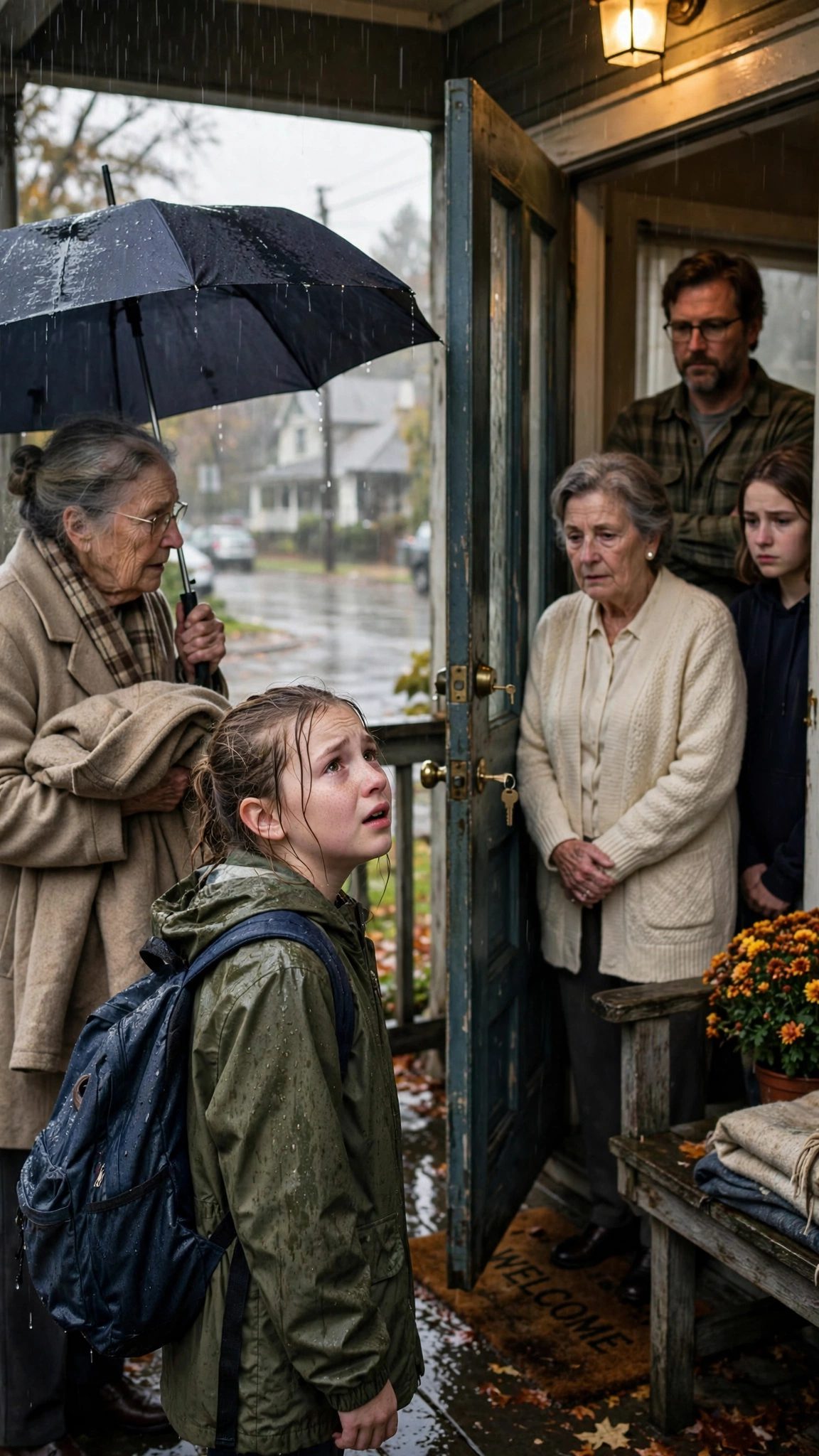

My eleven-year-old daughter came home from school to find her key no longer worked.
She waited on the covered porch while rain fell, unable to reach me or anyone else in the family. Hours passed before my mother finally opened the door.
“We’ve decided you won’t be staying here anymore.”
When I learned what had happened, I did not shout. I did not argue. I simply looked my mother in the eye and said one word.
“Understood.”
Three days later, a certified letter arrived at her door and changed everything.
4:12 PM, Portland
It was 4:12 on a cold afternoon in Portland, Oregon.
Rain glazed the street in dull silver as Lily stood beneath the porch light, working the brass key I had given her on her first day of middle school. She had used it dozens of times without a second thought.
That afternoon, it turned halfway and stopped.
She tried again. Nothing.
Her backpack was already damp when she called my phone. I was in a basement conference room at the county courthouse, buried in documents for a custody case, with no signal underground. She tried my office next. Then my mother. Then my younger sister.
No one answered.
Assuming the lock was broken, she sat beneath the porch roof and waited. The afternoon turned colder. After a while, our neighbor Mrs. Dalton noticed her from across the yard and came over with an umbrella.
“Are you all right, sweetheart?”
Lily had spent years learning to navigate my mother’s moods. She knew Evelyn’s quiet punishments and cold silences better than any child should have needed to. So she forced a small smile.
“I’m okay. I think something’s wrong with the door.”
Mrs. Dalton offered to let her wait inside, but Lily hesitated. She still believed someone would answer eventually. As the sky darkened, Mrs. Dalton returned with a warm coat and stayed close.
Then the front door opened.
My mother, Evelyn Mercer, stepped onto the porch wearing a cream cardigan and pearl earrings, her expression perfectly composed. Behind her stood my sister Natalie and my stepfather Frank. None of them appeared surprised to find an eleven-year-old shivering on the steps.
Lily rose slowly.
“Grandma?”
Evelyn folded her hands at her waist. “We’ve all agreed that you won’t be living here anymore.”
Lily stared at her. “Where’s my mom?”
“Your mother will understand,” Evelyn said. “This house is for family members who respect the rules.”
Lily had no idea what she had supposedly done. She looked from Evelyn to Natalie to Frank, searching for some explanation. No one offered one.
Mrs. Dalton stepped forward and placed the coat around my daughter’s shoulders.
That was when Lily began to cry.
What I Found When I Came Up for Air
I saw the missed calls at 9:37 that evening.
Six from Lily. Two from an unknown number that turned out to be Mrs. Dalton’s landline. Nothing from Evelyn. Nothing from Natalie. Nothing from Frank, who had been standing right there on that porch.
By the time I reached Mrs. Dalton’s house, Lily was on the couch beneath a pile of blankets, holding a warm drink with both hands. The moment she saw me, she stood and ran.
“I’m sorry, Mom,” she whispered into my shoulder.
“You have nothing to apologize for.”
I held her until her breathing slowed. Then I helped her to the car, crossed the yard, and knocked on my mother’s door.
Evelyn opened it before my knuckles fell a second time. She had always preferred to control the opening of every confrontation. Natalie stood behind her with her arms crossed. Frank stared at the floor. He had a talent for that. Fifteen years I had known the man and he had never once looked directly at a difficult thing.
My eyes moved to the new lock on the door, then to Lily’s damp backpack sitting against the wall like discarded luggage.
My mother lifted her chin. “Before you become dramatic, Claire, you should understand that this was necessary.”
I did not raise my voice. I did not ask how she could lock out a child without a single word to me. I did not turn to Natalie or demand that Frank look up from the floor. I simply studied each of their faces, let the silence go on a beat longer than was comfortable, and said one word.
“Understood.”
Evelyn’s expression shifted. She had expected anger. She had expected tears. Most of all, she had expected me to beg. I had done that before, years ago, in this same doorway, over smaller things. She knew the shape of my capitulations.
I did none of those things. I picked up Lily’s backpack and walked away.
The Hotel, the Soup, the Laptop
That night, I took my daughter to a hotel two miles from the house. The kind with a pool no one uses and a lobby that smells like industrial carpet cleaner. Lily thought it was the best place she had ever been.
We ordered soup from the place on the corner. We changed into dry clothes. We watched an old movie, something animated and loud, until Lily fell asleep with her face half-buried in the pillow beside me.
I sat in the dark for a while with the television off.
Then I opened my laptop.
My mother had treated the Portland house as though it were entirely hers for so long that the assumption had calcified into fact. She hosted holidays there. She set the rules about shoes at the door and which towels were for guests and how long people could stay in the shower. She reminded everyone, with quiet regularity, that living under her roof was a privilege she could revoke.
What she had never once mentioned was how she had come to be there at all.
My late father, Gerald Mercer, had purchased the house in 1987. He had bought it with money he had worked for before he ever met Evelyn, before he had children, before any of us existed in his life. Before he died, eleven years ago now, he placed it in a family trust. The structure was straightforward. Evelyn had the right to live there for the remainder of her life, provided she maintained the property and abided by the trust’s conditions. She did not own it. Her name was not on the deed.
The trust named me as legal successor and trustee.
I had never made anything of it. My father had asked me to take care of the family, and I had interpreted that the way he probably intended: keep the peace, look after your mother, don’t make things harder than they need to be. So I had stayed quiet through the years of small humiliations. The comments about my parenting. The rules about Lily’s behavior that shifted without notice. The way Evelyn could make you feel, without ever saying anything you could directly argue against, that your continued presence in her home was a daily act of tolerance on her part.
I had been managing her moods since I was about Lily’s age.
But the trust had conditions. Specific ones. One of them was unambiguous.
No resident could deliberately exclude or remove a minor beneficiary without written authorization from the trustee.
Lily was a named beneficiary. My father had insisted on it, and I had not thought about that clause in years.
I was the trustee.
What the Text Message Proved
I called my attorney the following morning. Douglas Hatch, who had managed my father’s estate since before I was thirty and who had the particular manner of someone who has seen every variety of family disaster and stopped being surprised by any of it. I explained what had happened. He listened without interrupting.
Then I sent him everything.
Mrs. Dalton’s written account, which she had offered before I even asked. Photographs of the changed lock, the new deadbolt still bright and unscratched. Records of Lily’s unanswered calls. A screenshot of a text message my mother had sent Natalie at 2:48 that afternoon, more than an hour before Lily even arrived home from school.
The text read: Once Claire realizes we are serious, she will come back willing to follow our rules.
That single sentence did something the rest of the evidence only suggested. It established that my mother had not acted in a moment of anger. She had not changed the lock because something happened that day, some argument, some incident I was unaware of. She had planned it. She had coordinated it with Natalie. She had timed it to coincide with a day she knew I would be in court, unreachable, buried in someone else’s crisis.
She had used an eleven-year-old child as a bargaining chip.
Not even a bargaining chip, really. More like a message. A demonstration of what she could do.
Douglas was quiet for a moment after I walked him through the screenshot.
“She sent this before the girl got home,” he said.
“Yes.”
Another pause. “All right.”
By the following morning he had prepared the notice. I reviewed it that evening at the hotel while Lily did homework at the desk by the window, her pencil tapping a slow rhythm against the paper. The document was not aggressive in tone. It was precise. It cited the specific clause. It named the specific violation. It laid out, in the flat language of legal correspondence, exactly what my mother had done and exactly what followed from it.
Three days after I signed it, a courier arrived at Evelyn’s door with a thick certified envelope.
The Envelope
She opened it in the same living room where she had spent years reminding me, in a hundred different ways, that I was there at her discretion.
The first page informed her she had violated the terms of the family trust. The second explained that her authority over the property had been suspended pending trustee review. The third notified every adult resident, Natalie included, that their continued presence on the property required my written approval.
At the bottom of the final page was the name of the property’s legal trustee.
Mine.
My phone began ringing less than ten minutes after delivery was confirmed. Evelyn first, three times in a row, each call going to voicemail. Then Natalie, who left a message that was mostly silence and then the word “Claire” said in a tone I recognized from childhood, the one that meant she thought I was being unreasonable. Then Frank, who had stared at the floor while my daughter stood shivering on the porch, left a careful voicemail asking if we could discuss this calmly as a family.
I looked across the hotel room at Lily.
She was sitting by the window in the afternoon light, finishing a worksheet, her repaired backpack on the floor beside her chair. The straps were still a little damp at the stitching but she hadn’t complained about it. She had her father’s stubbornness about certain things, that quality of just absorbing what happens and continuing. I had always worried it would make her too quiet about the wrong things. Watching her now, I thought maybe I’d been wrong about that.
She looked peaceful. Not happy exactly. Peaceful.
I turned my phone face down on the bedspread.
My mother had believed that changing one lock would prove she controlled our future. What it actually proved was that she had never understood something far more fundamental.
She had never understood who held the key.
—
If this one stayed with you, share it. Someone out there needs the reminder that quiet isn’t the same as powerless.
If you’re looking for more wild family stories, check out My Father Called the Police on Me After I Sent Him $8 Instead of $8,000 or My Parents Called My Graduation “a Loser’s Parade.” Then the Camera Panned.. And for a truly unbelievable twist of fate, don’t miss My Wife Was the Flight Attendant on the Flight I Booked to Cheat on Her.