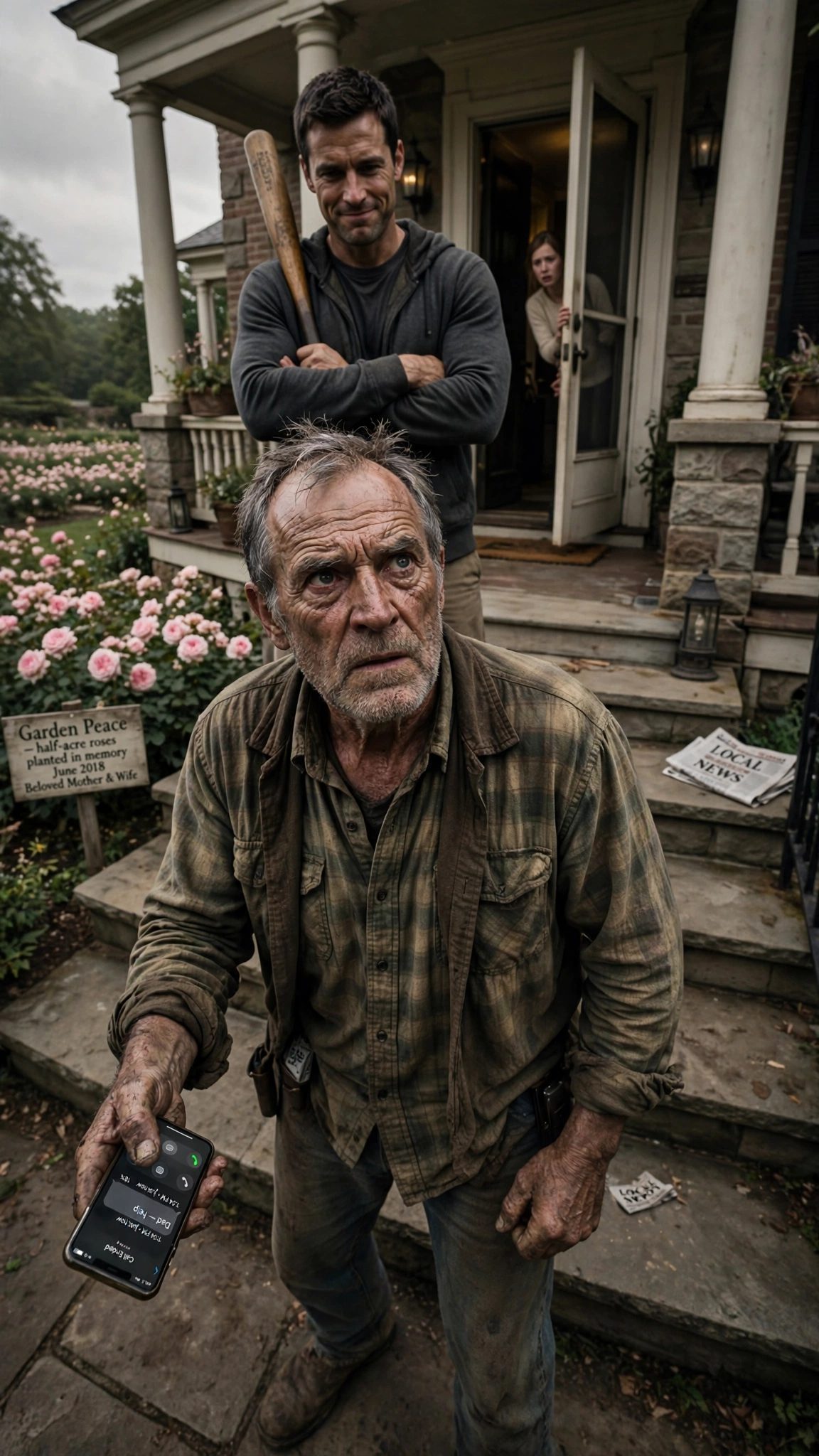

My daughter gasped, “Dad, help,” and then the line went dead.
I was doing ninety before I cleared my own street.
It was ten o’clock on a Saturday morning, and my world had shrunk to the half-acre garden behind my house. The air carried damp soil, old leaves, and Peace roses in full bloom. A good smell. An honest smell.
For most people, retirement meant golf courses and porch complaints about gas prices.
For me, it meant silence.
Clean silence.
No shouting. No orders. No radio crackling in my ear. No rooms I had to forget before I could sleep. Just soil under my nails, sun on the back of my neck, and tomatoes that asked nothing of me except water and patience.
My name is Arthur Hale. Sixty-three years old, widowed, and to anyone beyond my fence, just an old man in a faded flannel shirt who grew vegetables and pruned roses for half the neighborhood.
That was what I wanted them to see.
That was what I had spent years working to become.
My daughter Emily used to tease me about it.
“You look like a retired farmer, Dad.”
“I look peaceful.”
She’d laugh and shake her head. “You look dangerous pretending to be peaceful.”
Emily had always seen too much. She noticed when my smile stopped short of my eyes. She knew which sounds made me go still. She knew I checked exits in restaurants and parked facing the street. She never asked about the scars along my ribs or the white line beneath my jaw. She simply filed those things away, the way perceptive people do, and loved me anyway.
That morning I was trimming dead blooms when my phone rang.
Only three people had that number.
My daughter. My doctor. And Colonel Samuel Ward – a man who had once trusted me with lives in circumstances that had no good name.
When I saw Emily’s name on the screen, I smiled.
“Morning, sweetheart.”
One second of static.
Then her breathing.
Thin. Fractured. Wrong.
“Dad…”
My hand tightened around the phone.
“Emily?”
A crash from somewhere behind her. A woman’s voice, sharp and commanding, words I couldn’t make out. Emily made a sound – not quite a cry, not quite a gasp – something smaller and more frightened than either.
Then she whispered, so quietly I nearly lost it beneath the static:
“Dad, help.”
The line died.
I stood still for three seconds.
The garden dissolved around me.
There are moments when age stops mattering. When pain stops mattering. When the past doesn’t surface as memory but as something older and more reliable – muscle, instinct, the body remembering what the mind has tried to put away.
I dropped the pruning shears and ran.
—
I tore down the highway pushing a hundred miles an hour, heading straight for my son-in-law’s family estate – a word they used freely and I had always found telling. When I turned through the iron gates and up the long gravel drive, Marcus was already on the porch.
He stood with his feet planted and a baseball bat hanging loose in one hand, the way a man holds something he wants you to notice. He was smiling. Not warmly.
“Arthur.” He said my name like a verdict. “This is a private family matter. You should turn around.”
I stepped out of the car and closed the door quietly behind me.
“Your daughter,” he continued, his voice taking on the practiced calm of a man accustomed to being obeyed, “needed to be disciplined. That’s between a husband and his wife.”
I looked at the bat. I looked at his smile.
Then I looked at him – really looked, the way I used to look at problems that needed solving.
His smile faltered. Just slightly. Just enough.
“Move away from the door, Marcus,” I said.
My voice came out quiet. It always did, when it mattered most.
He didn’t move.
That was his mistake.
What Thirty Years Buys You
I want to be honest about something.
I am not a large man. I’m five-eleven on a good day. My hair went white before I hit fifty. I have a bad left knee that predicts rain better than any weather service, and a right shoulder that locks up in cold mornings until I’ve moved it through its range. I look, as Emily said, like a farmer.
Marcus was thirty-four. Six-two. He played tennis three times a week and had the kind of shoulders that come from a gym membership and a personal trainer named Kyle.
He looked at me the way young men sometimes look at old ones. Weighing. Discounting.
I let him.
The bat came up. Not a swing – not yet – just a raise. A statement. The kind of gesture men make when they want to establish the terms of a conversation.
I closed the distance between us in four steps.
What happened next took about eight seconds. I won’t catalog it. The bat ended up on the porch boards. Marcus ended up with his back against the front door and my forearm across his collarbone, and he was breathing in the rapid, shallow way of a man whose body has received information his brain hasn’t processed yet.
The information was this: the person in front of him was not what he appeared to be.
“Where is she,” I said.
Not a question. The inflection mattered.
He told me.
The Room at the End of the Hall
The house was the kind of house that announces money without apology. High ceilings, art on every wall, furniture chosen by someone who charged by the hour. I’d been inside it a dozen times for dinners I’d sat through with a smile that cost me something.
I took the stairs two at a time.
The door at the end of the hall was closed. I could hear voices behind it – one of them was a woman I recognized. Diane. Marcus’s mother. A woman who had attended every family dinner for four years and had never once addressed Emily directly, only about her, in the third person, as though Emily were a piece of furniture whose placement she found mildly inconvenient.
I knocked once. Opened the door.
Emily was sitting on the edge of a chair in the corner of the room. She was wearing a gray sweater with the sleeves pulled down over her hands. Her face was dry. Emily had always cried privately, never in front of people who hadn’t earned it. There was a red mark along her left cheekbone that the concealer she’d applied hadn’t fully covered.
I had seen worse. That didn’t make it better.
Diane turned from the window. Sixty-one years old, helmet of silver hair, a silk blouse that cost more than my monthly grocery bill. She looked at me with the expression she reserved for things that had entered her home uninvited.
“Arthur.” Same tone Marcus had used. Must have practiced it together. “You have no business being here. This is a family matter and Emily is perfectly – “
“Emily,” I said.
My daughter looked up.
“Can you walk?”
She stood.
That was all I needed.
What Diane Said Next
Diane moved to block the door. Actually stepped in front of it, arms folded, with the confidence of a woman who had spent sixty years having rooms arrange themselves around her will.
“She’s not going anywhere,” Diane said. “They have a marriage. They have vows. Whatever disagreement – “
“Step aside, Diane.”
“You listen to me.” Her voice went up. “My son has given her everything. Everything. A home, security, a life she never would have had on her own. If she can’t manage her behavior, if she can’t show basic gratitude – “
“Diane.”
She stopped.
I looked at her the way I had looked at Marcus on the porch. The full thing. The thing I kept behind the flannel shirt and the tomato plants and the quiet retirement on a quiet street.
She went very still.
“The next words out of your mouth,” I said, “will be to a police officer. Your choice is whether that happens in this room or in a courthouse.”
The room was quiet enough that I could hear a clock somewhere down the hall. Second hand. Tick. Tick.
Diane stepped aside.
The Drive
Emily didn’t speak until we cleared the gates.
I didn’t push her. I drove. The same road I’d come in on, at a different speed, the morning looking exactly as it had an hour ago – same sky, same fields, same ordinary Saturday going about its business.
She had her knees pulled up and her arms wrapped around them, which she’d done since she was seven years old in the backseat of her mother’s car. Some things the body holds onto.
After about ten minutes she said, “I didn’t know if you’d come.”
I kept my eyes on the road. “Yes you did.”
She was quiet a moment. “I didn’t want to be the reason you…”
She didn’t finish the sentence. She didn’t need to. I knew what she meant. She’d spent her whole life being careful not to pull me back toward the version of myself I’d worked to put down.
“Emily.” I waited until she looked at me. “You are never the reason. You’re the reason I stopped.”
She turned back to the window.
I let that sit.
What I Found in the Sweater
We got back to my house around noon.
I made tea because it was something to do with my hands, and Emily sat at the kitchen table the way she had as a teenager when she’d come home from something difficult – not talking yet, just being inside the house, letting the house do its work.
When she finally took off the sweater, she was wearing a long-sleeved shirt underneath. She caught me looking and pulled back the sleeve herself. The bruising on her forearm was three days old at least, going yellow at the edges.
“How long,” I said.
She looked at the table. “It started small. A year ago, maybe. And then it wasn’t small.”
A year.
She’d sat across from me at Christmas. She’d called me on my birthday in February and laughed about something I said. She’d sent me a photograph of the roses she’d planted along the back fence of their property, the ones I’d given her cuttings for, and I’d thought: she’s happy. She looks happy.
I hadn’t looked closely enough.
That was the thing that sat in my chest the rest of the afternoon. Not Marcus. Not the bat, not the mark on her cheekbone, not even the bruise. The year.
I should have known.
She’d told me once, years ago, that I always saw too much. But I’d gotten comfortable. I’d gotten peaceful. And somewhere in the process of becoming the man I wanted to be, I’d stopped looking at the people who needed me to look.
What Happens to Marcus
I’ll tell you what I did and didn’t do.
I didn’t go back to that house.
Not because of restraint, exactly. Because Emily asked me not to, and that request meant more than what I wanted.
What I did: I called a lawyer named Greta Sloan, who had handled two cases for friends of mine and who had a reputation for being precise and relentless in roughly equal measure. I sat with Emily at my kitchen table while she told the whole story into a voice recorder. I drove her to a clinic that afternoon where a doctor named Farris documented everything with the thoroughness that the situation required.
Marcus’s lawyer called my phone six days later. I don’t know how he got the number. I let it go to voicemail. Then I called Greta and told her, and she handled it.
The divorce took eleven months. The settlement was what Emily deserved.
I don’t know what Marcus is doing now and I don’t think about it.
The Garden, Now
It’s been two years.
Emily lives twenty minutes from me in a house she chose herself, with a garden she’s started from scratch. She called me last spring to ask about soil pH and I spent forty-five minutes on the phone explaining it, and she pretended to take notes and I pretended not to know she was only half-listening, and it was the best forty-five minutes I’d had in a long time.
She came over on a Tuesday in September and we planted bulbs together. Tulips, mostly. Some alliums. She got dirt under her nails and didn’t seem to mind.
At one point she sat back on her heels and looked at my roses and said, “They’re better than last year.”
“They needed cutting back,” I said. “You have to cut them back hard in winter or they get leggy.”
She looked at me with that look. The one that sees too much.
“Is that a metaphor, Dad?”
“It’s horticulture,” I said.
She laughed. The full one, not the careful version.
I kept working and didn’t say anything else. Some things don’t need saying. The garden was warm and the soil smelled right and my daughter was laughing twenty feet away from me, and that was the whole of it.
That was enough.
—
If this one hit close to home, pass it on to someone who needs it.