
I was eight months pregnant, sitting near the end of a long dinner table with swollen ankles and an aching back, holding a glass of sparkling water and trying very hard not to cry in front of strangers.
Then my father held up my car keys and gave my BMW to my brother’s fiancée.
My name is Claire Whitman. I was thirty-two years old, married, and four weeks from my due date. The white BMW X5 parked downstairs belonged to me and my husband, Daniel. We had saved for three years to buy it together.
None of that mattered to my father.
It never had.
The engagement celebration was held in a private room above an upscale steakhouse in Boston. The kind of place with low lighting, heavy silverware, and staff trained to pretend they haven’t heard anything.
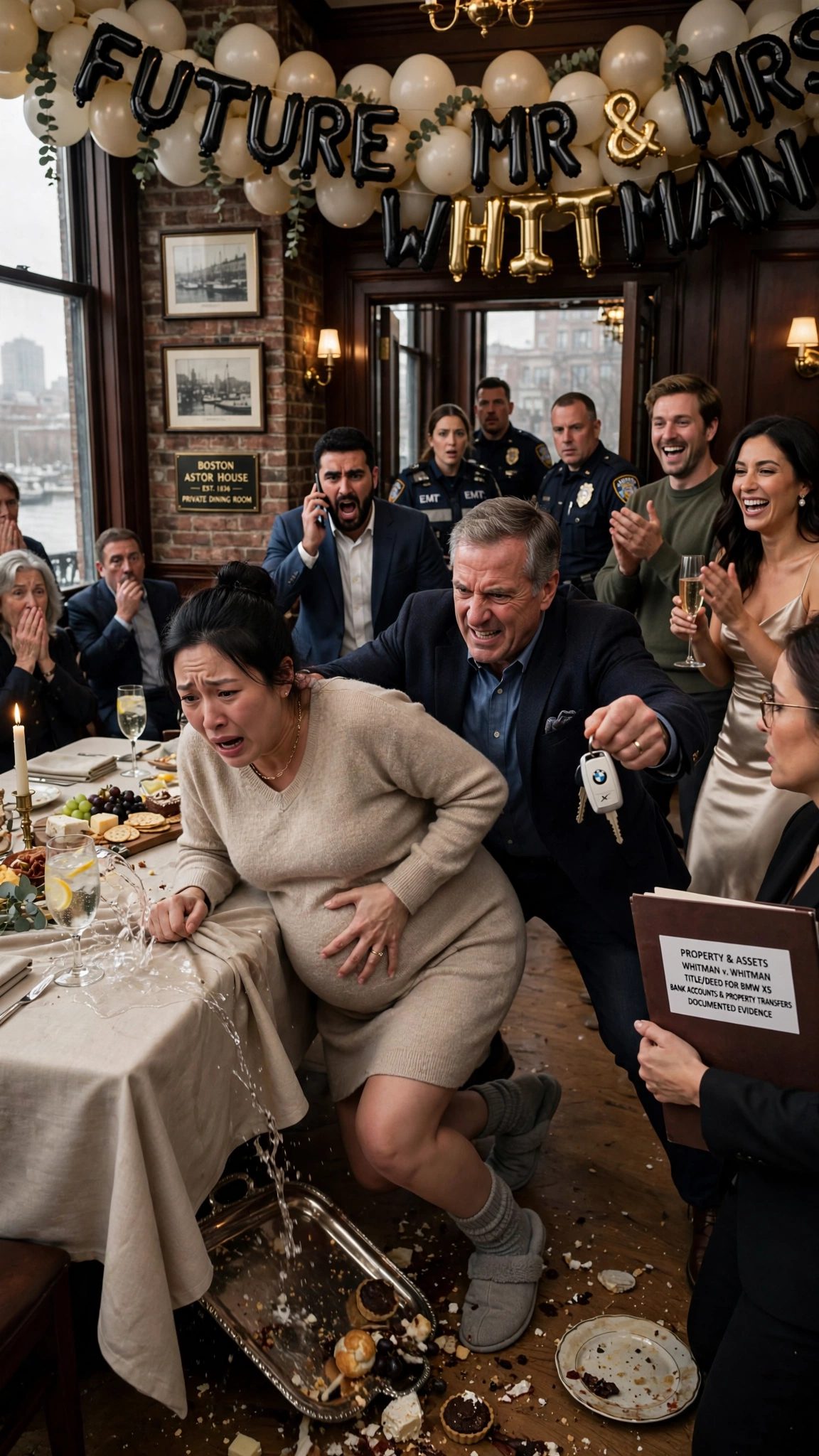
My brother Ethan stood beneath a balloon arch with his fiancée, Vanessa Cole, both of them glowing beneath letters that read FUTURE MR. & MRS. WHITMAN. Vanessa wore a champagne dress and a smile she had clearly practiced. Most people found her charming. I had always noticed something sharper underneath it – a particular brightness in her eyes when she thought she was winning something.
That evening, I finally understood what she had been trying to win.
My father, Richard Whitman, tapped a fork against his wineglass. The room settled into silence. He rose from his chair with the easy confidence of a man who had never once doubted his own authority.
“Everyone,” he announced, smiling broadly, “we have one final gift.”
My mother looked confused. Ethan’s expression shifted into something uneasy. Vanessa’s face lit up like she already knew.
Dad reached into his jacket and raised a set of keys above his head.
My keys. The BMW fob with the small scratch on the corner where I’d dropped it in a parking garage two winters ago.
My stomach tightened.
“This,” he said, “is our gift to the real bride.”
The room went quiet in that particular way that means everyone understands something ugly is happening but nobody wants to be the first to acknowledge it.
Then Vanessa clapped her hands together and laughed.
“Richard! You didn’t!”
I placed both palms flat against the table and pushed myself to my feet.
“Dad.” My voice was steady. “Those are my keys.”
Vanessa tilted her head with the soft, pitying expression she reserved for public humiliations. “Claire, please. You’re making a scene. You can take an Uber to your appointments.”
A few guests released the kind of uncomfortable laughter people use to fill silences they don’t know how to escape. I ignored them and kept my eyes on my father.
“Give me my keys.”
His smile hardened at the edges. “You and Daniel already have two vehicles. Ethan and Vanessa deserve to start their marriage properly.”
“The BMW is registered in my name,” I said. “I paid for it with my husband. My due date is four weeks away.”
He raised the keys above my reach and looked at me the way he always had – like I was a child throwing a tantrum over something that was never really mine to begin with.
“You have always been selfish, Claire.”
I reached for them anyway.
He pushed me.
It wasn’t a dramatic shove. It probably didn’t look like much from across the room. But I was eight months pregnant, off-balance, and entirely unprepared for my father’s hand against my shoulder.
My hip caught the edge of the dessert table. A silver serving tray hit the floor with a sound like a gunshot. And then a pain moved across my lower abdomen – slow and deep and wrong in a way that emptied my mind of everything except fear.
I grabbed the tablecloth with both hands. The room seemed to tilt.
“Claire?” my mother cried.
For one long, terrible second, nobody moved.
Then Vanessa said, quietly but clearly: “She’s doing it deliberately.”
I looked at her. I looked at my father, still holding my keys, his expression caught somewhere between guilt and defiance. I looked at my mother, who was half-risen from her chair but hadn’t crossed the room.
Something inside me went very cold.
I took out my phone and called Daniel.
He answered on the second ring.
“Hey, love. Everything okay?”
“No,” I said. My voice came out smaller than I intended. “Dad pushed me. I fell against the table. Something feels wrong.”
The warmth left his voice immediately, replaced by a quietness that was somehow more frightening than anger.
“Where are you?”
“The Astor House. Private room upstairs.”
“Don’t let anyone near you. I’m calling an ambulance. Stay on the line.”
My father stepped toward me. “Give me that phone.”
I moved back, one hand pressed against my stomach.
Daniel heard him.
“Richard.” His voice came clearly through the speaker, calm and precise. “Do not take another step toward my wife. If you touch her again, tonight will be the last night your family has any control over anything connected to us.”
Then I heard him open another call on his end.
The doors opened ten minutes later.
Paramedics came first. Then two police officers. Then Daniel, still in his navy work suit, his face pale but his eyes carrying a controlled fury I had only seen in him once before, years ago, when someone had tried to take something he loved.
Behind him walked Marissa Kane, a criminal attorney from his firm.
And behind her came our family lawyer, carrying a thick manila folder.
The room went absolutely silent.
My father’s hand dropped slowly to his side. The BMW keys dangled from his fingers, then stilled.
Vanessa’s smile was gone.
And Richard Whitman, for the first time all evening, had nothing to say.
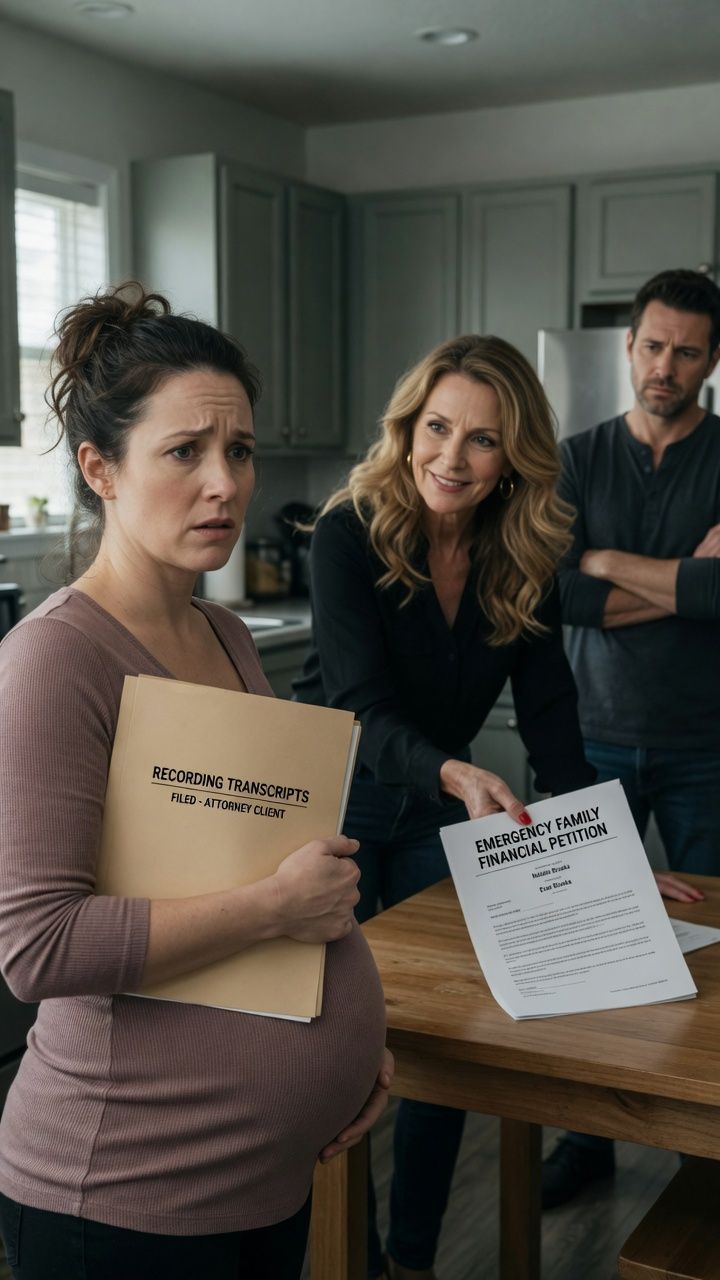
Because the folder in our lawyer’s hands held far more than the title to my car.
It contained records of every account, every property transfer, every quiet financial arrangement my father had been making for years – the ones he had assumed nobody was paying close enough attention to notice.
He had been wrong about that.
He had been wrong about a great many things.
What the Paramedics Found
They took me to Mass General. Daniel rode in the back with me, holding my hand so hard I had to ask him twice to ease up.
The pain in my abdomen turned out to be a pulled ligament, aggravated by the impact against the table edge. Not labor. Not placental. The on-call OB used the word “fortunate” three times in five minutes, which told me exactly how bad it could have gone.
Our daughter was fine. I spent four hours on a monitor anyway, watching her heartbeat scroll across a screen, listening to Daniel on the phone in the hallway outside my room. His voice was low, controlled, very even. That particular tone he uses when he has already made a decision and is simply executing it.
I’d heard it before. I’d married it, in fact, partly because of it.
My mother called twice. I let it go to voicemail both times. I wasn’t ready. My chest was doing something complicated every time I thought about her half-rising from her chair and then not moving, not crossing the room, not doing the one simple thing a mother is supposed to do.
I’d have time to work through that later.
Right then I was focused on the monitor, on the steady green line, on the proof that my daughter had survived my father’s particular brand of love.
What Daniel Had Been Watching
Here’s the thing about Daniel Whitman – he took my last name when we married, which my father had found baffling and slightly insulting, which was partly why Daniel had done it – he is the kind of person who notices patterns.
He had been noticing my father’s patterns for six years.
Richard Whitman was a commercial real estate developer. Successful, by most measures. The kind of man who owned tables at charity dinners and got his name on donor walls at institutions he’d never actually visited. He had a gift for appearing generous while moving money in directions that benefited only himself.
Daniel worked in financial law. Corporate restructuring, mostly. He spent his days reading the spaces between documents, the things that weren’t said, the transfers that happened one step removed from where they should have happened.
He’d started paying attention to my father’s finances about two years earlier, after a holiday dinner where my father had casually mentioned, in front of everyone, that he’d “helped” Daniel’s firm land a particular client. The implication being that Daniel owed him something. That we both did.
Daniel had smiled and said nothing. Then he’d gone home and started reading.
What he found wasn’t illegal, exactly. Not all of it. But some of it was. And the parts that weren’t illegal were the kind of thing that, when laid out clearly in a manila folder at a dinner party in front of witnesses, had a way of restructuring a family’s understanding of itself very quickly.
Property transfers to a holding company my mother didn’t know existed. A trust set up in Ethan’s name that drew on funds from a joint account my parents shared, without my mother’s documented consent. A pattern of valuation discrepancies in three commercial sales going back to 2019.
Small things. Careful things. The kind of things a person does when they’re very sure nobody is watching.
The Folder
Marissa Kane handled the police.
She was calm and specific and used the phrase “documented assault on a pregnant woman” twice in her opening exchange with the officers, which had an immediate effect on the temperature in the room.
My father tried to speak twice. She talked over him both times, not rudely, just as if his words were weather.
The BMW keys went into an evidence bag. One of the officers photographed the dessert table, the fallen tray, the tablecloth still bunched where I’d grabbed it.
Ethan stood against the far wall with his hands in his pockets, looking at the floor. He hadn’t said a word since Daniel walked in. I don’t know what he’d expected the evening to become, but it wasn’t this.
Vanessa had found her voice again by then. She was explaining, at some length, to anyone who would listen, that there had been a misunderstanding, that Richard had simply been making a gesture, that Claire had always been prone to overreaction.
Nobody in the room was listening to her.
Our family lawyer set the folder on the table in front of my father and opened it to the first page.
“Richard,” he said. “I think you should sit down.”
My father looked at the page. His face went through several things in quick succession. I watched from the doorway, where a paramedic was still trying to get me to sit in a wheelchair, which I was ignoring.
The first expression was confusion. Then recognition. Then something I had genuinely never seen on my father’s face before.
Fear.
Not of Daniel. Not of the police. Of my mother, who had finally crossed the room and was standing at his shoulder, reading the same page he was reading, her hand pressed flat against her collarbone.
“Richard,” she said. Her voice was very quiet. “What is this?”
He didn’t answer her.
What Happened After
The police took a statement. My father was not arrested that night, though assault charges were filed the following week. Marissa was precise about the timeline and the evidence and the fact that seventeen people in that room had witnessed him push his eight-months-pregnant daughter into a piece of furniture.
He hired a lawyer within forty-eight hours. His lawyer called Daniel’s firm. Daniel’s firm did not return the call.
My mother retained her own attorney eleven days later. She called me the night before she did it, not to ask permission, just to tell me. She cried on the phone. I didn’t, but not because I wasn’t close to it.
“I didn’t cross the room,” she said. “At the party. I should have crossed the room.”
“Yes,” I said. “You should have.”
She didn’t argue with that. It was the first honest conversation we’d had in maybe fifteen years.
Ethan called once. He said he hadn’t known about the car. I told him I believed him, which I did, mostly. He said Vanessa was very upset. I told him that was between him and Vanessa. He didn’t call again after that.
The BMW was back in our garage by the following Tuesday, released once the police had documented what they needed. I drove it to my thirty-six-week appointment that Thursday. The scratch on the key fob was still there, same as always.
Our daughter was born on a Wednesday morning in late October. Seven pounds, four ounces. Entirely healthy. Daniel cried in a way I had never seen him cry before, standing in the corner of the delivery room with his hand over his mouth.
We named her June.
Not for anyone in particular.
Just because it was a name that sounded like something new.
—
My father sent flowers to the hospital. No card. Just a large arrangement of white lilies that the nurses moved into the hallway before I saw them, because Daniel had gotten there first and quietly asked them to.
He knew I’d have wanted to throw them out the window.
He was right.
—
If this one hit somewhere close to home, pass it on – someone you know might need to read it.
For more tales of family drama, check out “My Daughter’s Key Stopped Working While I Was at the Courthouse” or perhaps “My Father Called the Police on Me After I Sent Him $8 Instead of $8,000,” and don’t miss “My Parents Called My Graduation “a Loser’s Parade.” Then the Camera Panned.”