
My daughter came home for a quiet visit with no luggage, no wedding ring, and a smile that looked like something she’d practiced in the car.
I noticed all three things before she reached the porch steps.
Clara had always been transparent to me – even as a teenager, even across the distance that careers and marriages create. So I said nothing, made tea, and let her settle into the house where she’d grown up. I told myself she would talk when she was ready. Mothers learn to wait.
She wasn’t ready until the second morning, when I stepped into her room to bring fresh towels and found her changing by the window.
The light caught her back before she heard me.
I had spent twenty-two years on the federal bench. I had reviewed photographs of violence that made seasoned prosecutors look away. I believed, in some professional corner of myself, that I had developed a certain distance from the worst of what people do to one another.
I was wrong. Nothing prepares you for your own child.
The marks were methodical. That was what stopped my breath – not just their presence, but their patience. Fading bruises along her ribs. A healing cut near her spine. Older, yellowing traces beneath the newer ones, a record of repetition.
“Oh, sweetheart.”
She spun around and grabbed her blouse, clutching it to her chest. In the mirror I caught her expression – not embarrassment, but the specific, practiced fear of someone calculating consequences.
“Please, Mom. Don’t.”
“Clara – “
“He’s a partner at Mercer, Vale and Knox.” Her voice was barely above a whisper. “He knows the police. He knows judges. He says no one will believe a nervous wife over a man like him.” She pulled the blouse over her shoulders with trembling hands. “He says if I leave, he’ll prove I’m unstable and take Sophie. He’s already drafted custody papers.”
Sophie. My four-year-old granddaughter, still at preschool near Daniel’s house, twenty minutes away.
That single sentence turned my fear into something colder and more useful.
I had watched confident defendants for two decades mistake polished manners for immunity. I recognized the architecture of what Daniel had built around my daughter – the isolation, the financial control, the borrowed authority of legal language deployed against someone who loved him. He had constructed a very careful cage, and he had made sure Clara understood exactly how many locks were on it.
What he didn’t know was that I understood the locks too.
He knew me only as Evelyn Cross, Clara’s widowed mother. I had used my maiden name on the bench for exactly this reason – to keep my family separate from my courtroom, to protect the people I loved from the weight of what I did. Daniel had never thought to look further. Men like Daniel rarely imagine that the quiet older woman at Thanksgiving dinner might be someone worth researching.
I took Clara’s cold hands in both of mine.
“We are going to the hospital,” I said. “Then we are going to get Sophie.”
“He’ll say I kidnapped her.”
“No. We will document everything, follow every procedure, and leave him nothing to stand on. Do you trust me?”
She looked at me for a long moment. Then she nodded.
—
At the hospital, a forensic nurse spent two careful hours with Clara. She documented every visible injury with the quiet professionalism of someone who has done this work too many times and refuses to become numb to it. Clara spoke haltingly at first, then steadily – three years of abuse, financial control, deliberate isolation, threats calibrated to her specific fears. A victim advocate arrived, made calls, and by late afternoon had secured an emergency protective order.
By sunset, Sophie was home. She ran to Clara in the front hallway and buried her face in her mother’s neck, and Clara held her with the particular fierceness of someone who had been afraid, for a very long time, that she might not be allowed to do exactly this.
I stood in the kitchen doorway and watched them and did not trust myself to speak.
—
At 8:13 p.m., Daniel called.
Clara’s phone lit up on the kitchen table. She looked at it the way people look at things that have hurt them before. I reached over and put it on speaker.
“You took my daughter.” His voice was composed, almost conversational – the tone of a man accustomed to being the most dangerous person in any negotiation. “Bring her back, Clara, or I will destroy you. Both of you.”
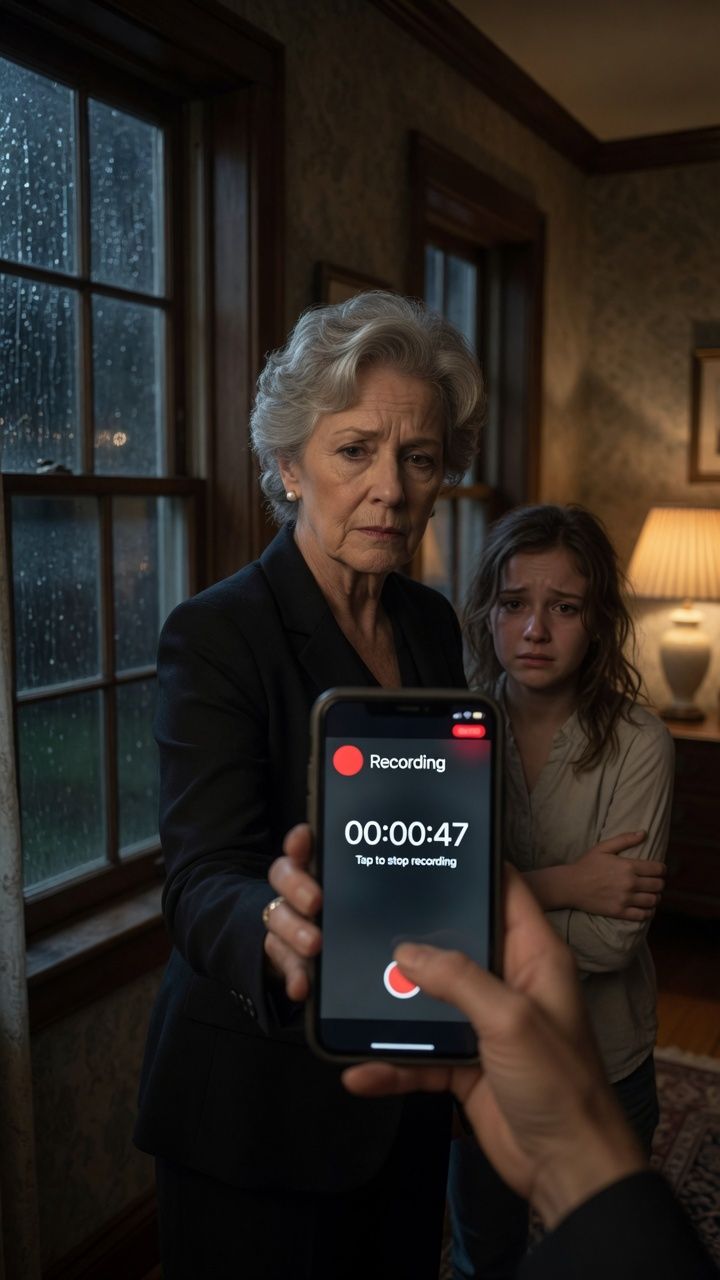
I glanced at the recording indicator glowing red on the table.
“Counselor,” I said, “choose your next words carefully.”
A pause. Then a short laugh.
“And who exactly are you supposed to be?”
Clara was watching me. I thought of the marks on her back, of three years I hadn’t known about, of Sophie asleep down the hall in her mother’s childhood bedroom.
“The person who just heard you threaten someone protected by an emergency court order,” I said. “A threat, I should mention, that is now documented, timestamped, and will be in front of a judge by nine o’clock tomorrow morning.”
Another pause. Longer this time.
“I know judges.”
“I’m certain you do.” I kept my voice even, almost gentle – the same tone I used when a defendant’s attorney had just made a significant error and hadn’t realized it yet. “But right now, I’d like you to think very carefully about what you’ve already said on this call, and whether you’d like to continue.”
The line was quiet for a moment.
Then I added, “I’ll be honest with you. I’m hoping you do.”
What He Did Next
He did continue.
For forty-seven seconds, he continued. Told me Clara was mentally unwell, that she’d fabricated injuries before, that he had documentation from her own therapist. Told me I was an old woman who didn’t understand how things actually worked. He used the word unstable four times. He mentioned his firm’s senior partner by first name, a federal appellate judge he’d clerked for, a deputy commissioner he played squash with on Thursdays.
I let him talk.
Clara had her hand pressed flat against the kitchen table, fingers spread, like she needed to feel something solid. I watched her face while he spoke. The particular way her jaw tightened when he said mentally unwell. The small flinch at fabricated.
Three years of that. Three years of being told that what she knew to be true wasn’t.
When he finally stopped, I said, “Thank you. I mean that genuinely.”
Silence.
“You’ve been very helpful tonight, Daniel. Get some sleep.”
I ended the call.
Clara looked at me. “What does that mean?”
“It means he just spent forty-seven seconds making threats and dropping names into a recorded line, while subject to an active protective order.” I set the phone down. “It means tomorrow morning I’m going to call two people I’ve known for fifteen years, and by Thursday this goes in front of a judge who will not be impressed by squash partners.”
She stared at me for a moment. Then something in her face did something I hadn’t seen in three years of Thanksgiving visits and birthday calls. Not relief exactly. More like a door she’d stopped believing in had opened a crack.
“You were on the bench,” she said. Not a question. She’d always known, in the abstract way children know things about their parents’ work. But abstract and real are different countries.
“Twenty-two years,” I said. “Sit down. I’ll make more tea.”
What I Hadn’t Let Myself Think About
I didn’t sleep that night.
Not because I was afraid, though there was some of that. Men who threaten like Daniel threatened don’t always stop at threatening. I’d seen enough of that work to know. I’d put the porch light on, checked the locks twice, and sent a message to a former colleague, a federal marshal named Dennis Pruitt, who owed me nothing but called back in twelve minutes anyway and said he’d drive past the house a few times before morning.
Good man. Terrible poker player. I’d beaten him at the courthouse Christmas party three years running.
But I wasn’t awake because of Daniel.
I was awake because of the timeline.
Three years. Clara and Daniel had married in October four years ago. I’d been at the wedding. I’d stood in the back of a church in Connecticut and watched my daughter walk toward a man in a good suit with a clean smile, and I’d thought, she seems happy. She seems genuinely happy.
I’m supposed to read people. It’s the whole job. You sit on that bench long enough and you develop a working theory of human behavior, a sense for when someone is performing versus when they’re present, when a story has gaps, when the chronology doesn’t hold.
I’d missed it entirely.
That was the thing I turned over in the dark. Not anger at Daniel, not yet, not the cold useful kind. Just the plain fact of what I hadn’t seen. The calls where Clara sounded tired and I’d thought, young children are exhausting. The Christmas visit two years ago when she’d flinched at a door slamming and I’d thought, she’s become jumpy in her old age. The way she’d stopped talking about her friends, her work, the small daily texture of her life, and I’d thought, we’ve grown a little distant, that happens.
It had happened right in front of me.
I got up at 4 a.m. and sat in the kitchen with the lights low and wrote down everything I remembered. Not for any legal purpose. Just because I needed to put it somewhere outside my own head.
The Thursday Hearing
The judge was Patricia Holloway, a woman I’d appeared before exactly once, years ago, in a completely different capacity. She didn’t know me well. She didn’t need to.
What she had was the recording, the hospital documentation, the forensic nurse’s report, the victim advocate’s notes, a three-year pattern Clara had given in a two-hour affidavit the previous morning, and Daniel’s own voice, timestamped, making explicit threats against a woman already under court protection.
Daniel’s attorney was a man named Gerald something. Young. Expensive suit. He had the look of someone who’d been told this was a manageable situation and was beginning to revise that assessment.
He argued Clara had fabricated the injuries. He argued the recording was taken out of context. He argued the emergency order had been obtained improperly and should be vacated.
Judge Holloway let him finish.
Then she looked at the documentation in front of her for a moment. Turned one page. Turned another.
“Counsel,” she said, “I’ve reviewed the forensic report. I’ve reviewed the timeline your client provided in his own call, which he made voluntarily, to a recorded line, while subject to an active order.” She set the papers down. “Is there anything else you’d like to add before I rule?”
Gerald said something about due process. He wasn’t wrong, technically. He just wasn’t helping himself.
Clara was sitting beside me. She had her hands folded in her lap and she was looking at the middle distance, the way people look when they’re trying to stay somewhere safe inside their own head. I put my hand over hers once, briefly, and then moved it away. She didn’t need comfort right then. She needed to watch.
I wanted her to watch.
What Daniel Understood, Finally
The order was extended. Custody arrangements were temporarily modified, pending a fuller hearing. Daniel’s attorney requested a continuance and got a shorter one than he’d asked for.
Daniel himself said nothing in the courtroom. He sat very still in a good suit and looked at the table in front of him. Once, near the end, he looked up and his eyes found Clara, then found me.
I’ve had a lot of people look at me from across a courtroom. Defendants, attorneys, witnesses running through their options. You learn to read what’s behind the look.
What was behind his was recalculation.
Not remorse. I want to be clear about that. Men like Daniel don’t arrive at remorse quickly, if at all. What he was doing was updating his model. He’d built his entire strategy around a specific version of Clara: isolated, frightened, without resources, without anyone in her corner who understood the machinery he’d been using against her.
That version wasn’t there anymore.
He was looking at the new version. And he was looking at me.
I held his gaze for a moment. Then I looked away, because he wasn’t worth the attention.
Where We Are Now
That was eight months ago.
Clara is living in the house where she grew up. Her old bedroom is too small for two people so we converted the back room, the one that used to be my husband’s study, into something that actually fits a four-year-old. Sophie has opinions about paint colors. Strong opinions. We went with yellow.
The full custody hearing is in six weeks. Clara has a good attorney, a woman named Rosalind Burke who’s been doing family law for twenty years and has the specific energy of someone who has stopped being surprised by anything but hasn’t stopped being angry about it. I like her.
Daniel’s firm quietly moved him to a different office, in a different city. I don’t know the details. I don’t need them.
Some nights Clara and I sit at the kitchen table after Sophie’s asleep and just talk. About nothing in particular. About her father, who’s been gone twelve years and would have had a lot of feelings about all of this. About the cases I worked that I can actually tell her about. About Sophie, who is funny in ways that seem too specific for a four-year-old.
Last week Sophie told me very seriously that yellow was the right choice for the room because it was “the color of being awake.”
I wrote that down too. But not in the other document.
In a better one.
—
If this story stayed with you, pass it along to someone who needs to read it.
For more tales of family dynamics and surprising revelations, you might enjoy reading about when I let my daughter and her husband think I was broke at my own dinner table.