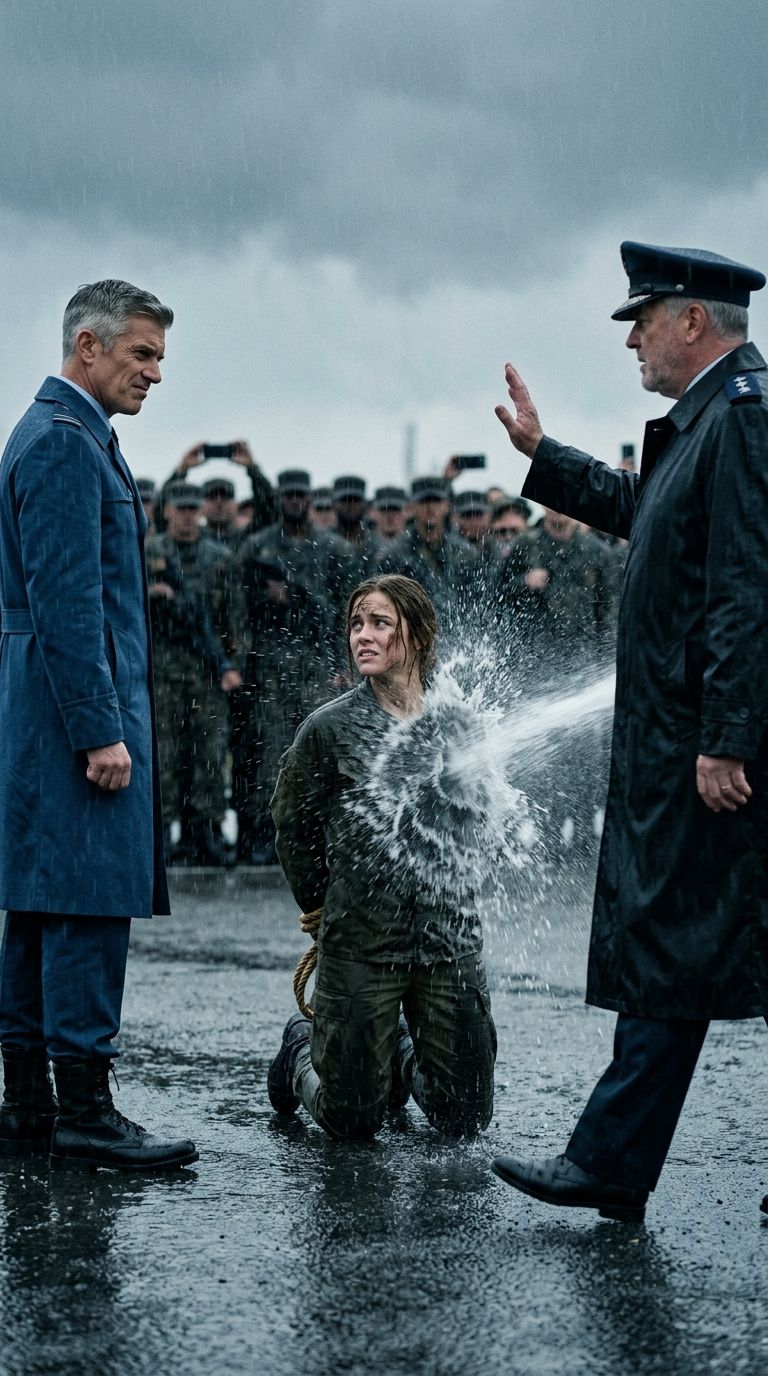

The first thing Grace felt was not the cold water.
It was the laughter.
It rose around her like smoke off wet pavement, cruel and careless, carried on the sharp morning wind that swept across the parade ground. She was on her knees before hundreds of soldiers, her uniform soaked through, her dark hair plastered across her face, her hands clenched behind her back so tightly her nails had broken the skin of her palms.
Then the fire hose found her again.
The freezing stream hit her chest like a battering ram, stealing the air from her lungs in a single instant. Water burst against her collarbone, flooded her mouth, stung her eyes, and poured in sheets down the front of her dark green uniform. Her body rocked backward from the force of it.
But she did not fall.
Somewhere in the back of her mind, beneath the cold and the noise and the pressure building in her chest, a thought surfaced with strange, almost embarrassing clarity: I’ve been colder than this. She didn’t know why that was the thing she held onto. But she held onto it.
That seemed to disappoint them.
“Look at her!” someone shouted.
Laughter rolled through the crowd. Several soldiers held up phones, recording every second with the casual enthusiasm of spectators at a sport. Some grinned like boys watching a street fight. Others turned away – not out of decency, but out of the quiet, shameful arithmetic of self-preservation.
At the center of it all stood Captain Adrian Pike.
He was a broad-shouldered man in his late forties, with a jaw cut from granite, gray threading his temples, and a smile that lived only on the surface of his face and went no deeper. His polished boots were planted in a puddle, but unlike Grace, his uniform was pressed and dry, not a crease out of place. He watched her the way a man watches something he has already decided to break.
“Well?” he called over the roar of the water. “Still got that attitude?”
Grace lowered her head. A single cough. Water dripped from her lashes onto the flooded ground. Her skin had gone the color of chalk, but her breathing remained measured and slow.
She did not answer.
The captain’s smile tightened at the edges.
Two weeks earlier, Grace had arrived at Fort Blackwood carrying one duffel bag, one sealed envelope, and a reputation that arrived before she did – passed between officers in lowered voices, in half-finished sentences that nobody seemed willing to complete. She was listed as a temporary transfer, a junior logistics recruit assigned to warehouse inventory. She barely spoke. She never complained. She completed every task ahead of schedule and then disappeared into the margins of the base like a shadow that had learned to move without a body.
That made people curious.
Her stillness made them uneasy.
But what truly unsettled them – what had, in the end, brought her to her knees in the rain before a crowd of several hundred – was something far simpler than any of them would admit.
Grace was not afraid of Captain Pike.
And on this base, in this world he had spent fifteen years constructing around himself, that was the one thing he could not forgive.
The Infraction
It had started on a Tuesday.
Small things always do.
Grace had been in the motor pool, signing off on a fuel discrepancy report, when she’d noticed something that didn’t add up. Three hundred liters of diesel logged as transferred to vehicle units that, according to her own inventory sheets, hadn’t been operational in six weeks. She’d flagged it the way she flagged everything: quietly, in writing, through the proper channel, with a copy filed under her own name.
The proper channel, it turned out, ran directly through Captain Pike’s office.
By Thursday, she’d been reassigned from logistics to grounds maintenance. By Friday, her bunk had been moved from the east barracks to a converted storage room near the motor pool that smelled like rubber and old paint. By Saturday morning, she was standing in front of Pike’s desk while he explained, with great patience and a voice like gravel on sheet metal, that junior transfers who couldn’t read the room had a way of finding their time at Fort Blackwood cut very short.
Grace had looked at the wall behind his head and said nothing.
He’d waited for her to flinch.
She hadn’t.
That was Friday. This was Monday. And now she was on her knees in the rain with a fire hose pointed at her sternum while two hundred and forty soldiers watched and the laughter kept coming in waves.
The pretext had been a uniform infraction. A button. Specifically, the second button on her left breast pocket, which Pike had declared improperly fastened during morning inspection. The punishment – corrective physical conditioning, he’d called it, his voice smooth and official – had been announced in front of the full company. The hose had appeared two minutes later, carried by a specialist named Rourke who wouldn’t meet Grace’s eyes.
Nobody had said a word.
That was the part Grace kept turning over. Not the cold. Not the pain in her knees where they pressed against the gravel. The silence from two hundred and forty people who all knew exactly what this was.
What She Carried
Grace Navarro was thirty-one years old.
She’d grown up in Laredo, Texas, in a house with a roof that leaked when it rained and a mother who worked doubles at a diner on Route 83 and a brother named Eddie who’d joined the Army at seventeen and come home at nineteen in a flag-draped box. She’d enlisted at twenty-two, not out of patriotism exactly, and not out of grief exactly, but out of something that lived between those two things and didn’t have a clean name.
She’d spent four years in signals intelligence before a reassignment nobody would fully explain had moved her into a unit whose name didn’t appear on any organizational chart she’d ever seen. She’d spent three years there. She couldn’t talk about what she’d done. Not because of the rules, though there were rules. But because most of it still lived in her body in ways that language couldn’t reach.
The sealed envelope she’d arrived with at Fort Blackwood: she’d been told to hand it to the base commander upon arrival.
The base commander had been away at a conference in Washington. His deputy, a Lieutenant Colonel named Marsh, had accepted it, glanced at the exterior, and then set it on his desk with the particular careful disinterest of a man who’d decided not to know something.
It was still sitting there, as far as Grace knew.
Unopened.
The hose hit her again. Her shoulder torqued sideways. She brought it back.
I’ve been colder than this.
The Crowd Shifts
It was Private Denise Cho who noticed the vehicles first.
She was standing near the back of the crowd, nineteen years old, four months out of basic training, still at the stage where she watched everything and said almost nothing. She’d been watching Grace’s face, which hadn’t changed expression once in the twelve minutes this had been going on, and she’d been thinking about what that meant, when she saw the two black SUVs roll through the main gate.
They moved slowly. No lights, no sirens. But they didn’t stop at the security checkpoint the way every other vehicle did. The gate guard just stepped back and let them through.
Cho nudged the soldier next to her. He didn’t look. She looked back at Grace.
Grace hadn’t seen them. Her eyes were on the ground.
The SUVs parked at the edge of the parade ground, engines running. Nobody got out for a moment. Then the passenger door of the lead vehicle opened, and a man stepped onto the wet gravel in a uniform so decorated that Cho had to actually count the stars on his shoulder to make sure she was reading it right.
Four of them.
Four stars.
She’d never seen four stars in person. She wasn’t certain anyone on this base had.
The General was a compact man, maybe sixty, with close-cropped white hair and a face that had been outdoors for most of its life. He moved without hurry across the parade ground. The aide who’d climbed out behind him had to half-jog to keep pace.
Someone near the front of the crowd saw him first. Then the next person. Then the next.
The laughter stopped.
It didn’t fade. It just stopped, the way a power line goes dead.
The Name
Captain Pike had not yet turned around.
He was watching Grace with his arms crossed, waiting for the hose to run its next cycle, when the silence registered. He felt it before he understood it. The crowd’s energy had changed, gone from loose and loud to something rigid and airless, and Pike was good enough at reading rooms to know that meant something had entered the room.
He turned.
He saw the four stars.
Something happened to his face. It wasn’t fear, exactly. More like a man who has been playing cards for hours suddenly realizing the other players have been watching his reflection in the window the whole time.
The General stopped six feet from Pike. He didn’t look at Pike.
He looked at Grace.
She was still on her knees. Her uniform was soaked black. Her hands were still behind her back. She’d raised her head slightly when the hose stopped, and now she was looking at the General with an expression that was almost – not quite, but almost – relief.
“Captain,” the General said.
His voice was not loud. It carried anyway.
“Sir.” Pike straightened. His hand started toward a salute.
“Don’t.” The General said it without looking at him. Still looking at Grace. “Somebody get her up.”
Rourke, the specialist with the hose, dropped it immediately. Two soldiers from the front row moved forward and helped Grace to her feet. Her knees didn’t buckle, but her left hand went to the shoulder of the nearest soldier for one second, then dropped.
The General took two steps toward her.
“Major Navarro,” he said.
The word went through the crowd like current.
Major.
Not recruit. Not junior transfer. Not the woman kneeling in the rain while they laughed and filmed it on their phones.
Major Grace Navarro.
The General reached out and straightened the soaked collar of her uniform. It was a small gesture, almost paternal, and it was the most devastating thing anyone on that parade ground had ever watched an officer do.
“I apologize for the delay,” he said, quietly enough that only the front rows could hear. “The envelope should have reached me on Thursday.”
Grace’s jaw moved once. “It’s fine, sir.”
“It is not fine.” He said it simply, without heat. Then he turned, and for the first time looked directly at Captain Pike.
Pike’s polished boots were still planted in the puddle.
“Captain.” The General’s aide had a folder out, already open. “You’ll want to come with us.”
What Happened After
The soldiers didn’t know what to do with themselves.
They stood in the rain for a moment after the General and his aide walked Pike toward the lead SUV, and then they began to drift apart the way crowds do when the thing that held them together is suddenly gone. Some of them looked at their phones. A few of them, Cho noticed, quietly deleted what they’d recorded.
Grace was given a dry jacket by the base medic, a tired-looking man named Garrett who checked her hands without being asked and didn’t comment on the broken skin of her palms. She sat on the rear bumper of the second SUV and drank coffee from a thermos someone had produced from somewhere. Her hair was still wet. She didn’t seem to notice.
Cho stood at a distance for a while, not sure why she hadn’t left with everyone else.
Then Grace looked up and saw her standing there.
“You were watching my face,” Grace said. “The whole time.”
Cho didn’t deny it. “Yes, ma’am.”
Grace looked at her for a moment. “What were you thinking?”
Cho considered lying. Decided against it. “I was thinking you’d been through worse.”
Something shifted in Grace’s expression. Not quite a smile. The shape of one, maybe.
“Yeah,” she said. “I have.”
She looked back down at the coffee.
Cho turned and walked back across the parade ground, her boots loud on the wet gravel, the rain still coming down thin and cold.
Behind her, the lead SUV’s door closed.
—
If this one stayed with you, pass it on to someone who needs to read it today.
For more intriguing reads, discover Why Your Stool Sometimes Floats – and When It Deserves Attention, or consider how ONLY 1 Potato in the Car Will Save Your Life! Everyone Is Silent About This!. You might also be curious about What Would Happen If You Chewed ONE Clove Daily.