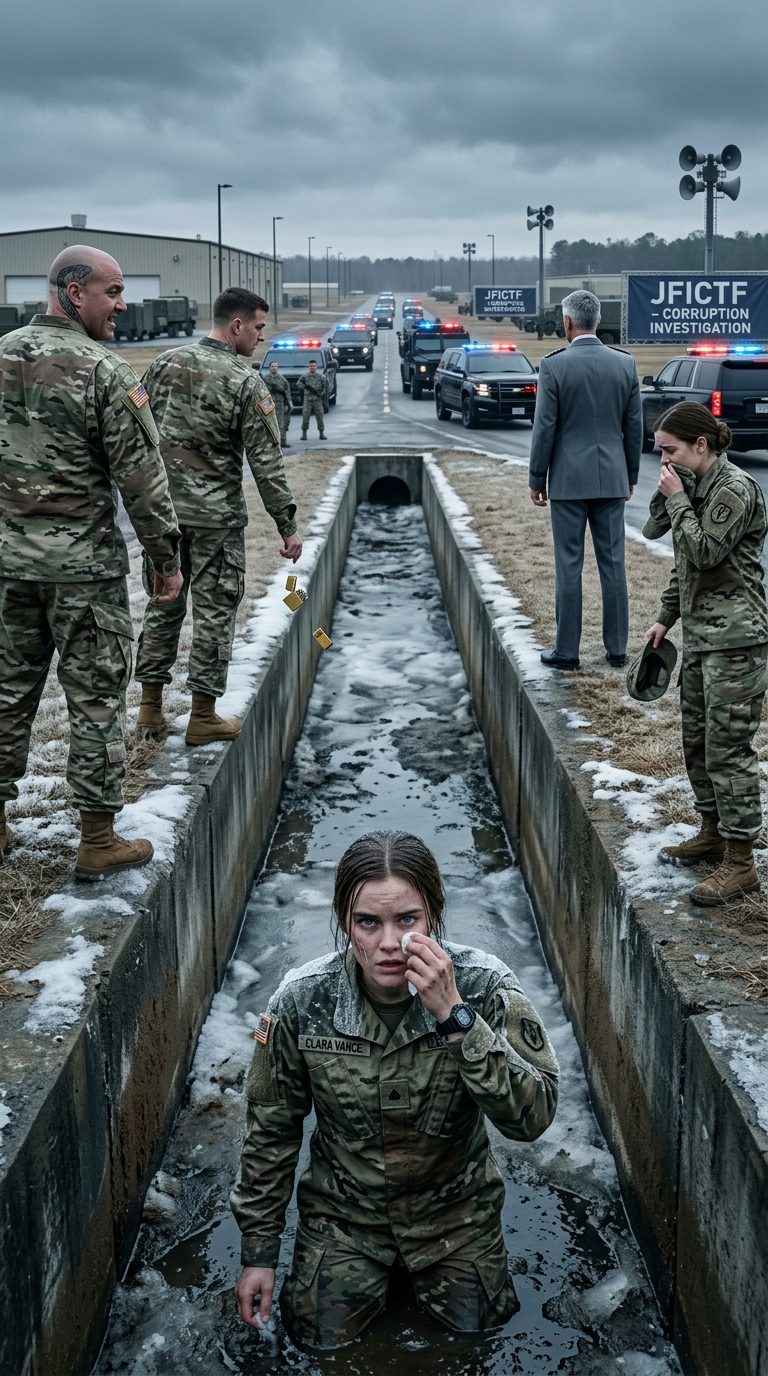

They threw her into an icy drainage ditch to crush her spirit, laughing while she gave them exactly thirty seconds to apologize. Then the base sirens screamed, announcing her father’s federal investigation team at the front gates.
The Weight of the Mud
The water in the drainage ditch tasted of diesel, rusted metal, and the sharp red clay of North Carolina.
When Specialist Clara Vance struck the bottom, the impact drove every bit of air from her lungs. A bright, burning pain tore through her shoulder where it smashed against the concrete culvert, but she refused to make a sound. For one second, she stayed there, staring up at the dull gray sky, feeling the freezing water creep through the seams of her Operational Camouflage Pattern uniform until it soaked her completely.
Thirty seconds, she thought. Give them thirty seconds.
Above her, laughter rang hollow, bouncing off the concrete walls.
“Look at that,” Specialist Brody Jax sneered, spitting a dark stream of tobacco juice onto the grass only inches from Clara’s face. “The proud little Vance finally landed where she belongs. Down in the gutter with the rats.”
Jax was huge, shaped like a slab of brick, with a faded, badly inked tattoo of a curled pit viper crawling up his right forearm. He reeked of old energy drinks and sweat, his face always bent into the easy grin of a bully who had never once been hit back. He was the kind of soldier who only felt powerful when someone else was forced to feel small.
Beside him stood Staff Sergeant Marcus Miller, the squad leader. Miller wasn’t laughing. He simply stood with his arms folded across his chest, a wintergreen dip tucked neatly inside his lower lip.
Miller was a career soldier whose ambition had curdled years earlier after being passed over for promotion twice. He carried a cruel, magnetic control over the weaker men in the platoon. In his pocket, he always kept a flawless gold-plated Zippo lighter, a trophy stolen from a dead private’s footlocker during his last deployment. A quiet symbol of how completely empty his conscience was.
“You did this to yourself, Vance,” Miller said, his voice flat and stripped of warmth. “You wanted to play hero. You wanted to run your mouth to the logistics clerk about inventory problems. In my squad, we cover each other. We don’t make space for snitches.”
A few steps behind them stood Private First Class Sarah “Pip” Pippin. She held Clara’s fallen patrol cap in her shaking hands. Pip was quiet, painfully thin, twenty-one years old, and always chewing the cuffs of her uniform sleeves until the threads came loose. She didn’t want to be there. She hated it. But she was terrified of Miller. Back home in Ohio, she had a younger brother with Down syndrome, and every cent of her paycheck went to her mother for his therapy. She couldn’t afford to lose her career, so she said nothing, becoming a silent witness to the rot.
Clara slowly pushed herself onto her elbows. The frozen mud clung to her boots, trying to drag her back down. Her left cheek burned, scraped raw against the gravel at the bottom of the ditch.
She looked up at all three of them. Her face gave nothing away.
For six months, she had survived their quiet punishments. Extra guard shifts. Missing mail. Damaged gear. Whispers that followed her into the chow hall. They believed she was weak because she never complained. They thought she was easy prey because she never hit back.
But Clara hadn’t been hiding from them. She had been hiding from her own name.
Under her uniform shirt, resting beside her standard-issue dog tags, hung a faded silver ring on a thin chain. It had belonged to her mother, who had died of cancer five years earlier while Clara’s father was deployed somewhere on the other side of the world. Clara had joined the Army to escape the suffocating shadow of her family legacy, desperate to prove she could stand on her own merit, without a powerful last name shielding her. She had used her mother’s maiden name on her initial entry paperwork. She had wanted to know if she was enough on her own.
Now, staring up from the mud into Marcus Miller’s smug face, she had her answer.
She was strong enough to survive the mud.
These men were not strong enough to survive what was coming for them.
She slowly reached toward her left wrist and wiped a smear of thick mud from the face of her rugged black Casio. The digital numbers blinked back at her. Exactly 1459 hours.
He said he’d be at the gates by fifteen hundred.
“Miller,” Clara said, her voice dropping into something cold and crystal-clear that cut straight through the winter wind. “Jax. You have exactly thirty seconds to apologize to me. And thirty seconds to pull me out of this ditch.”
Jax burst into a loud, barking laugh and slapped his knee.
“Oh, man! You hear that, Sergeant? She’s giving orders now! What are you gonna do, Vance? Write a little letter to the commander? Call your mommy?”
Miller’s eyes narrowed. He didn’t laugh. Something in her voice, the total absence of fear, the eerie stillness of it, made the hair on the back of his neck rise. But his arrogance smothered the warning quickly enough. He stepped to the edge of the ditch and stared down at her like she was something he’d scraped off his boot.
“You don’t give me terms, Specialist,” Miller hissed. “You’re a body in a uniform. You’ve got ten seconds before I decide to leave you down there until morning formation.”
Clara kept her eyes on her watch.
Twenty seconds.
She thought of her father. General Raymond Vance. A man whose name moved through the halls of the Pentagon with both terror and deep respect. Head of the Joint Federal Investigation and Corruption Task Force. A merciless watchdog who had spent his career destroying corrupt officers, dismantling black-market supply networks, and enforcing the law down to its sharpest edge. He had been a cold and distant father, a man who placed duty above everything else, but his integrity was an unmovable mountain.
She had begged him not to interfere when she enlisted. She had demanded a regular line unit. She had wanted to know if she was strong enough alone.
Ten seconds.
Pip stepped forward, her voice tiny and frantic. “Sergeant, maybe we should just help her up. Someone could see us out here. If the First Sergeant catches us – “
“Shut up, Pippin,” Jax snapped, without even turning to look at her.
Five seconds.
Clara let her arm drop to her side. She looked up at Miller, and a faint, razor-thin smile touched the corners of her mouth. Not anger. Not satisfaction.
Finality.
“Time’s up,” she said.
What the Sirens Knew
Before Jax could throw out another insult, the air was torn open.
A piercing, deafening scream split the quiet afternoon. Not the normal rhythmic chirp of a routine siren. This was the nonstop, rising-and-falling wail of a Tactical Level-IV Emergency Lockdown, the kind that rattled windows and vibrated deep inside your chest.
Jax froze. His laughter died instantly in his throat. Miller spun around, his hand dropping instinctively toward his empty holster. Pip let Clara’s patrol cap fall into the mud, both hands flying up to cover her ears as the noise blasted from the giant voice towers scattered across the base.
Then came the rumble.
It started as a low vibration beneath their boots, a heavy, synchronized pounding rolling toward them like a thunderstorm. Down the long gravel access road from the main security gates, a convoy appeared.
These were not standard green Army trucks.
Four midnight-black armored SUVs led the column, blue and red lights strobing from deep inside their grilles. Behind them came three heavy tactical vehicles packed with armed Military Police in federal vests, weapons held in disciplined low-ready positions.
The convoy didn’t slow for the speed bumps. It tore through the motor pool gates, tires screaming against the asphalt, throwing up huge clouds of red dust and gravel.
“What the hell is that?” Jax muttered, stepping back from the ditch, his face draining. “Is that CID? Why are they – why are they coming here?”
Miller said nothing. His eyes were wide and locked on the lead SUV.
The convoy swept into a perfect high-speed tactical containment formation, surrounding the motor pool and sealing every exit. Soldiers from nearby platoons dropped their tools and wrenches, staring in stunned silence as federal agents poured out and formed a hard perimeter.
The door of the lead black SUV swung open.
A man stepped into the cold wind.
He was not wearing camouflage. He wore a crisp, tailored dark gray suit under a heavy black overcoat. On his shoulders, even from a distance, four silver stars caught the pale winter light. His hair was cropped short, silver at the temples. His face looked carved from granite.
General Raymond Vance surveyed the motor pool with the slow, terrifying precision of a man who had already decided how this would end. Behind him, twenty federal investigators in windbreakers marked JFICTF began unloading heavy plastic crates of evidence warrants.
The base speakers crackled.
“All personnel, freeze where you are.” The base commander’s voice came through strained and breathless. “Secure all electronics. This installation is under immediate Federal Administrative Seizure by order of the Department of Defense. Repeat – do not move.”
Miller’s hands began to shake.
The gold-plated Zippo in his pocket felt like a block of ice.
He looked down into the drainage ditch.
Clara was rising to her feet in the freezing mud. Slowly. Deliberately. She wiped the dirty water from her face with the back of her hand, her eyes cold and steady and blindingly clear as they found his.
“Thirty seconds,” she said softly. “I told you.”
The Thing About Stolen Lighters
Miller had been running the scheme for eleven months.
It wasn’t complicated. That was the thing nobody understood about corruption at the unit level. It was never complicated. It was just relentless, grinding, small-scale theft dressed up in paperwork. Fuel allotments diverted and resold through a civilian contractor out of Fayetteville. Maintenance parts logged as destroyed, then pulled from the scrap yard and fenced through the same contractor’s brother-in-law. Eight soldiers involved. Three NCOs. One warrant officer who kept his head down and signed whatever Miller put in front of him.
Clara had found the first thread six months ago, two weeks after she arrived at the unit.
She hadn’t been looking for it. She’d been assigned to logistics support during a motor pool inventory and noticed a discrepancy in the fuel consumption records so obvious it made her stomach hurt. Forty-seven gallons of JP-8 logged as burned during a training exercise that, according to the vehicle maintenance logs, had never actually run the engines. She’d flagged it quietly to the logistics clerk, a quiet, heavyset specialist named Donna Garza who had been in the unit four years and knew exactly what she was looking at.
Donna had gone pale. She’d asked Clara to forget she’d seen it. Clara had said she’d think about it.
She’d spent one night thinking.
Then she’d written a detailed memo and mailed it, in a plain white envelope with no return address, to the Pentagon inspector general’s office. Not to her chain of command. Not to CID on post. Directly to her father’s task force, though she hadn’t told them who she was. She’d signed it with a number, a case reference she’d memorized from a DOD whistleblower guidance document she’d read three times before enlisting.
Her father’s office had gotten the memo on a Tuesday morning in October.
By Wednesday, they’d cross-referenced it with two other anonymous complaints from different installations that pointed at the same contractor network.
By the following Monday, Raymond Vance had a federal warrant package and a convoy route.
He hadn’t known it was his daughter who’d started it. Not until two weeks ago, when a junior investigator running background on unit personnel had flagged a name discrepancy in Clara’s service record, maiden name versus legal name, and brought it to the General’s desk.
Raymond Vance had sat alone in his office for a long time after that.
Then he’d moved up the raid date by three weeks.
What Pip Did Next
The agents moved fast and without noise, the way people do when they’ve done a thing many times and stopped needing to talk about it.
Miller was still standing at the edge of the ditch when two of them reached him. He didn’t run. He didn’t argue. He just stood there while they took the gold Zippo out of his pocket and dropped it into a clear evidence bag, and something in his face went slack and small in a way that had nothing to do with the handcuffs.
Jax tried to talk his way out of it. He always would. He was explaining, loudly and with great confidence, that he didn’t know anything about any contractor, that he was just a specialist doing his job, that somebody must have made a mistake, that he had rights, that he wanted a lawyer, that – the agent processing him put a hand on his shoulder and Jax went quiet mid-sentence like a radio losing its signal.
Pip was standing fifteen feet away, still holding her own elbows, watching all of it.
One of the JFICTF investigators, a woman with a short gray braid and a badge clipped to her vest, walked directly to her. Not to arrest her. To hand her a card.
“You’re not on our list,” the woman said. “But if you have information you want to give voluntarily, now is the right time. Before this goes to a grand jury and the window closes.”
Pip looked at the card for a long time.
She thought about her brother. About her mother’s voice on the phone every Sunday. About the way she’d stood there with Clara’s patrol cap in her hands and said nothing, done nothing, for six months while the mud built up.
She took the card.
She talked for two hours.
What the General Said
Clara was sitting on the tailgate of an MP vehicle, a foil emergency blanket around her shoulders, when her father walked over.
He stopped about four feet away. He looked at the scrape on her cheek. He looked at the mud on her uniform, the diesel smell coming off her wet clothes, the way she was holding herself very still against the shaking she wouldn’t let anyone see.
He didn’t say anything for a moment.
“I moved the date up,” he said finally. His voice was the same as always, flat and careful. But something around his eyes was different. Tight.
“I know,” Clara said.
“I wasn’t going to. The case needed another three weeks to be airtight.”
“Is it still airtight?”
He looked at her the way he used to look at maps. Checking every edge. “Tight enough.”
She nodded. Looked out at the motor pool. Two agents were photographing the drainage ditch.
“I didn’t want you to know it was me,” she said.
“I know you didn’t.”
“I needed to know I could do it without the name.”
He was quiet for a long time. Long enough that a junior agent nearby pretended to be very interested in his clipboard.
“You did,” Raymond Vance said.
That was all. He didn’t touch her shoulder. He didn’t hug her. He was not built for those things, and she had stopped needing them from him a long time ago. But he stood there beside her on the tailgate for another ten minutes before his radio called him back, and he didn’t move until it called him twice.
The Mud Dries
The formal charges came down six weeks later. Miller: eleven counts, including conspiracy to commit fraud against the government, theft of government property, and conduct unbecoming. The warrant officer flipped immediately and took a plea. Jax got four counts. The contractor out of Fayetteville was indicted federally the same morning.
Donna Garza, the logistics clerk who had gone pale and asked Clara to forget it, received a letter of commendation for her cooperation during the investigation. She cried when she got it. She told Clara later she’d spent four years being afraid of the wrong thing.
Pip finished her enlistment, got out, used the GI Bill, and became a social worker in Columbus. She sent Clara a message the day she got her degree. One sentence.
I stopped being quiet.
Clara made sergeant eight months after the raid. She was twenty-three. At her promotion ceremony, she wore her mother’s ring on the chain under her dress uniform, against her chest, where it had always been.
Raymond Vance sent flowers. He didn’t come. He was deployed.
She hadn’t expected him to come.
She stood at attention while her first sergeant pinned the new rank to her collar, and she didn’t think about Miller or Jax or the ditch or the diesel water in her lungs.
She thought about the thirty seconds.
How she’d known, going in, exactly how long it would take.
How she’d counted every one.
—
If this one hit somewhere real, pass it along to someone who needs it.
For another story of unexpected twists and turns, check out They Forced Her to Kneel in the Rain – Then the General Said Her Name.