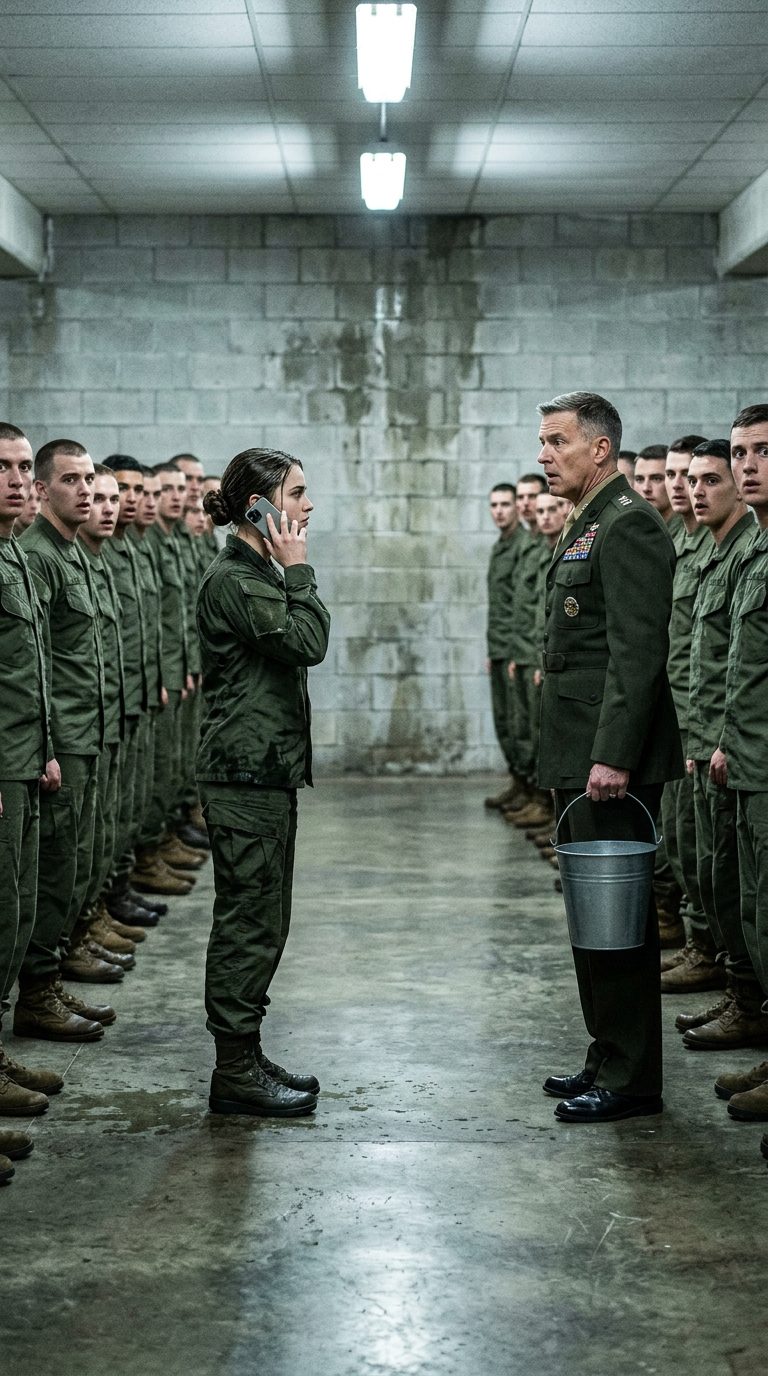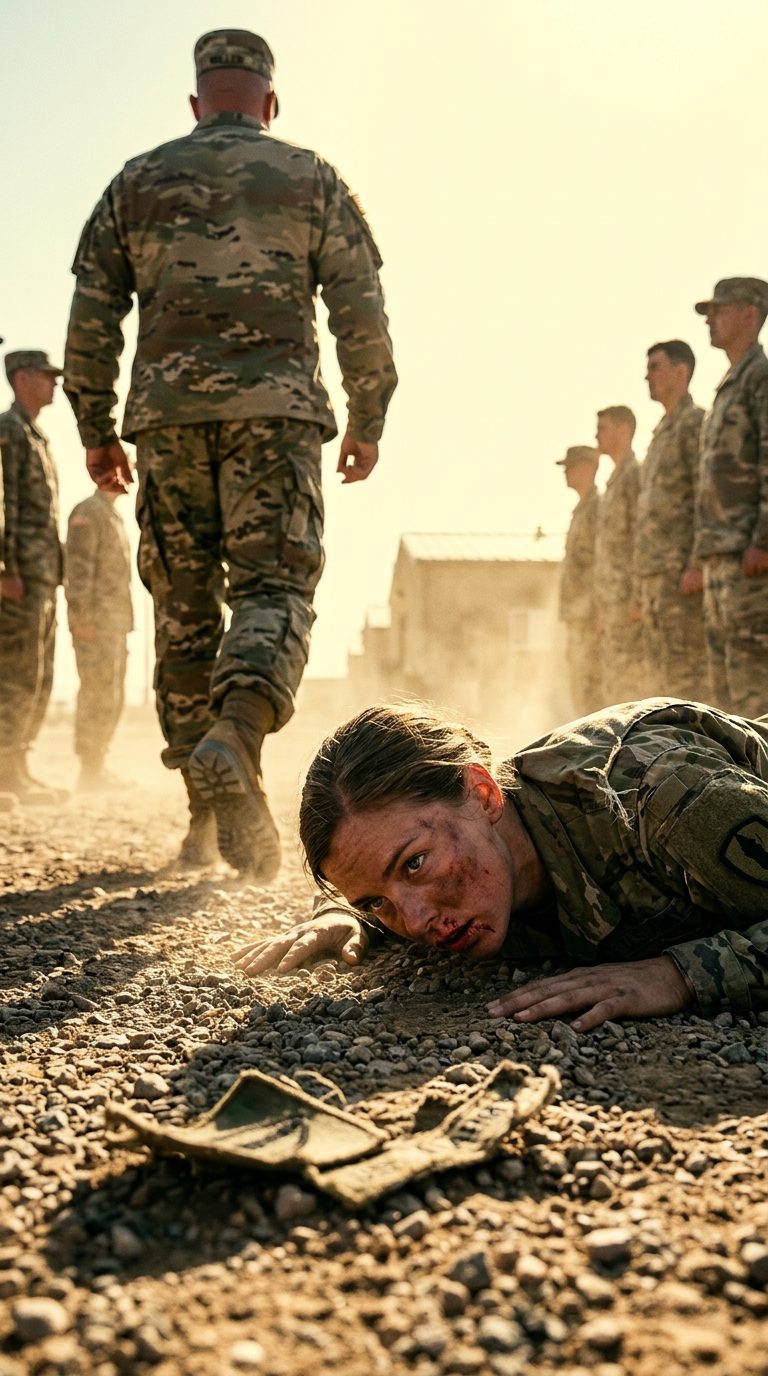

The gravel shredded through my uniform as Lieutenant Miller hauled me across the drill yard by my collar.
He thought I was just another female private he could grind down for sport.
He had no idea he’d just ended his own career.
It was the kind of midday heat at Fort Moore that made you feel like your lungs were pulling in wet sand. My cheek scraped along the dirt, stones opening up the skin just below my eye. Miller’s fist stayed knotted in the back of my collar, dragging me like something he’d scraped off his boot.
“You think you’re special, Private?” The words came out low and close, his breath hot against my neck.
The recruits stood in formation maybe thirty feet away. Nobody moved. Nobody breathed too loud. They’d watched him do this to people for three months, but I got the sense today he wanted to leave a mark that lasted.
He grabbed the unit patch off my shoulder and tore it free, the fabric splitting down past the seam. He threw it into the mud without looking at it.
“You don’t deserve this uniform. You sure as hell don’t belong in my army.”
I kept my face down and my mouth shut. My hands weren’t shaking from fear. My whole body was running hot, heart going fast, everything sharp and clear the way it gets when something you’ve been waiting for finally arrives.
Miller had no idea the whole thing was being logged. He didn’t know the rank on my sleeve was a cover. He didn’t know I reported directly to the General.
He turned and walked away, already done with me in his mind.
I got up slowly, brushed the gravel off my palms, and watched him go.
His clock had already started.
How I Got There
I want to back up six months, because the dragging didn’t come out of nowhere.
My name is Carla Reyes. I came up through intelligence work, spent four years doing embedded assessment in field units before anybody offered me the job that put me at Fort Moore. The official title was something bureaucratic and meaningless. The actual job was simple: go in as a low-ranking recruit, document command culture, and report back to Brigadier General Dennis Hauck, who had been getting complaints about 2nd Battalion’s training cadre for the better part of two years.
Complaints from female recruits, mostly. Some male. A pattern of physical intimidation, targeted harassment, documentation falsified to bury incident reports. The kind of thing that doesn’t survive a formal investigation because by the time investigators show up, the paperwork has been sanitized and the witnesses have been quietly reassigned.
Hauck needed someone inside the machine before the machine knew it was being watched.
So they gave me a name, a service record, a uniform, and a bunk in the barracks at Fort Moore. Private Carla Mendez, age twenty-four, from Tucson. Struggled in her first enlistment, came back for a second shot. Quiet. Keeps to herself. Exactly the kind of recruit Miller liked.
I’d been on post for eleven days when he first noticed me.
What Miller Was
He wasn’t stupid. That was the thing people got wrong about men like him. They assume the bully is a blunt instrument, all muscle and no brain. Miller had a brain. He used it specifically to identify which recruits could be pushed without consequence, and he was good at the calculation.
He’d been at Fort Moore for six years. Made Lieutenant at thirty-one, which is not remarkable. But he’d stayed a Lieutenant, which told you something. Either he had no ambition or someone above him had quietly put a ceiling on his advancement and never told him why. I found out later it was the second thing. Two previous commanding officers had flagged him in informal channels. Nothing in his official file, because nothing ever made it there. But the word had moved through certain conversations: Miller is effective, Miller gets results, Miller has a problem with women in uniform.
He was forty-three when I met him. Thick through the shoulders, short haircut going gray at the temples. He had a way of standing very still when he talked to you, like he wanted you to feel the weight of his attention.
The first time he singled me out, it was a drill formation at 0600. He walked the line and stopped in front of me for about fifteen seconds without saying anything. Just looked. Then he moved on.
That was the first entry in my log.
The Long Game
The thing about undercover work inside a military unit is you can’t move fast. You can’t react the way you want to react. You take the hit, you write it down, you wait.
Miller escalated slowly, the way experienced abusers do. Week two, he started riding me in PT. Singling me out for extra sets, dressing me down in front of the group for form issues that weren’t actually form issues. Week three, he started with the comments. Nothing overtly sexual, nothing that would trip a wire on its own. Just the steady low-grade stuff. You sure you want to be here, Private? Some people aren’t built for this. The kind of language that’s hard to quote out of context because each individual sentence sounds almost reasonable.
I wrote it all down. Time, location, exact wording, witnesses present.
My recorder was a piece of equipment the size of a shirt button, sewn into the collar of my BDU jacket. Audio and a timestamp. I had three of them, rotating, because if one got damaged I needed backup. I transferred files every four days to a secure drop that Hauck’s office monitored.
The recruits around me were eighteen, nineteen years old. Some of them had been at Fort Moore longer than I had, and they’d already learned the geometry of survival around Miller. You stayed in the middle of the formation. You didn’t make eye contact. You didn’t volunteer for anything that would make you visible. A kid named Doug Pruitt, eighteen years old, barely 150 pounds, had developed a specific way of making himself look smaller in Miller’s presence. I watched him do it every morning and it made me feel something I didn’t have a word for. Not pity exactly. Something more like rage that had nowhere to go yet.
I kept writing.
The Day He Put His Hands On Me
The incident on the drill yard wasn’t the first physical contact. Three weeks before the dragging, he’d grabbed my arm during a weapons cleaning exercise and yanked me toward a workbench hard enough to leave bruising. I documented it. Got it on audio. Wrote up the witnesses.
But the drill yard was different.
I still don’t know what set him off that morning. I’d done nothing outside the ordinary. Ran the course, kept my time, fell into formation. My best theory is that he’d had a bad night and I happened to be standing in the wrong place, or maybe the right place, depending on how you look at it.
He came across the yard fast. I clocked him coming and I made a decision in about two seconds: don’t step back, don’t give ground, but don’t escalate either. Just hold still and let it happen and get every word of it on tape.
His hand went into my collar from behind. Then the ground came up.
The gravel was sharper than it looks from standing height. My cheek hit first and I felt the skin open up immediately, that specific sting that tells you it’s more than a scrape. He dragged me maybe fifteen feet before he stopped, and I kept my hands loose at my sides the whole time because I needed the audio to be clean. No struggle sounds. Just his voice.
“You don’t deserve this uniform. You sure as hell don’t belong in my army.”
He threw the patch.
He walked away.
I got up and touched the side of my face. My fingers came back red.
Behind me, in formation, nobody made a sound. I didn’t turn around to look at them because I didn’t want to see Doug Pruitt making himself small again. I wasn’t sure I could keep my face neutral if I did.
The Report
I filed the full documentation package forty-eight hours later. Audio, written log, medical record from the post clinic where I’d had the cheek looked at, and signed statements from three recruits who’d agreed to go on record. Getting those statements was the part nobody talks about. Those kids were terrified. Pruitt sat across from me in the supply room we’d borrowed for twenty minutes and I watched him weigh the cost of telling the truth against everything Miller had taught him about what happened to people who talked.
He signed.
The other two were a woman named Gretchen Farr and a guy named Kevin Sloan who’d been at Fort Moore for five months and had his own incident he’d never reported. He told me about it in about four sentences, very flat, like he’d compressed it down to something he could carry. He signed too.
I sent the package up to Hauck’s office on a Thursday.
The following Monday, Miller reported for duty at 0530 like always.
By 0800 he was in a room with two JAG officers and a CID agent.
I wasn’t there for that part. My job was done.
What Came After
I heard later, through channels, that Miller sat in that room for three hours before he understood that the private he’d dragged across the drill yard had put him there. I heard he asked twice about my service record, trying to figure out how someone like me had access to the people who were now sitting across from him with a folder full of his own voice.
He was separated from service eight months after that Thursday. Not quietly. It went through formal proceedings, which meant it went on record, which meant the two commanding officers who’d flagged him informally finally had something to point to.
I was back in a different office by then, different post, different cover. But Hauck sent me a note. Two sentences. Good work. The recruits from that cohort are doing well.
I thought about Pruitt when I read that. About the way he’d learned to make himself smaller. About whether that reflex ever goes away once you’ve built it.
I kept the note.
The patch Miller threw in the mud, I kept that too. It’s sitting in a box in my apartment in a zip-lock bag, still dirty.
I haven’t washed it.
—
If this one hit you somewhere, pass it along to someone who’d get it.
For more stories of grit and defiance in uniform, you’ll want to read about the private who dropped a bullet in formation, or the soldier who didn’t salute and then unzipped her jacket. And for a truly moving tale, check out the woman who walked onto the firing line with her dead husband’s rifle.