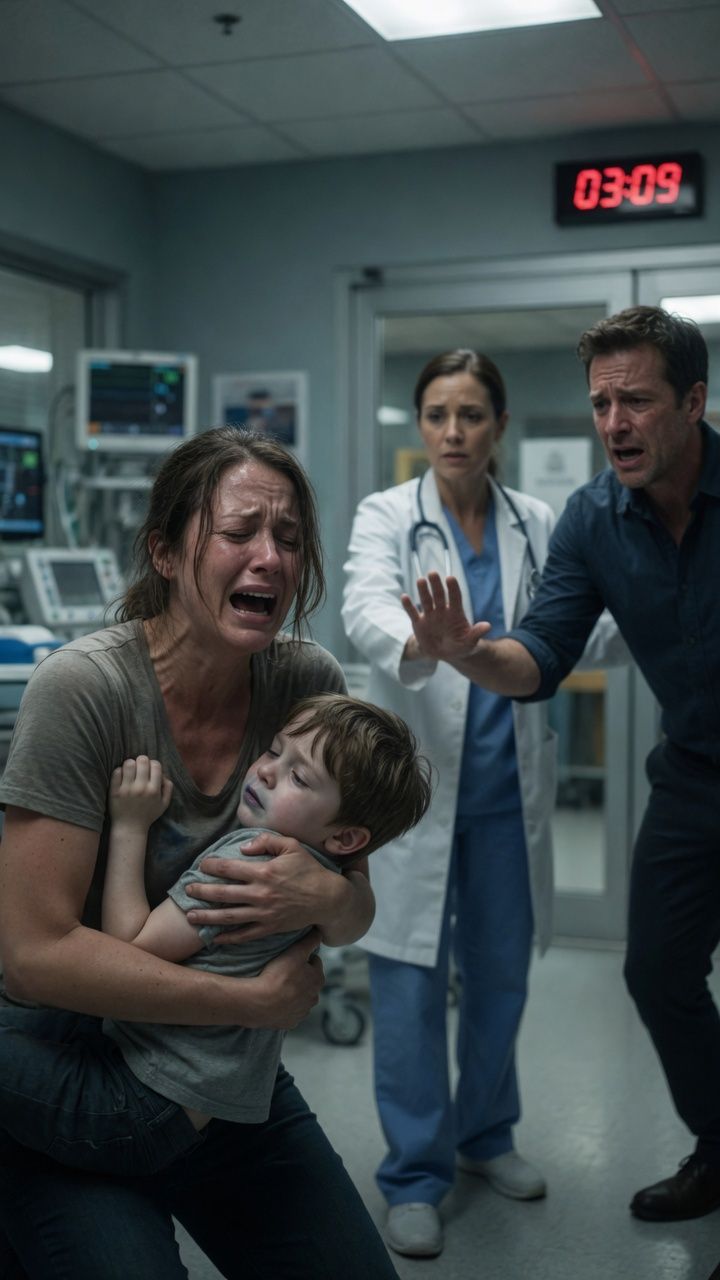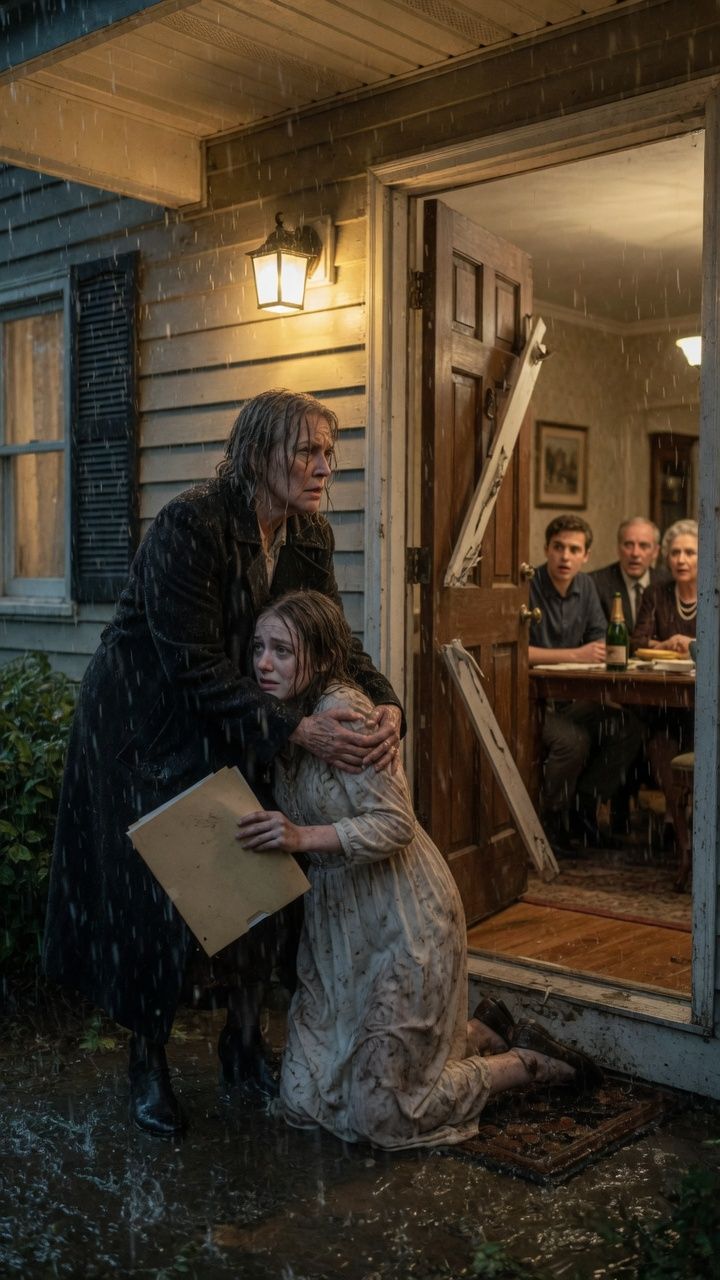

I found my daughter on her knees in the rain.
She was kneeling beneath the yellow porch light like a criminal awaiting sentence, her pale dress streaked with mud, her lips blue, both hands trembling around a soaked folder. From inside the house came the sound of laughter and the bright, careless clink of champagne glasses.
I dropped my umbrella.
“Mom,” Emily whispered when she saw me. She looked up with the expression of someone who had been ashamed for so long they’d forgotten what safety felt like. “I wouldn’t sign.”
Through the kitchen window, I heard her husband’s voice, loose and satisfied.
“Once she signs, the house is ours.”
His mother laughed. “And the trust account.”
I crossed the yard and lifted my daughter into my arms. She weighed almost nothing. She was shaking so hard I could feel it in my own bones.
The front door was locked.
I kicked it once. The frame cracked open like it had been waiting for permission.
Daniel, his father Richard, and his mother Patricia froze around the dining table. A bottle of champagne stood beside a neat stack of legal documents. A pen waited on top, angled just so, as though the signing were already a formality.
I carried Emily to the sofa and laid her down gently.
Daniel recovered first. He straightened his collar and looked at me the way men like him always look at women like me – with the mild irritation of someone interrupted during something important.
“This is private family business.”
I turned to face him. “You punished the wrong woman.”
Patricia let out a short laugh. “What is that supposed to mean?”
I understood what she saw. Emily’s quiet widowed mother. A woman who drove an old sedan, wore department-store coats, and had spent years keeping herself small and unnoticed. They had mistaken my privacy for weakness. It was a common mistake. I had never bothered to correct it.
“Leave,” Daniel said, pointing toward the door, “before I call the police.”
“Call them,” I said.
Something shifted behind his eyes.
Emily reached up and gripped my sleeve. Her voice was barely above a whisper. “Dad’s inheritance came through last month. Daniel said that marriage meant everything belonged to him now. When I refused to sign, they took my phone, locked me outside, and told me I could come back in when I was ready to be reasonable.”
Richard swirled his glass and offered a thin smile. “A husband has responsibilities. These assets need to be managed by someone competent.”
I looked at the documents spread across the table. They were not simple transfer forms. There was a power of attorney, a property deed, and a trust amendment naming Daniel as sole trustee over every account my late husband had spent a lifetime carefully building.
They had prepared everything.
What they did not know was that I had prepared more.
I took out my phone and dialed a single number.
“Mark,” I said when he answered. “Activate the emergency protocol.”
Daniel let out a short laugh. “Emergency protocol?”
“The one my husband wrote,” I said, meeting his eyes, “for men exactly like you.”
Headlights swept through the rain-streaked windows. Three black vehicles turned slowly into the driveway.
Patricia’s smile disappeared.
The first car stopped beside my sedan. A paramedic climbed out and moved quickly toward the house. From the second came two sheriff’s deputies, unhurried and deliberate. From the third stepped Mark Ellison, my husband’s attorney for thirty years, carrying a locked silver case and wearing the expression of a man who had been waiting a long time for this particular evening.
No one at the table spoke.
For the first time all night, there was no laughter.
I draped my coat over Emily’s shoulders as thunder rolled through the walls. That was when I noticed it – a small red light blinking steadily beneath the smoke detector mounted above their table.
It had been recording since the moment I walked through the door.
My husband had always said: the best preparation is the kind no one sees coming.
Daniel followed my gaze upward. The color left his face slowly, the way heat leaves a room when the fire goes out.
“That’s not – ” he started.
“Everything you said tonight,” I told him quietly, “everything you did to my daughter, every word spoken in this house – ” I paused and let the silence do its work. “My husband built systems for moments like this. He just never imagined he wouldn’t be here to use them himself.”
Mark stepped through the broken doorway, set his case on the table beside their champagne, and clicked it open.
The deputies positioned themselves near the door.
The paramedic knelt beside Emily and began checking her pulse, her temperature, the swelling along her cheek. Emily watched me from the sofa with wide, exhausted eyes.
“It’s over,” I told her softly. “You held on. That’s all you needed to do.”
Patricia looked at the documents on the table, then at Mark, then at me. For just a moment, the smirk was gone. In its place was something rawer – the sudden, dawning recognition that the woman they had dismissed without a second thought had been, quietly and patiently, several steps ahead of them the entire time.
I had not come here tonight to argue.
I had come to finish something.
Daniel sank into his chair. Richard set down his glass. The pen sat untouched on top of the papers – papers that would now serve a very different purpose than the one they’d intended.
Outside, the rain continued to fall.
Inside, for the first time in what I imagined had been a very long time, my daughter finally stopped shaking.
What My Husband Knew That I Didn’t
Thomas built things quietly.
That was the truest thing I could say about him after thirty-four years of marriage. He didn’t announce plans. He didn’t explain systems. He just built them, layer by layer, the way he’d built everything else in our life – the business, the house on Sycamore, the trust accounts he’d structured with Mark sometime around 2009 when Emily was still in high school and Daniel was nobody yet, just a name she’d mentioned once at dinner and blushed over.
Thomas was sick for almost two years before he died. Pancreatic. Fast at the end, slow and grinding in the middle. There were weeks where I barely left the hospital and weeks where he barely spoke. But in the last good stretch – that autumn before everything collapsed – he’d called Mark in twice. Sat with him for hours in the study with the door closed.
I’d asked him once what they talked about.
He looked at me from the hospital bed, still himself behind the yellow skin and the weight loss, and said: Emily’s going to need you to be ready.
I didn’t know what that meant then. I thought he meant grief. I thought he meant the ordinary kind of readiness, the kind where you learn to cook for one and stop buying his brand of coffee.
He meant something else entirely.
The Marriage I Watched and Said Nothing About
I want to be honest about this part.
I saw Daniel for what he was before Emily married him. Not all of it – not the worst of it – but enough. The way he talked over her at dinner. The way his voice shifted register when she disagreed with him, going quiet and flat in a way that made her start apologizing before she even finished her sentence. The way his mother Patricia would look at Emily’s clothes, her choices, her opinions, with that particular expression: tolerant, slightly bored, waiting for Emily to catch up to some standard that was never actually stated.
I said nothing. That’s my part in this.
I told myself Emily was an adult. I told myself it wasn’t my place. I told myself marriages have textures I couldn’t see from the outside, and maybe I was wrong, and maybe he loved her in ways that didn’t show up at Sunday dinners.
I was not wrong. I just didn’t want to be right.
After Thomas died, I watched it accelerate. Daniel’s confidence grew in direct proportion to his sense that the money was getting closer. He started talking about Thomas’s estate at family gatherings, casually, like he was already doing the math. He said things like when things settle and once everything’s sorted with a forward-leaning energy that made my stomach clench.
Emily called me three times in the six months after Thomas’s death. Short calls, careful, like she was reading from a script she’d been coached on. She was fine. Everything was fine. Daniel was handling the paperwork.
The fourth call came at 9:47 on a Thursday night in November. She didn’t say anything for a long moment. Then: Mom, I think I made a mistake.
The line went dead.
She didn’t call back.
What Mark Had Been Carrying
I called Mark the next morning.
He’d been expecting me to call sooner, he said. His voice had that careful quality it gets when he’s choosing every word. He told me Thomas had left specific instructions, structured around specific triggers – not vague contingencies, but precise ones. If Emily was ever in a position where she was being coerced into signing documents related to the trust, if she was ever isolated or threatened, if anyone attempted to use the marriage to access the accounts Thomas had built for her – there was a protocol.
Three calls. Three teams on standby. A recording system Thomas had paid to have installed in the house on Birch Street, the one he’d quietly gifted to Emily and Daniel as a wedding present two years before he died, the one with the smoke detector in the dining room that had a secondary function nobody had ever mentioned.
I sat with that for a long time.
My husband, dying, had spent some portion of his last good days building a trap for a man who hadn’t fully shown himself yet. He’d looked at Daniel and seen something I’d refused to name, and he’d built around it anyway.
I asked Mark if Thomas had said anything. About Daniel specifically.
Mark was quiet for a moment. Then: He said he’d never met a man who smiled that much at money.
The Evening Before the Rain
I drove to Birch Street the night before, just to look.
Emily’s car was in the driveway. The lights were on downstairs. Through the front window I could see Daniel’s silhouette at the dining table, and another shape I didn’t recognize until I got closer – Richard, his father, a man I’d met twice and disliked both times. He had Daniel’s same quality of ease, the ease of someone who’d never had to consider whether a room wanted them in it.
I sat in my sedan for twenty minutes with the engine off.
I was not afraid. That surprised me. I’d thought I would be afraid, driving out there, knowing what was coming. But I just felt cold and clear in the way you feel when something that’s been waiting finally starts moving.
I drove home. I called Mark. I told him tomorrow.
He said: I’ll have everyone ready by eight.
I said goodnight and I made tea I didn’t drink and I sat in Thomas’s chair in the study and looked at the wall where his degrees used to hang before I’d taken them down because I couldn’t stand seeing them every day.
I thought about what he’d known. What he’d built. The quiet, systematic way he’d loved our daughter from three feet underground.
The Papers That Changed Direction
Mark spread Thomas’s documents across the dining table at 9:22 p.m.
He did it slowly, deliberately, each page placed with the precision of a man who’d been rehearsing this specific sequence for a long time. Daniel’s legal papers – the power of attorney, the deed, the trust amendment – were set to one side. The deputies logged them as evidence. One of them photographed each page with a camera that looked too ordinary for what it was doing.
Daniel watched this with his hands flat on the table, very still.
Richard had aged ten years in the last twenty minutes. He kept looking at the door, then at Mark, then at his son, then back at the door, like he was calculating distances.
Patricia sat with her hands in her lap and said nothing at all. That was new. She’d had a comment for everything all night, right up until the moment the headlights came through the window. Since then: nothing. Her face had gone somewhere private and I didn’t try to follow it there.
The trust documents Thomas had prepared were different from what Daniel had put together. Cleaner, tighter, built around Emily’s sole ownership in language so specific that Mark said – to the room, to no one in particular – that it would take a very expensive and very patient legal team several years to find a crack in it.
He said this without looking up from the pages.
He said it the way you say something you’ve been waiting to say.
Emily was sitting up on the sofa by then, the paramedic’s thermal blanket around her shoulders, a mug of water from the kitchen in both hands. The swelling on her cheek had been photographed and documented. She watched Mark work with an expression I didn’t have a word for. Not relief exactly. Something more like a person who’s been holding their breath for so long they’ve forgotten how their lungs work, and now the air is coming back and it almost hurts.
She caught me looking at her.
She mouthed something. I couldn’t read it at first. Then I could.
Dad knew.
I nodded.
Yeah. He knew.
The Part No One Expected
Daniel asked to speak to me alone.
The deputy near the door looked at me. I nodded. He stepped back but didn’t leave the room.
Daniel leaned forward in his chair and dropped his voice to the register he probably used in meetings – measured, reasonable, the voice of a man who’d talked his way out of things before.
“You’ve made your point,” he said. “But you need to think about what this does to Emily. Dragging this into the courts, making it a whole thing. She’ll be humiliated.”
I looked at him.
He kept going. “I’m willing to walk away clean. No contested divorce, no counter-claims. Emily keeps the house. We split the liquid assets fifty-fifty and that’s it. Everyone goes home.”
He said fifty-fifty like he was offering me something.
I thought about my daughter on her knees in the rain. Her blue lips. The mud on her dress. The folder she’d been clutching like it was the only thing keeping her connected to herself.
“Daniel,” I said.
He looked at me with those reasonable eyes.
“My husband spent two years dying,” I said. “He used some of that time to make sure you’d never touch a cent of what he built. He sat in a hospital bed and thought about men like you and he built something that would outlast him.”
I paused.
“You’ve already lost. You lost before tonight. You were just the last one to know.”
He started to say something else. I turned back to Mark.
We were done.
What Came After the Rain
The divorce was filed the following week. Mark handled it with the same unhurried thoroughness he handled everything.
Daniel contested it. His attorney was expensive and patient, exactly as Mark had predicted. It took fourteen months. The recording from the smoke detector was admitted into evidence in the sixth month, and after that, things moved faster.
Emily stayed with me for the first three weeks, sleeping in her old room with the faded yellow curtains she’d picked out when she was twelve. She slept a lot. She ate soup. She watched television in the evenings with her feet tucked under her on the couch, and sometimes she’d look over at me with an expression I recognized – Thomas used to get it too, that look of someone settling back into a place that had always held their weight.
She didn’t talk much about Daniel. When she did, it was practical. What she needed to sign, what she needed to cancel, what she needed to change.
Once, late on a Tuesday, she said: “I kept the folder because I didn’t want him to say I never had it.”
I asked what was in it.
“Every document Dad ever put in my name,” she said. “I memorized the account numbers. I wasn’t going to sign anything.”
She’d been standing in the rain for forty minutes by the time I found her. Forty minutes, in November, holding that folder in both hands.
Thomas would have been proud enough to burst.
I didn’t say that out loud. Some things you hold.
I just reached over and put my hand over hers, and we sat there in the blue light of the television until she fell asleep.
—
If this one hit somewhere real, pass it on to someone who needs it today.
For more stories about family drama and betrayal, check out My Brother Sold My Farmhouse While I Was Standing in an Airport Security Line, My Parents Told Everyone I Dropped Out. They Were Wrong to Show Up at My Graduation., and My Husband Stood Silent While His Sister Threatened My Unborn Children’s Future.