
After my brother proudly announced at dinner that he had sold my house for $300,000, my family gave him a standing ovation for “finally making a responsible choice.”
I said nothing.
I smiled and waited.
Then the buyers’ lawyer called, his voice shaking, and asked why federal agents were standing inside his office.
—
The dining room smelled of warm rolls, beer, and cheap supermarket icing. Beneath the bright ceiling fixture, silverware caught the light and flashed like tiny blades.
I was still standing near the doorway in my coat.
No suitcase beside me. No keys in my hand.
The only thing I had brought into that room was silence.
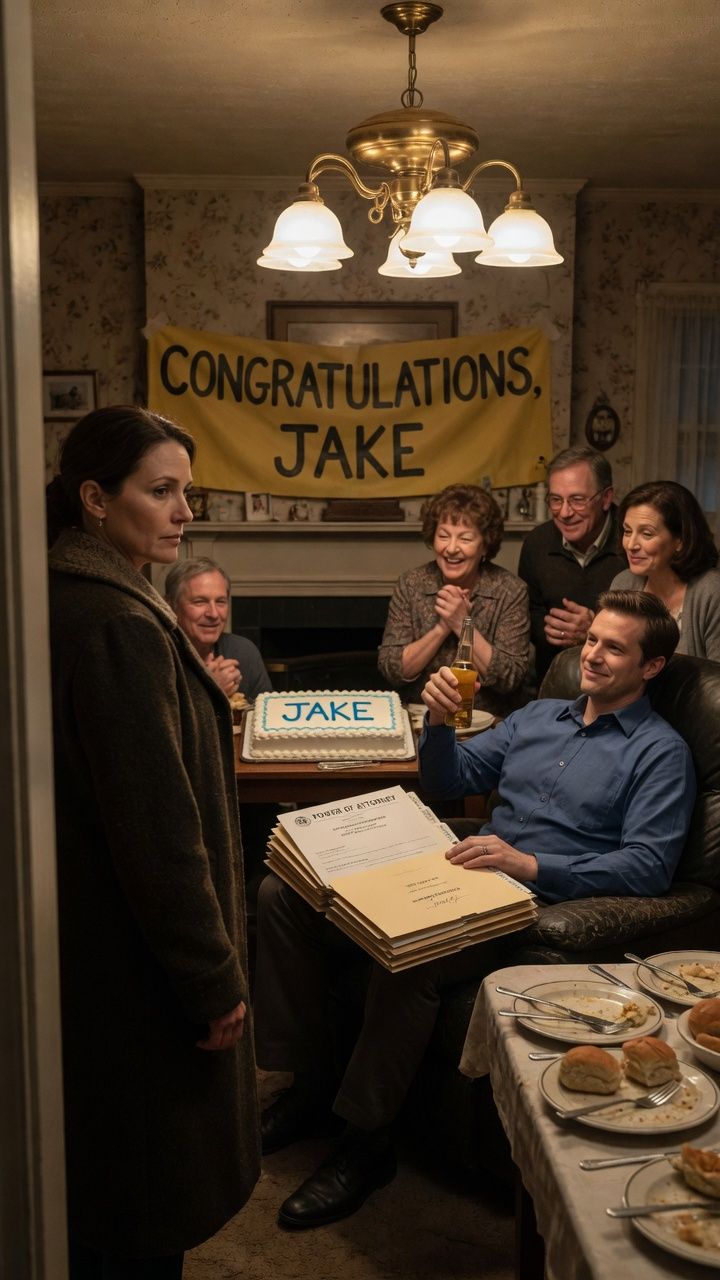
“I sold that little house of yours for three hundred thousand dollars,” Jake announced from my father’s favorite recliner, grinning like a man who had just rescued the entire family. “Honestly, Sarah, you should be thanking me.”
Everyone applauded.
My mother pressed both hands to her chest and beamed. My father nodded in that familiar way he always did when Jake spoke – as though my brother’s words required neither proof nor questions.
A sagging yellow banner drooped above the fireplace.
CONGRATULATIONS, JAKE
His name was also piped across a sheet cake in thick blue frosting.
I stayed in the doorway.
Mom hurried over and wrapped her arms around my shoulders, as though I had arrived late to a party somehow organized in my honor. “We’re so proud of your brother,” she whispered. “He took care of everything without causing a fuss.”
Jake lifted his beer.
“Someone had to.”
Cousins laughed. My aunt offered me a soft, sympathetic look – the kind reserved for people presumed too fragile to understand what was happening around them.
Dad cleared his throat. “You know, sweetheart, maintaining a house is a serious responsibility. Jake acted before things got worse.”
“What things?” I asked.
The room changed.
The air seemed to press inward around the question. Jake’s grin held, but only barely.
“The missed payments,” he said. “The warning notices. The foreclosure deadline. Don’t stand there pretending you had no idea.”
At exactly 7:18 p.m., my phone vibrated for the fourth time.
Secure message. Missed call. Secure message.
I ignored it.
Instead, I looked at the folder resting across Jake’s lap – thick, spotless, arranged with almost obsessive precision.
Power of attorney. Property deed transfer. Buyer authorization. Mortgage payoff statement.
The first page bore the logo of a title company, a closing date, and a signature that resembled mine closely enough to fool anyone who had never watched me sign my own name.
“You sold my house,” I said.
Jake leaned back. “I rescued you from it.” He tapped the folder with one finger. “Power of attorney. Deed transfer. Buyer approval. Payoff documents. Everything was handled legally.”
My mother touched my sleeve. “Sarah, maybe you don’t remember signing them. You were under so much stress before that overseas assignment.”
There it was.
The same story, polished smooth from years of use. Jake was decisive. I was unstable. Jake was sensible. I was emotional. When he failed, the family offered understanding. When I succeeded, they cautioned me against getting ahead of myself.
Some families don’t replace reality with one enormous lie. They revise it slowly – one sentence at a time – until the lie has its own furniture, its own lighting, and a permanent seat at the table.
When I bought that two-bedroom house at twenty-five, my parents asked whether I understood how expensive a water heater could be. When Jake stopped paying rent on his apartment, they called it a temporary setback.
Before leaving the country for a government assignment, I had given my parents a spare key – strictly for emergencies, I’d explained clearly. No one was to enter the property unless something serious happened.
Apparently, Jake had decided that was close enough to an invitation.
And now he sat in our parents’ living room in an ill-fitting sport coat, accepting congratulations for selling property that had never belonged to him.
“Tell her the best part,” Dad said, eager to steer the mood back toward celebration.
Jake brightened. “The buyers are a lovely young couple. Their first home. They adored the neighborhood. I even saved you thousands in agent fees by finding them myself.”
“You found the buyers personally?” I asked.
“David and Michelle Parker.” He said the names with quiet pride. “They’ve already moved in. You should probably send them a housewarming card.”
Someone laughed. This time, the laughter came out uncertain.
I walked to the sideboard and placed my phone face-down beside a crystal bowl of candy. It kept vibrating against the polished wood – more secure messages, more missed calls, names I couldn’t mention in front of relatives who still believed my government job amounted to little more than filing paperwork.
Jake gestured toward the cake. “You might want to thank me before the icing dries out.”
I smiled.
There was no warmth in it. He noticed immediately.
“What is that look supposed to mean?”
“How did you convince my mortgage company to discuss my loan with you?” I asked.
He shrugged. “I told them I was your brother and that I was concerned.”
“And they simply gave you information about my payments?”
“They confirmed what I needed to know.”
“Enough to sell my home.”
His gaze cut toward Dad. “Stop twisting everything.”
Before he could pull the folder away, I took it from his lap.
The documents smelled of printer ink and fresh manila paper. The signature at the bottom of the power-of-attorney form looked elegant. Smooth. Certain. Almost a perfected version of my handwriting.
Too perfect.
“You told the notary I signed this in my kitchen?” I asked.
“That’s where you signed it. The day before you left.”
“I didn’t leave from the house,” I said. “I left directly from my office.”
Jake blinked once.
My mother’s fingers closed around her napkin. My father stopped nodding.
I turned to the next page.
Foreclosure warning. County filing receipt. Mortgage payoff confirmation. Each document carried another carefully printed block of text – another piece of a story the whole room had accepted because it cast me as incapable and transformed Jake into a hero.
This was not a misunderstanding. It was not concern.
It was a calculated paper trail. A staged performance. Fraud dressed up as family loyalty.
“You never tried to reach me,” I said.
“You couldn’t be reached.”
“You managed to leave three voicemails making jokes about my overgrown lawn.”
“That was different.”
“No,” I said. “It wasn’t.”
The silence that followed was dense. Forks rested untouched beside half-finished plates. My cousin froze with a wineglass halfway to her mouth. My aunt stared at the blue frosting as though Jake’s name had become something she no longer recognized. The refrigerator hummed from the kitchen. Somewhere near the end of the table, a spoon scraped against a plate, then stopped abruptly.
Nobody spoke.
For one brief moment, I imagined throwing the folder across the room and watching every polished lie scatter across the carpet.
Instead, I held the top page carefully between two fingers and kept my voice level.
Anger can be explosive. But the kind that becomes useful turns cold first.
My phone buzzed again.
Jake glanced at it. “Another work crisis?”
I let it ring once. Then twice.
“Possibly,” I said.
My mother started to rise. “Sarah, please don’t make this ugly. Your brother genuinely believed he was helping you.”
I looked at her directly. “That has always been the problem. Jake believes something, and the rest of you applaud.”
Jake stood. He held his beer in one hand and reached for the folder with the other. The confidence in his face had begun to fracture.
“Watch yourself,” he said.
The phone buzzed again, rattling sharply against the wood.
This time, I answered.
The man on the other end was breathing so quickly that everyone in the room could hear him through the speaker.
“Am I speaking with Sarah Morrison?”
“Yes.”
“My name is James Wheeler. Our firm represented the Parkers in the purchase of your property.” His voice faltered on the last word. “Why are federal investigators standing inside our office?”
Jake went completely still.
My father’s expression emptied.
My mother sank slowly back into her chair.
And for the first time all evening, my brother stopped smiling.
What James Wheeler Did Not Know
He didn’t know that I had been back in the country for eleven days.
He didn’t know that three of those eleven days were spent in a windowless conference room with two attorneys from my agency’s legal division and a special agent from the FBI’s financial crimes unit named Dennis Pruitt, who had a habit of tapping his pen against his notepad exactly twice before asking a question.
He didn’t know that I had known about the sale since day four.
What had happened was this: a colleague stateside had flagged an unusual inquiry on my property records. A title search. Not the first one, it turned out. Someone had been poking at the deed for months, going back to last spring, around the time I’d shipped out. The inquiries had been spaced carefully enough to avoid triggering an automatic alert. But not carefully enough to avoid Dennis Pruitt.
Dennis was the kind of man who looked like he’d been born holding a manila folder. Mid-fifties, gray at the temples, wore the same style of navy blue tie every time I saw him. He’d explained everything in a flat, even voice that first afternoon, spreading photocopies across the table in a specific order that I understood was not accidental.
The forged power of attorney. The notary who had been paid five hundred dollars in cash to stamp a signature he’d never witnessed. The title company that had processed the paperwork without flagging the irregularities because someone had been careful to use a branch two counties over from my property. The $300,000 sale price, which was, Dennis noted without inflection, roughly $80,000 below market value for the neighborhood.
Jake had not just stolen my house.
He’d gotten a bad price for it.
“We’d like to let this run a little further,” Dennis had said, tapping his pen twice. “If you’re willing.”
I told him I was willing.
The Folder on the Table
I set the phone on speaker and placed it on the sideboard.
James Wheeler was still talking. His voice had the particular quality of a man trying to hold himself together while everything around him came apart. He mentioned federal agents twice more. He mentioned the Parkers. He mentioned a document hold.
Jake had not moved.
I watched him the way you watch something you’ve been watching for a long time – not with surprise, but with the specific patience of a person who has been waiting for the exact right moment and has finally arrived at it.
“Mr. Wheeler,” I said. “My brother will need to retain his own legal counsel before speaking with anyone further. Please pass that along.”
A beat of silence. Then: “Of course.”
I ended the call.
The room was so quiet I could hear the candles guttering in the centerpiece my mother had arranged specifically for this occasion. Little orange flames bending sideways, straightening, bending again.
Dad said, “Jake.”
Just the name. Nothing after it.
Jake turned toward him and I watched something pass between them – not words, not even a look exactly. More like the moment a structure shifts before it falls. A vibration. A groan in the frame.
“It wasn’t supposed to go like this,” Jake said.
“No,” I agreed. “It wasn’t.”
What My Mother Asked Me
She followed me to the kitchen twenty minutes later, after Jake had gone outside to make calls in a voice too low for anyone inside to hear.
She stood near the sink with her arms crossed over her chest, not angry, not defensive. Just tired in a way that had been building for years and had finally found a night to land on.
“Did you know?” she asked. “When you walked in tonight. Did you already know?”
“Yes.”
She was quiet for a moment. “Why didn’t you warn us?”
I thought about that. Genuinely thought about it, standing there in her kitchen with the party still half-assembled in the next room and the sheet cake with Jake’s name still sitting on the counter, one corner slice already gone.
“Because I wanted you to see it,” I said. “Not hear about it from me. See it.”
She didn’t say anything to that.
I don’t know if it landed the way I meant it to. I don’t know if anything I’ve ever said to her has landed quite the way I meant it to. That’s the thing about a family that has spent decades building a particular story about who is capable and who is not. The story doesn’t fall apart in one night. It just develops a crack you can finally see through.
She poured herself a glass of water and drank half of it standing at the sink.
“He told us you were in trouble,” she said. “He showed us notices. He said you’d been ignoring calls from the bank.”
“The notices were printed from a template he downloaded,” I said. “Dennis found the file on his laptop.”
Her hand tightened around the glass.
“The bank calls were his own number, dialed to voicemail, saved as screenshots,” I said. “He was thorough. I’ll give him that.”
She set the glass down.
I picked up my coat from the chair where I’d draped it when I came in and folded it over my arm.
“I’m not going to tell you what to feel about your son,” I said. “But I need you to understand that I didn’t come here tonight to humiliate anyone. I came here because this is where he chose to announce it. He made this room part of it. So this room gets to be part of what comes next.”
She was still standing at the sink when I walked back out.
What Came Next
Jake was arrested fourteen days later. Not at the house. Not dramatically. Dennis Pruitt called me at 8:40 on a Tuesday morning to let me know it had been processed and that I’d receive paperwork within the week.
“Anticlimactic,” I said.
“Usually is,” he said. Tap tap. “You doing all right?”
I told him I was fine.
The Parkers, David and Michelle, had to vacate the property while the title was legally restored. I spoke with them once, briefly, through their attorney. They were twenty-eight years old. They’d used their entire savings on the down payment. They’d already painted the second bedroom a pale yellow because Michelle was pregnant.
I did not send a housewarming card.
I did something else.
I won’t go into the details of it here because it’s not the part of the story I want to end on. But they didn’t lose their money and they didn’t lose the house, and the pale yellow room got to stay pale yellow.
My father called me six weeks after the arrest. He asked how I was doing in the careful voice people use when they’re not sure which version of a conversation they’re about to have. We talked for twelve minutes. He didn’t mention Jake. I didn’t either.
My mother texts me on Sundays. Short messages. A photo of her garden. A question about whether I need anything. I answer when I can.
The banner with Jake’s name on it, I assume, came down at some point. I didn’t ask.
The sheet cake is long gone.
The folder is in an evidence box somewhere in a federal building, filed under a case number I have memorized the way you memorize things you never wanted to have to memorize.
And the house is mine.
Still mine.
It always was.
—
If this one hit close to home, pass it along to someone who needed to read it.
If you’re looking for more wild family stories, you won’t want to miss My Parents Skipped My Graduation and Told Everyone I Failed. Or, if you need a breather, perhaps learn a little more about Turmeric and Honey: A Time-Tested Combo People Swear By – What It Can and Can’t Do or the 6 Benefits of eating cucumber at night.