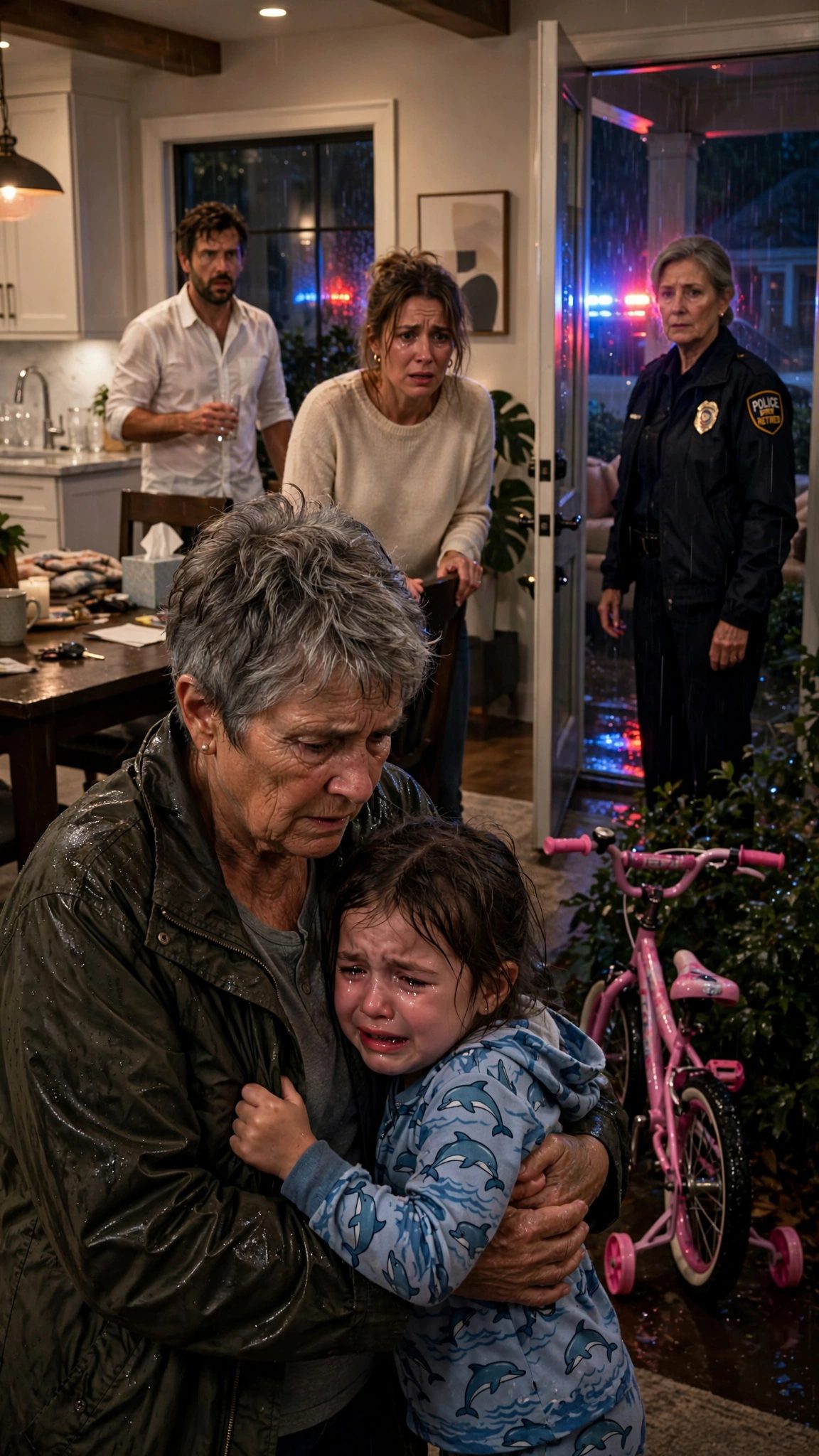

“If you take one more step toward my daughter, tomorrow this entire community will know exactly who you are.”
I said those words to Victor Hale at 11:26 p.m., standing in cold rain outside my daughter Lena’s house in Princeton. The neighborhood was beautiful in the way expensive things often are – perfect lawns, warm windows, polished facades concealing terrible silences. I had lived long enough to know the difference between a neighborhood and a home.
Twenty minutes earlier, I had been in my garage sanding a cedar trunk while my dog slept by the door.
Then my phone vibrated.
Two words on the screen: Blue lantern. A map pin followed, showing Lena’s exact location.
My blood went cold.
She hadn’t used that phrase since she was fourteen, the year her father died without warning during a family dinner. After that, she developed a quiet, persistent fear – that something terrible might happen to her and no one would know in time. So we built a system together. If she couldn’t speak freely, she would send those two words, and I would come without questions, without calling ahead, without hesitation.
I called her three times anyway.
No answer.
I grabbed my keys and dialed Maggie – an old friend, retired police officer, someone I trusted completely.
“I’m already moving,” she said.
What I Walked Into
When I turned onto Lena’s street, the first thing I noticed was Ellie’s pink bicycle lying sideways in the wet bushes near the front walk. The second thing I noticed was the shouting. It carried through the walls, sharp and rhythmic – not the sound of two people arguing, but the sound of one person using another person’s fear like a weapon.
Then I heard Ellie crying.
I opened the front door without knocking.
The house smelled of tequila, burned food, and something harder to name – a specific kind of dread that settles into walls over time. Lena stood near the dining table, bent slightly to one side, her lip split, her hair plastered against her face. Behind her, eight-year-old Ellie pressed herself into the corner in dolphin pajamas, both hands gripping her mother’s shirt.
Victor stood in the kitchen in a spotless white button-down, a glass in his hand, wearing the expression of a man who had talked his way out of everything before and fully expected to do it again.
“Nora,” he said smoothly. “This isn’t what it looks like.”
Liars always seem to believe that sentence still works.
Maggie came in behind me and cleared the room with the quiet efficiency of someone who had done it a thousand times. Ellie broke from her mother and ran into my arms, shaking.
“It was just a disagreement,” Victor continued, his voice measured and reasonable. “Lena gets intense sometimes. You know how she is.”
My daughter stared at the floor. Her shame frightened me more than the blood on her face.
“Did he hit you?” I asked her.
She swallowed. Before she answered, she glanced at Victor.
That single second – that involuntary check – broke something open in my chest.
Victor moved toward her. “Don’t start with the drama.”
“Patrol is already on the way,” Maggie said from the living room, her voice flat and final.
Victor’s expression shifted. Not guilt. Something colder – the fear of a man who had relied for years on no one ever pushing back.
The Head Shake
When the officers arrived, one led Lena into the hallway and asked directly whether Victor had hurt her that evening. I watched from the doorway. Victor stood in the living room behind the officer’s shoulder, and without moving his head, he shook it – barely, almost nothing. A small, practiced correction.
“We both just got upset,” Lena whispered.
Ellie stood at her mother’s side, both arms wrapped around her waist, holding on as if she were the one keeping them both upright. That was the moment I understood the full shape of what I was looking at. My granddaughter wasn’t reacting to one frightening night. She already knew the routine. She had learned it young.
I looked at Maggie. She had seen it too – the head shake, the practiced half-second of control. She didn’t say anything. She just wrote something in the small notebook she kept in her jacket pocket, and I knew she’d be making calls in the morning.
Victor accepted a glass of water from the second officer like a man hosting a dinner party that had gotten slightly out of hand. He asked about road conditions. He laughed once, low and sociable. The officer laughed back.
I stood in that hallway and kept my mouth shut because Maggie had told me on the drive over: Let the process work. Don’t give him an excuse to make you the story.
But I watched him.
And I memorized exactly what I saw.
Cold Coffee at Midnight
At midnight, I brought Lena and Ellie back to my house. Victor stayed behind. Lena refused to file a report.
We sat in my kitchen with cold coffee while Ellie slept on the couch under an old quilt. For a long time, neither of us spoke.
Then Lena began to cry – quietly, without drama, the way people cry when they’ve been doing it alone for years.
“Do you think I’m weak, Mom?”
I looked at the bruise spreading along her jaw.
“Surviving this for as long as you have,” I said, “is not weakness.”
She was quiet for a moment. Then she said the words that undid me.
“The first time he pushed me down, Ellie was three.”
Five years. Five years of fear while the rest of us looked at beautiful family photographs and believed them.
I thought about every Sunday dinner. Every birthday. Every Christmas card with the three of them in coordinated colors, Victor’s hand on Lena’s shoulder, Lena smiling in the specific way I now understood – the smile you practice until it doesn’t cost you anything, because it has to last all day.
Then she lowered her voice further, as if the truth were something that still had to be hidden.
“He took Ellie’s college fund. All of it.”
“How much?” I asked.
She didn’t answer.
That silence told me everything I needed to know – and everything I needed to do next.
What “The Community” Actually Meant
I want to be clear about what I said to Victor on that front walk, because it wasn’t a bluff and it wasn’t a threat made in the heat of the moment.
I am sixty-three years old. I taught high school English in Princeton for twenty-seven years. I know every parent on four surrounding blocks by first name. I sit on the board of the local library. I coached youth soccer for eleven seasons. I have attended the same church for thirty-one years. I know the woman who runs the PTA. I know the man who owns the building where Victor’s architecture firm leases its office space. I know his partners’ wives. I know the couple who introduced Victor and Lena at a dinner party eight years ago – and who have, I suspect, felt quietly responsible ever since.
When I said this entire community will know exactly who you are, I was not speaking in the abstract.
Victor knew that. That’s why he stopped moving.
The next morning, I called Maggie first. She walked me through what documentation mattered – photographs of Lena’s face, the split lip, the bruise along her jaw, the mark on her forearm she hadn’t shown the officers. Maggie knew a family law attorney named Karen Sloan who had handled cases like this for twenty years and had no patience for men like Victor.
Karen met us at her office at nine a.m. on a Tuesday. She brought a yellow legal pad and a box of tissues she placed on the table without comment, the way you’d set out salt. She had done this enough times to know where the crying usually landed.
She asked Lena everything. Lena answered most of it. Some of it she answered looking at the table.
The college fund – forty-two thousand dollars – had been moved in increments over fourteen months into an account Lena hadn’t known existed. Karen made a note. She didn’t flinch.
“This is documented financial abuse,” she said. “We can work with this.”
What Lena Decided
Lena didn’t decide everything that Tuesday. That’s not how it works. If you’re expecting the part where she stood up straight and said I’m done and everything snapped cleanly into place, that’s not this story.
She went back to the house twice that week to get things. Victor was not there – Maggie had made sure of that, through a phone call to someone who owed her a favor, the details of which I did not ask about. Both times Lena came back to my house, she sat in the kitchen for an hour before she could sleep.
She cried about the wedding photos. She cried about the dog they’d had to put down two years ago, a retriever named Biscuit, and how Victor had been the one to hold him at the vet while she couldn’t. She cried about the version of him she’d married, whoever that had been, and whether she’d invented him entirely or whether something had curdled over time and which of those was worse.
I made tea. I didn’t offer answers to questions she wasn’t asking.
Ellie, for her part, adjusted faster than either of us expected – or maybe she’d already been adjusting for years, and this was just the part where she got to stop pretending. The third morning at my house, she came downstairs, sat at the kitchen table, poured herself cereal, and said, “Grandma, can we get a fish?”
“Yes,” I said.
“Can it be orange?”
“We’ll look for an orange one.”
She ate her cereal. She didn’t ask about going home.
The Part That Isn’t Over
Victor retained a lawyer within forty-eight hours. His lawyer sent a letter that used the word amicable four times in two pages, which told me everything about what Victor thought the situation still was.
Karen sent a response the following Monday. I did not read it. I trusted her to say what needed saying in the language that worked.
The financial investigation is ongoing. Forty-two thousand dollars does not vanish cleanly, and Karen has a forensic accountant she works with who apparently finds this kind of paper trail the way a dog finds a bone – not quickly, but with complete certainty.
The custody arrangement is being negotiated. Victor’s attorney is pushing for fifty-fifty. Karen says that’s where they always start. She says it in the tone of someone who has heard that number a thousand times and knows exactly what it’s worth.
Ellie has a therapist now – a woman named Dr. Pruitt who has an office with beanbag chairs and a sand tray and a cabinet full of small plastic animals. Ellie likes the horses. She goes on Thursdays.
Lena is still sleeping in my guest room. Her coffee mug is on my counter every morning when I come downstairs. Her shoes are by the back door. Her shampoo has claimed the second shelf in the bathroom.
I don’t mind any of it.
Last Thursday, I was sanding a new project in the garage – a small bookshelf, nothing complicated – and I heard the back door open, and Lena came and sat on the step and watched me work without saying anything for a while. The dog put his head in her lap.
“I keep thinking I should feel angrier,” she said eventually.
I kept sanding.
“You will,” I said. “Give it time.”
She nodded. She scratched the dog’s ears.
Outside, the neighbor’s kids were doing something loud on a trampoline. The streetlight was coming on early because of the clouds. Somewhere down the block, someone was grilling something.
She stayed on that step for another hour.
I let her.
—
If this story is sitting with you, pass it on. Someone you know might need to read it.
For more stories about standing up for what’s right, check out My Father Toasted My Brother With the Restaurant Keys. Then a Colonel Walked In. and My Husband’s Ex-Wife Spent $2M to Destroy Me in Front of Everyone Who Mattered.