
My father handed my brother the keys to our family restaurant and raised a glass.
“To the son who keeps things running,” he said. “My daughter here couldn’t manage a kitchen if she tried.”
I folded my napkin quietly and held my tongue.
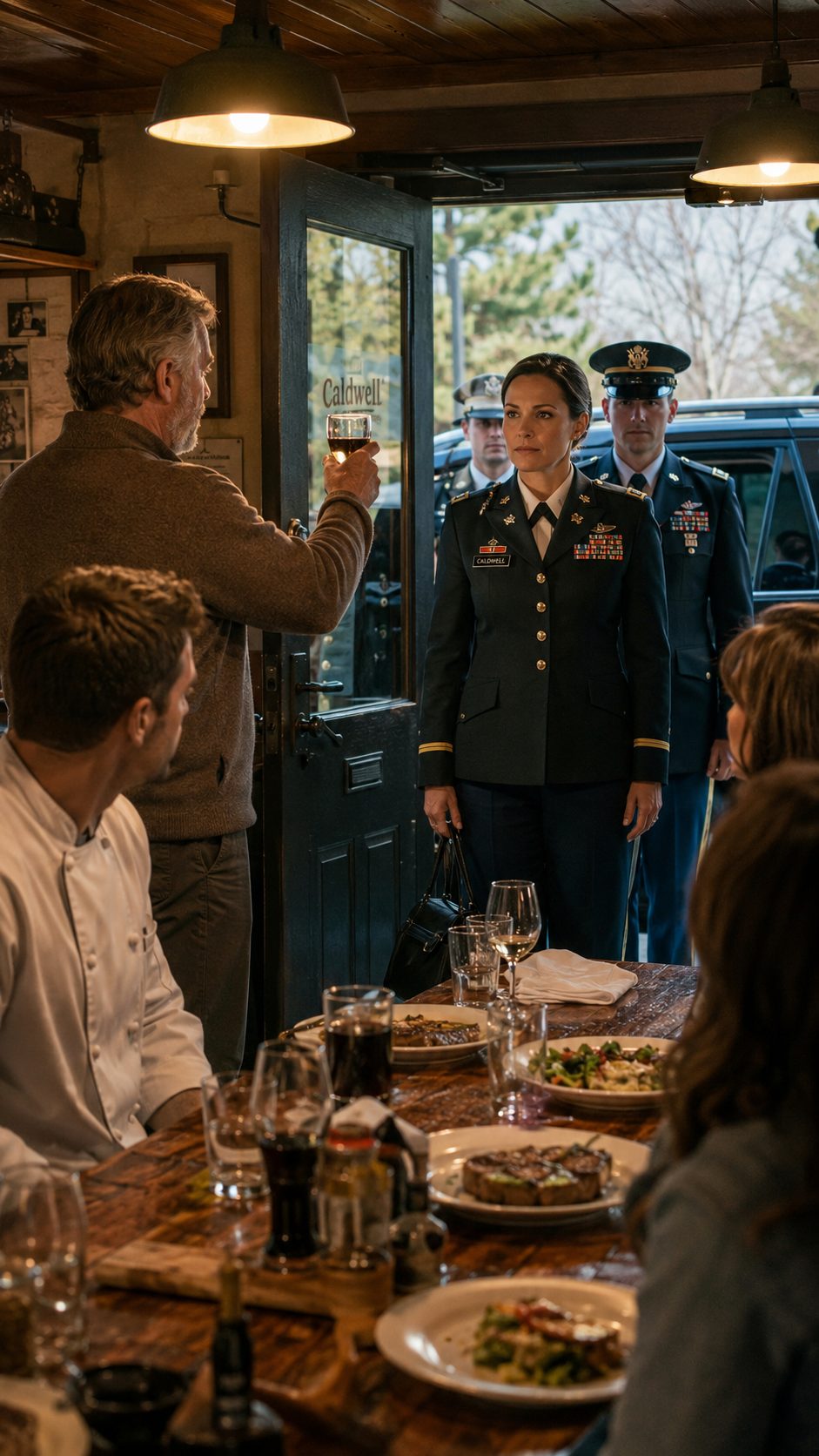
Then a sleek black sedan pulled up outside. A military aide opened the door. A Colonel stepped in, snapped to attention, and said, “Ma’am, the Task Force has been activated.”
—
My name is Marianne Caldwell. I am forty-four years old, and for twenty-two years I served in the United States Army doing the kind of work nobody puts on recruiting posters.
No one cheers for logistics. Not until the fuel runs dry. Not until the food stops coming, the trucks stop moving, and the people in charge finally understand that courage alone does not move an army.
I was a logistics officer. That title sounds small only if you have never stood in a room where thousands of lives depended on water, aircraft, fuel, food, medical supplies, and convoy timing so precise that one delayed shipment could become a headline no family should ever have to read.
My father never understood any of that.
To him, I was still the daughter who had left his restaurant. The girl who chose paperwork over the grill. The useful one who could fix an inventory system, clear plates, and quietly make everything run smoother without ever needing credit for it.
—
The restaurant was called Caldwell’s Table, and in our small lake town in northern Michigan, it was more than a business. People came there after funerals and Friday night games, after engagements and ordinary days that simply needed food and familiarity. My father, Arthur Caldwell, built it in 1979 with a borrowed stove, two used refrigerators, and a confidence strong enough to cut through brick.
My brother Eli was born a year later. I came three years after him, which meant the restaurant was already the first child in our family before either of us understood we were competing with it.
By twelve, I could peel fifty pounds of potatoes before breakfast, wipe stainless steel until it shone, smell when fryer oil had one more night left in it, and stay out of my father’s way when the dinner rush hit hard.
He was not an unkind man. He hugged me, fed me, bought my school shoes, and taught me to drive in the restaurant parking lot before sunrise. He once stayed up all night giving me ice chips when I had the flu.
But there is a difference between being loved and being counted.
In our family, Eli was counted.
I was useful.
Eli stood beside my father at the grill while Dad explained timing, heat, pressure, and instinct – how to feel the whole room without ever looking up from the flame. I stood at the sink with my sleeves wet to the elbows, listening while pretending I wasn’t.
When Eli suggested a Saturday special, my father listened like the governor had called. When I told him our produce supplier was shorting us on tomatoes, he said to write it down and then forgot. Three weeks later, Eli noticed the same shortage and was praised for having “an owner’s eye.”
I learned early that truth mattered less than who delivered it.
—
At sixteen, I built an ordering system in a blue spiral notebook because waste bothered me in a way I couldn’t quite explain. I tracked par levels, delivery dates, seasonal shifts, lake crowds, church crowds, and weekend patterns. Within a single summer, our food cost dropped sharply.
My father told my mother, Helen, “We had a good season.”
It wasn’t a good season.
It was me.
I said nothing. I had already learned that silence was the smoothest path through our house.
—
At seventeen, I told my parents I had accepted an Army scholarship and would be leaving for college four hours south. I had rehearsed the speech for nights – how I wanted something of my own, how I loved the restaurant but didn’t want to disappear inside it.
My father heard none of it.
He stood at the flattop and said, “Who’s going to help your brother run Saturdays?”
Not I’m proud of you. Not That’s a big opportunity. Just a question that already held the answer he wanted.
My mother squeezed my hand later and said kindly, “Don’t take it so seriously, honey. It’s only the Army. You can always come home and help Eli.”
She meant it with love. That was the hardest part. She didn’t know she was telling me that the life I was about to build was only a detour from the life they had already assigned me.
I left anyway.
I drove south with two duffel bags, a stiff new haircut, and the smell of bacon still clinging to my jacket.
I didn’t yet know that every skill my father believed belonged to a kitchen – reading a room, managing resources, finding order inside chaos, knowing what was needed before anyone thought to ask – would become the foundation of everything I was about to build.
Seeing chaos and finding order inside it had a name.
Logistics.
And I would spend the next twenty-two years becoming one of the best in the Army at the very thing my father thought I had run away from.
What Twenty-Two Years Actually Looks Like
My first posting was Fort Lee, Virginia, 1999. Supply school. A low brick building that smelled like floor wax and old coffee, full of lieutenants who were disappointed they hadn’t been assigned infantry.
I was not disappointed. I had found my language.
Inventory. Distribution. Throughput. Constraint analysis. Supply chain failure modes. The math of keeping people alive when everything is trying to go wrong at once. It was the blue spiral notebook scaled up to a size that made my hands shake a little the first time I saw the numbers.
I was good at it immediately. Not in a showy way. In the way that a room gets quieter when you walk in because the right person has arrived and everyone can feel it without knowing why.
By 2003 I was in Kuwait, running fuel and water coordination for a convoy operation that moved more tonnage in eleven days than the unit had projected for three weeks. My commander, a Colonel named Pruitt, wrote in my evaluation that I had “an instinct for system pressure that most officers develop over a decade, if ever.”
I sent the evaluation home to my parents.
My father called and said the weather up north had been rough and the road out to the lake was flooding again.
He hadn’t read it.
Or he had read it and it hadn’t translated into anything he recognized as worth remarking on. I was never sure which was worse.
The Promotions Nobody Announced at Dinner
I made Captain in 2004. Major in 2009. I did two more deployments, one to Afghanistan where I coordinated medical resupply for a forward operating base that had been cut off for six days by weather and a compromised route. We got them supplied. Nobody died waiting.
Nobody at Caldwell’s Table knew that story.
I made Lieutenant Colonel in 2014. By then I was running logistics planning for a joint task force, which meant I sat in rooms with generals and told them, politely but without apology, what was and wasn’t physically possible given the assets they had.
Generals don’t love being told what’s not possible. You have to be very precise and very calm and very certain, or they will find someone else who will tell them yes and then watch things fail. I was precise and calm and certain. They kept calling me back.
My mother sent me a care package that year. Beef jerky, hand cream, a clipping from the local paper about Eli expanding the restaurant’s patio seating.
I ate the beef jerky. It was good.
The Dinner
The dinner was my father’s idea. His seventy-second birthday, late September, the restaurant closed for the private party on a Tuesday night. Family, a few old friends, the couple who had supplied the restaurant’s produce for thirty years.
I flew in from D.C. the morning before.
I was in civilian clothes. Jeans, a gray sweater, my hair down. I looked, I think, like someone’s unremarkable aunt. That was fine. I was used to not looking like what I was.
Eli had done well with the place. The patio was nice. New lighting, a better wine list, the kind of incremental upgrades that take patience and decent instincts. I told him so and meant it. He’d put real work in. That was true regardless of everything else.
My father was in good health, good spirits, loud in the way he got when he was happy. He made the rounds. He told the same three stories he’d been telling for twenty years. He laughed at his own jokes before he finished them.
I was glad he was seventy-two and healthy and laughing.
And then he picked up the keys.
They were actual keys, old ones, on a ring with a small brass bottle opener my father had carried since before I was born. He held them up and made a small speech about legacy and hard work and a son who had never stopped showing up.
“To the son who keeps things running,” he said. He raised his glass. “My daughter here couldn’t manage a kitchen if she tried.”
He was smiling when he said it. That was the thing. He meant it as a joke, the kind you make about someone who took a different road. Affectionate, almost. The way you’d say, well, she was never the sporty one.
He didn’t know what he was saying. That was always the thing with my father. He never knew what he was saying.
I folded my napkin in my lap. I looked at the table. I did not look at Eli, who had gone slightly still, or at my mother, who was studying her wine glass.
I had been in rooms where a single wrong word could end careers. I knew how to stay quiet.
I stayed quiet.
The Sedan
I heard it before I saw it. That particular engine sound, the one that belongs to government vehicles, something in the idle that civilian cars don’t have.
The black sedan pulled up to the front window of Caldwell’s Table at 7:48 p.m. on a Tuesday in September. I know the time because I checked my watch out of habit when I heard the engine. Old reflex.
The aide was a young sergeant, maybe twenty-six, in dress uniform. He came through the door, scanned the room once, found me in two seconds.
He came to the table. He stood straight.
“Ma’am,” he said. “The Task Force has been activated. General Harwick requests your immediate availability.”
The table went quiet the way a room goes quiet when something has shifted and no one has caught up yet.
My father was still holding his wine glass.
I looked at the sergeant. “Give me four minutes,” I said.
He nodded and stepped back to the door.
I stood up. I put my napkin on the table. I picked up my phone and my jacket from the back of the chair.
My father said, “Marianne, what – “
“I have to go, Dad.” I leaned down and kissed him on the top of his head. “Happy birthday.”
I shook Eli’s hand. I squeezed my mother’s shoulder.
And then I walked out of Caldwell’s Table and got into the back of the sedan.
What He Saw Through the Window
I didn’t look back.
But my mother told me later, on the phone, two weeks after, when things had quieted down enough to talk.
She said my father sat at that table for a long time after the sedan pulled away. That he didn’t finish his wine. That he asked her, quietly, what exactly it was that Marianne did in the Army.
She told him what she knew, which wasn’t everything, but was enough.
She said he nodded slowly and didn’t say much.
Then he picked up the brass key ring, the one he’d just handed to Eli, and he turned it over in his hands for a while.
She didn’t tell me what he was thinking. She didn’t know. Maybe he was thinking about the blue spiral notebook. Maybe he was thinking about a seventeen-year-old driving south with two duffel bags. Maybe he was just thinking about how a room can run perfectly and you can eat in it every day for years and never once ask who’s keeping the lights on.
I don’t know.
I was already in a different room by then. One where the lights had just gone out in eleven places at once, and someone needed to figure out how to get them back on before morning.
I got them back on.
That’s what I do.
—
If this one sat with you, pass it along – someone else needs to read it.
For more dramatic tales, read about my husband’s ex-wife who spent $2M to destroy me or discover the most effective vitamin for cleansing arteries. You can also check out these 6 movements Japanese elders do every day for senior wellness!