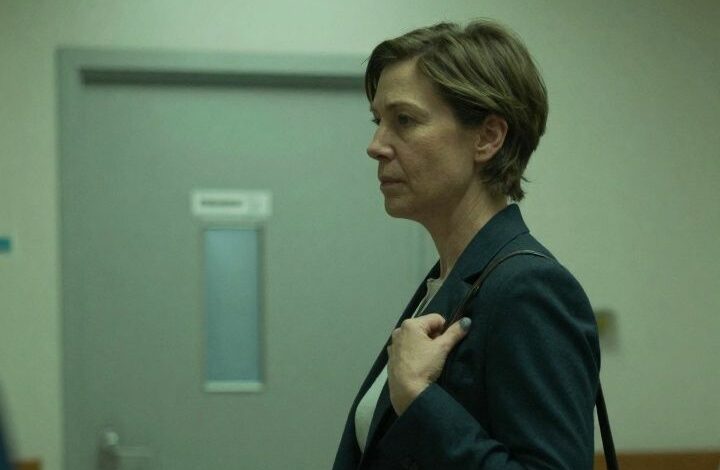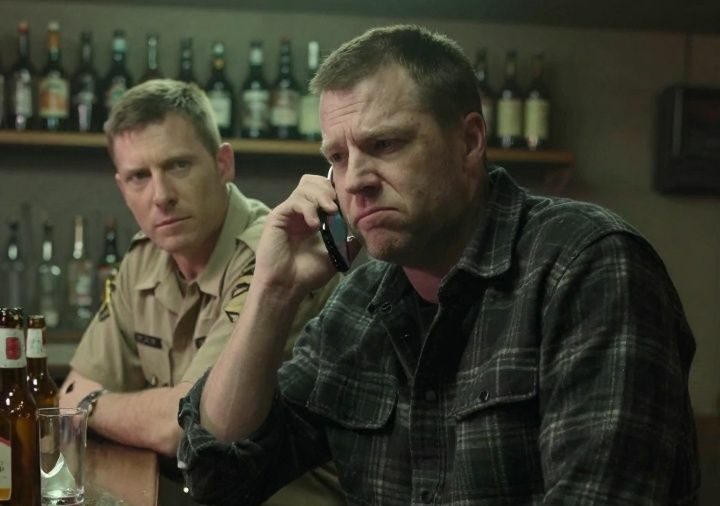

I was three beers in at Murphy’s when a soldier walked through the door – and it was my brother Daniel, who we’d buried four years ago.
We had a flag. A folded flag in a triangle case on my mother’s mantle.
We had a grave with his name carved into granite, two towns over, where she goes every Sunday with fresh flowers and stays until her knees ache.
I dropped my glass.
He stood in the doorway in full uniform, looking right at me, older and thinner but unmistakably him.
The whole bar went quiet. Tom behind the counter stopped mid-pour.
“Hey, Mark,” Daniel said, like he’d seen me last week.
I couldn’t move.
The Army had sent two officers to our house. They’d told my mother his vehicle hit an IED outside Kandahar. They told her there wasn’t enough left to bring home in an open casket.
She believed them. I believed them. I gave the eulogy.
“You’re dead,” I said. It was all I could get out.
He sat down on the stool next to me and ordered a water. His hands were steady. Mine weren’t.
“I need you to listen before you call Mom,” he said.
“Four YEARS, Daniel. She visits your grave every week.”
“I know.” His jaw tightened. “I’ve watched her do it.”
That landed like a punch. He’d been here. Around. Close enough to watch.
“Then why – “
“Because the man they buried in my place was real,” he said. “And the people who put him there think I’m gone. That’s the only reason Mom’s still safe.”
My stomach dropped.
“What people,” I said.
He glanced at the door, then leaned in close, lowering his voice so Tom couldn’t hear.
“THE PAPERWORK THAT DECLARED ME DEAD WAS SIGNED BY SOMEONE IN OUR OWN FAMILY.”
The room tilted sideways.
“What are you talking about,” I said.
He pulled a phone from his jacket and set it on the bar, screen facing me.
“Look at who signed the release form, Mark,” he said. “And then tell me you still want to call Mom.”
The Name on the Screen
I looked at the phone.
The document was a scanned form. Official letterhead, military insignia, the kind of paperwork that ends a life on paper. My eyes went straight to the signature line at the bottom.
Gary Pruitt.
Our uncle Gary.
I read it twice. Three times. The name didn’t change.
“That’s not possible,” I said.
“It’s his signature, Mark. I had three different people verify it.”
Gary was Dad’s brother. He’d come to the funeral in a dark suit and cried in the parking lot where he thought nobody could see him. He’d held my mother’s arm at the graveside. He’d called me on the anniversary, two years running, just to check in.
I pushed the phone back across the bar.
“Gary doesn’t have the clearance to sign anything like that. He sells insurance in Trenton.”
Daniel’s expression didn’t move. “He did twenty-two years in Army intelligence before Trenton. You didn’t know that because nobody was supposed to.”
I thought about Gary. Soft around the middle now. Bad knee. Always brought store-bought pie to Thanksgiving and apologized for it.
“Why would he – “
“Because he knew what I’d found,” Daniel said. He picked the phone up and put it back in his jacket. “And he knew that if I came home, I’d have to tell someone.”
Tom was pretending to wipe down the far end of the bar. Doing a bad job of pretending.
“Let’s go outside,” I said.
What He Found in Kandahar
We sat in my truck in the Murphy’s parking lot. Engine off. October cold starting to come through the windows.
Daniel talked for a long time.
He’d been attached to a small unit doing logistics oversight outside Kandahar. Boring work, he said. Inventory, manifests, supply chain documentation. The kind of job that exists so other people don’t have to think about it.
Six weeks in, he found a discrepancy. A serial number that appeared twice, on two different manifests, routed to two different locations. The kind of thing that could be a clerical error. Usually was.
He flagged it to his sergeant. His sergeant told him to leave it alone.
He didn’t leave it alone.
What he found underneath that one doubled serial number was a supply chain that had been running for at least three years. Equipment. Medical supplies. Some of it to legitimate recipients. A lot of it not. The paperwork was good, he said. Really good. Whoever built it knew exactly how military documentation worked, knew where the blind spots were, knew which signatures carried weight and which ones were rubber stamps.
“How much?” I asked.
He looked out the windshield. “Enough that people have gone to prison for less and called it a good deal.”
“And Gary was part of it.”
“Gary built it,” Daniel said. “Or helped build it. I don’t know how deep he goes. But his name is on the architecture.”
I sat with that. Gary and his store-bought pie.
“The IED,” I said.
Daniel nodded slowly. “There was an IED. The vehicle did get hit. Two guys from my unit died.” He stopped. “The Army’s report on what was in that vehicle isn’t accurate. Someone made sure I was listed as a casualty. Someone with access to the after-action documentation and enough pull to make a death certificate stick.”
“And the man in your grave.”
“Corporal Ricky Tatum, from Beaumont, Texas. Twenty-four years old.” His voice went flat. “He died in that vehicle. His family was told he was MIA. They’ve been waiting four years.”
I put my hands on the steering wheel and just held it.
“His family doesn’t know either.”
“No.”
The cold was getting real now. I hadn’t started the engine.
“So you just disappeared,” I said. It came out harder than I meant it to.
“I had help. A woman I’d worked with, she saw what I was looking at and she understood the situation faster than I did. She got me out before the report was finalized. We had about six hours.”
“Who is she.”
“Her name doesn’t matter right now.”
“Daniel.”
“It doesn’t matter right now, Mark.” His voice had an edge I didn’t remember from before. Something the four years had put there. “What matters is that I’ve spent three of those four years building a case that will actually hold. Not just Gary. The whole chain.”
What He Needed From Me
“Then why are you here,” I said. “If you’ve been building a case, why walk into Murphy’s on a Thursday night and blow your cover talking to me.”
He almost smiled. Almost.
“Because the case is done,” he said. “It goes to a federal prosecutor in eleven days. After that, it’s out of my hands and the people involved will know I’m alive regardless. The window where my being dead protects Mom closes in eleven days.”
“So you need me to – what.”
“I need you to not tell her until I can tell her myself. I need eleven days.”
Eleven days. My mother, two towns over, probably already in bed. The flag on the mantle. The Sunday flowers.
“She thinks her son is dead,” I said.
“I know.”
“Daniel. She is not okay. She was not okay last year, she’s not okay now, she goes to that grave every single week and she – ” I stopped. My throat was doing something. “She kept his bedroom the same. Your bedroom. She kept it exactly the same.”
He looked out the passenger window.
“I know,” he said again. Quieter.
“Eleven days is a long time to sit on that.”
“Eleven days is nothing compared to four years.”
He wasn’t wrong. I hated that he wasn’t wrong.
“And if something happens to you in those eleven days.”
“Then you’ll know enough to finish it,” he said. He reached into his jacket again, not the phone this time, and pulled out a folded envelope. Thick. He set it on the center console between us. “Everything’s in there. Names, documents, contact information for the prosecutor’s office. If I go dark, you wait seventy-two hours and then you walk that envelope into the federal building on Fifth and you ask for a woman named Carla Dowd.”
I looked at the envelope.
“You’ve been planning this conversation,” I said.
“For about eight months.”
“And you picked Murphy’s.”
“You’re here every Thursday. You’ve been here every Thursday since 2019.” He finally looked at me directly. “I needed somewhere I knew you’d be alone.”
The Thing He Didn’t Say
We sat there another twenty minutes. He told me some of what was in the envelope, enough that I’d know what I was carrying. He told me Gary had been approached by investigators twice and had passed both times, clean. He told me the woman who’d helped him was somewhere safe.
He didn’t tell me if he was okay.
I didn’t ask, exactly. But at some point I said, “How are you doing,” and he said, “I’m functioning,” and that was the whole answer.
At one point I asked if he’d thought about what he was going to say to Mom.
He was quiet for long enough that I stopped waiting for an answer.
Then he said, “Every day.”
Just that.
I believed him.
Around eleven, he said he had to go. He opened the truck door and the dome light came on and I could see him clearly for the first time. The thinness wasn’t just lean. His face had a look I recognized from guys who come back from long deployments, a kind of permanent alertness, like some part of the brain never fully stood down.
He looked older than thirty-one.
He looked like someone who’d been carrying something very heavy for a long time and had gotten good at carrying it.
“Eleven days,” I said.
“Eleven days.”
He got out of the truck. Didn’t look back. Walked to a car I didn’t recognize, parked at the far end of the lot, and drove away.
What I Did After
I sat in the parking lot for a while.
Then I drove home. Checked the locks twice, which I don’t normally do. Put the envelope in the kitchen drawer under the takeout menus, then moved it to the closet shelf, then back to the kitchen drawer. Poured a glass of water and didn’t drink it.
I didn’t sleep.
Around three in the morning I got up and sat at the kitchen table and thought about Gary at the funeral. Gary crying in the parking lot. I’d thought it was grief. Maybe it was. Maybe it was both things at once. People are capable of that, I think. Loving someone and burning them down at the same time, and crying about it genuinely, and still not stopping.
Or maybe he didn’t cry. Maybe I’m misremembering.
I keep turning it over.
My phone was on the table the whole night. I didn’t call my mother. I didn’t call Gary.
I just sat there with the envelope in the drawer and eleven days on the clock and my brother’s voice in my head saying I’ve watched her do it, and outside the window the neighborhood was completely quiet and dark, the way it gets at that hour when you’re the only person awake for blocks.
Eleven days.
I’m counting.
—
If this one got under your skin, pass it on. Someone else needs to read it.