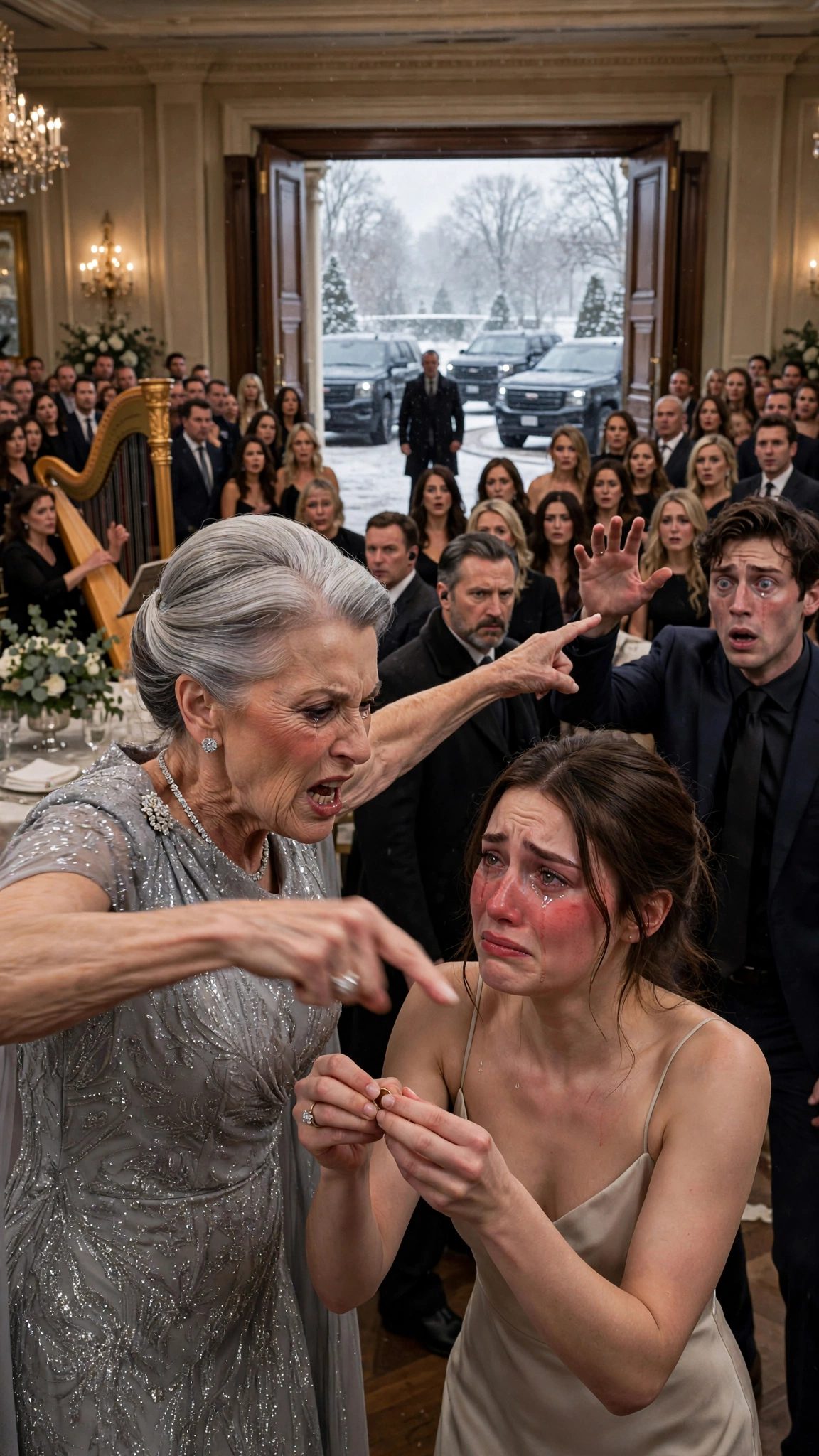

At my own engagement party, my future mother-in-law slapped me twice, called me “a penniless outsider who would never deserve this family,” and ordered me to leave in front of nearly two hundred guests.
So I pulled out my phone and said, “Dad, come get me. And don’t show them mercy.”
The second slap rang harder than the first.
The sound cracked through the ballroom like a gunshot, killing every conversation in an instant. Even the harpist froze, her fingers hovering above the strings as though she’d forgotten how to move them.
My cheek burned. Tears pressed against the backs of my eyes.
I didn’t let them fall.
Vivian Blackwood stood inches from my face, draped in a silver gown that had probably cost more than my first car. Diamonds caught the chandelier light and scattered it across the ceiling. None of it made her beautiful – not with that expression twisting her features.
“You actually thought you could scheme your way into this family?” she said, her voice low and cutting. “A broke little nobody like you? You will never belong here.”
I turned to look at Ethan.
He stood just behind his mother, his face drained of color. For one suspended moment, his hand lifted slightly – as though some part of him considered stepping forward, crossing the distance between us, saying something.
He didn’t.
His hand dropped. His mouth stayed closed.
That silence told me everything I’d been too hopeful to see before.
“Vivian,” someone murmured nervously from the crowd. No one else moved.
She reached out and wrenched the engagement ring from my finger. The band scraped hard against my skin. Then she extended one arm toward the towering doors at the far end of the room, her posture that of someone who had never once been told no.
“Get out.”
I looked at Ethan one last time. “Are you going to say anything?”
His mouth opened.
Then closed.
I bent down, picked up my clutch from the marble floor, and stood up straight. My face throbbed. My hands were steady.
I walked through the crowd without rushing. The whispers followed me like a current.
“Poor thing.”
“That was absolutely vicious.”
“Did she lie about who she was?”
Outside, the January air hit me like a wall. The cold cut straight through my dress, and snow blanketed the circular driveway in pale silence. The valet watched me from a distance, pretending not to stare, as I pulled out my phone with fingers that wouldn’t quite stop trembling.
My father answered on the second ring.
“Lena?”
I swallowed against the tightness in my throat. “Dad, come get me.”
I looked back through the glass doors. Inside, the Blackwood family was already resuming their celebration – laughing, toasting, accepting sympathetic embraces. Vivian stood at the center of it all, radiant with satisfaction.
“And don’t go easy on them.”
A brief silence.
When my father spoke again, his voice had gone very quiet. That particular quiet I’d heard only a handful of times in my life.
“Where are you?”
“The Blackwood Country Club.”
“Don’t move.”
Twenty minutes later, three black SUVs turned into the driveway.
My father stepped out of the first one in a dark charcoal overcoat, unhurried. Behind him came his attorney, his chief financial officer, and two members of his security team. The valet fumbled a set of keys.
Richard Vale almost never appeared in society magazines. He avoided cameras, declined interviews, and had no interest in being recognized at parties. But within American real estate, logistics, and private investment, his name carried the kind of weight that didn’t need announcing. It could open nearly any door in the country.
It could also shut down an entire company.
Vivian Blackwood had decided I was poor because I dressed without pretension, worked as a counselor at a public school, and never once mentioned my family’s money. It was a reasonable assumption, and a catastrophic one. What she didn’t know – what no one in that ballroom knew – was that the Blackwood construction empire had survived the past two years only because my father’s private fund had quietly extended it an emergency line of credit. They were still standing because of us.
Dad crossed the driveway and stopped in front of me. He studied the mark across my cheek without speaking. A muscle worked in his jaw.
“Who touched you?”
I nodded toward the glass doors.
Inside, Vivian was still smiling, still holding court, still basking in what she’d done.
My father straightened his collar and walked through the doors. His attorney and executives fell into step behind him. The crowd parted without being asked.
By the time Richard Vale reached the center of that ballroom, every Blackwood in the room had stopped smiling.
What Vivian Didn’t Know About Me
I should back up.
Ethan and I had been together for two years. We met at a charity auction for a literacy program – I was there representing the school district, he was there because his family wrote checks to things like that for appearances. We got seated at the same table by accident. He spent the first hour being politely bored and the second hour talking to me like he’d forgotten where he was supposed to be.
He was kind, back then. Or I believed he was.
I never hid anything about my family. I just didn’t lead with it. My father had raised me to understand that money announced too early in any relationship – romantic, professional, social – had a way of poisoning everything it touched. So I drove a sensible car. I wore what I liked. I taught kids how to process grief and anxiety at a Title I school in the city, because that was the work I actually wanted to do.
Vivian had done her research on me, clearly. She’d found my salary, my apartment lease, my student loan history from my master’s program. She’d built a complete picture of Lena Vale, and not one piece of it was wrong. She just hadn’t thought to look any further.
That was her mistake.
Ethan knew about my father. I’d told him six months in, sitting on his apartment floor eating takeout, because it felt dishonest not to. He’d gone quiet for a while. Then he said it didn’t change anything.
I believed him then, too.
The Room When My Father Walked In
I didn’t go back inside right away.
I stood in the cold and watched through the glass. I watched the exact moment people started recognizing my father – the small ripple of it, one face turning, then another, then a cluster of them near the bar going still. Someone touched Vivian’s arm and said something close to her ear. She shook her head slightly, dismissive.
Then she turned and saw him.
Her face didn’t collapse. Vivian Blackwood was too practiced for that. But something behind her eyes shifted, recalculated, and for the first time all evening she looked uncertain.
Dad didn’t raise his voice. He never does. That’s the thing people who haven’t seen him work don’t understand – the volume never goes up. He crossed the room, stopped a polite distance from her, and said something I couldn’t hear through the glass.
Whatever it was, the attorney opened a leather folder immediately after.
Gerald Blackwood – Ethan’s father, a man I’d met exactly four times and who had always been courteous in the thin, uninvested way of someone who considered you temporary – went the color of old chalk. He reached out and gripped his wife’s forearm. Not affectionately.
Ethan stood off to the side watching all of it. He looked like a man watching a building he recognized come down floor by floor.
I felt something for him in that moment. Not love, not anymore. Something older and sadder. The feeling you get when you realize the version of a person you fell for was always the best they were ever going to be, and even that wasn’t enough.
What the Folder Said
I found out the details later, from my father’s attorney, a sharp-faced woman named Carol Pruitt who had been with Dad’s firm for eleven years and who had the specific energy of someone who genuinely enjoys this kind of work.
The Blackwoods owed my father’s fund $4.3 million. The credit line had been extended quietly, through a holding company, and the terms had always been favorable – because Ethan had asked me to put in a good word, and I had, and my father had trusted my judgment.
The folder Carol opened contained a formal notice of accelerated repayment. Full balance. Thirty days.
The Blackwoods did not have $4.3 million liquid. Not even close. They had assets, property, receivables – but nothing that could be converted in thirty days without serious damage to the business. Gerald knew it. His face said he knew it.
There was a second document behind the first.
A letter to three of the Blackwood company’s largest commercial partners, whom my father also happened to do business with, outlining his decision to withdraw from two joint projects currently in early development. The kind of withdrawal that, once it circulated, would raise questions. The kind of questions that made other partners nervous.
My father hadn’t raised his voice once.
“This is the opening position,” Carol told me later, with what I can only describe as professional satisfaction.
The Part I Didn’t Expect
I went back inside about fifteen minutes after my father. By then the crowd had developed that particular uncomfortable energy of people who desperately want to leave but feel they can’t yet.
Ethan found me near the door.
He looked terrible. Not physically – Ethan always looked put together, it was practically genetic – but something behind his eyes was frayed in a way I hadn’t seen before. He reached for my arm and I stepped back, not dramatically, just enough.
“Lena.” His voice was rough. “I’m sorry. I should have – I should have said something.”
“Yeah.”
“She blindsided me. I didn’t know she was going to – “
“Ethan.” I kept my voice even. “She slapped me. Twice. In front of everyone we know. And you stood there.”
He didn’t have an answer for that. Which was its own kind of answer.
“I love you,” he said. Like that was the relevant fact.
I looked at him for a moment. This person I’d spent two years learning. His laugh. The way he made coffee badly on purpose because he liked it weak. The specific nervous habit he had of tapping his thumb against his thigh when he was thinking.
“I know you do,” I said. “I don’t think it matters.”
He flinched.
I didn’t stay to watch it settle on him. I found my father near the center of the room, touched his sleeve, and told him I was ready to go.
He looked at my face – not the cheek, which had mostly faded by then, but my eyes – and nodded once. He said one quiet word to Carol, who closed the folder, and then he put his hand on my shoulder and walked me out.
What Happened After
The repayment notice stood.
The Blackwoods spent the following three weeks in emergency meetings with their lenders. They sold a property in Connecticut at a loss. Gerald restructured two contracts. They made the payment with four days to spare, which I’m told was genuinely impressive, and also left them in a significantly weaker position than they’d been in before.
My father withdrew from the joint projects anyway. Not as punishment – he told me that part was just good business sense, given what had happened. He didn’t want the entanglement anymore.
Vivian sent a letter to our home address. Handwritten, on cream stationery, in the careful cursive of someone who’d been taught that the quality of your penmanship reflects your character. She apologized for her behavior. She cited stress, and misunderstanding, and a mother’s protective instincts that had gotten away from her.
She did not apologize for the slaps specifically. She called them “the way things escalated.”
My father read the letter, set it on the kitchen table, and went back to his breakfast.
I didn’t respond.
Ethan called for about six weeks. Then he stopped. I heard through a mutual friend that he’d moved to his family’s place in Charleston for a while, which sounded like him – retreating somewhere comfortable when things got hard.
I still have the mark from the ring being pulled off. Not visible, nothing dramatic. Just a small rough patch of skin at the base of my finger where the band scraped. My hands are steady most of the time.
Most of the time.
—
If this one got under your skin, pass it along to someone who needed to read it today.
If you’re in the mood for more family drama, you might want to check out “My Dad Suspended Me Until I Apologized to My Sister. So I Went to My Attorney.” or even “My Father Gave Away My Car at a Party. He Didn’t Know What Daniel Had in That Folder.”. For another compelling read, don’t miss “My Daughter’s Key Stopped Working While I Was at the Courthouse”.