
My sister looked me in the eye and said, “Please put your apartment in my name. I cannot work right now.”
I smiled, reached for the remote, and turned on the living room screen.
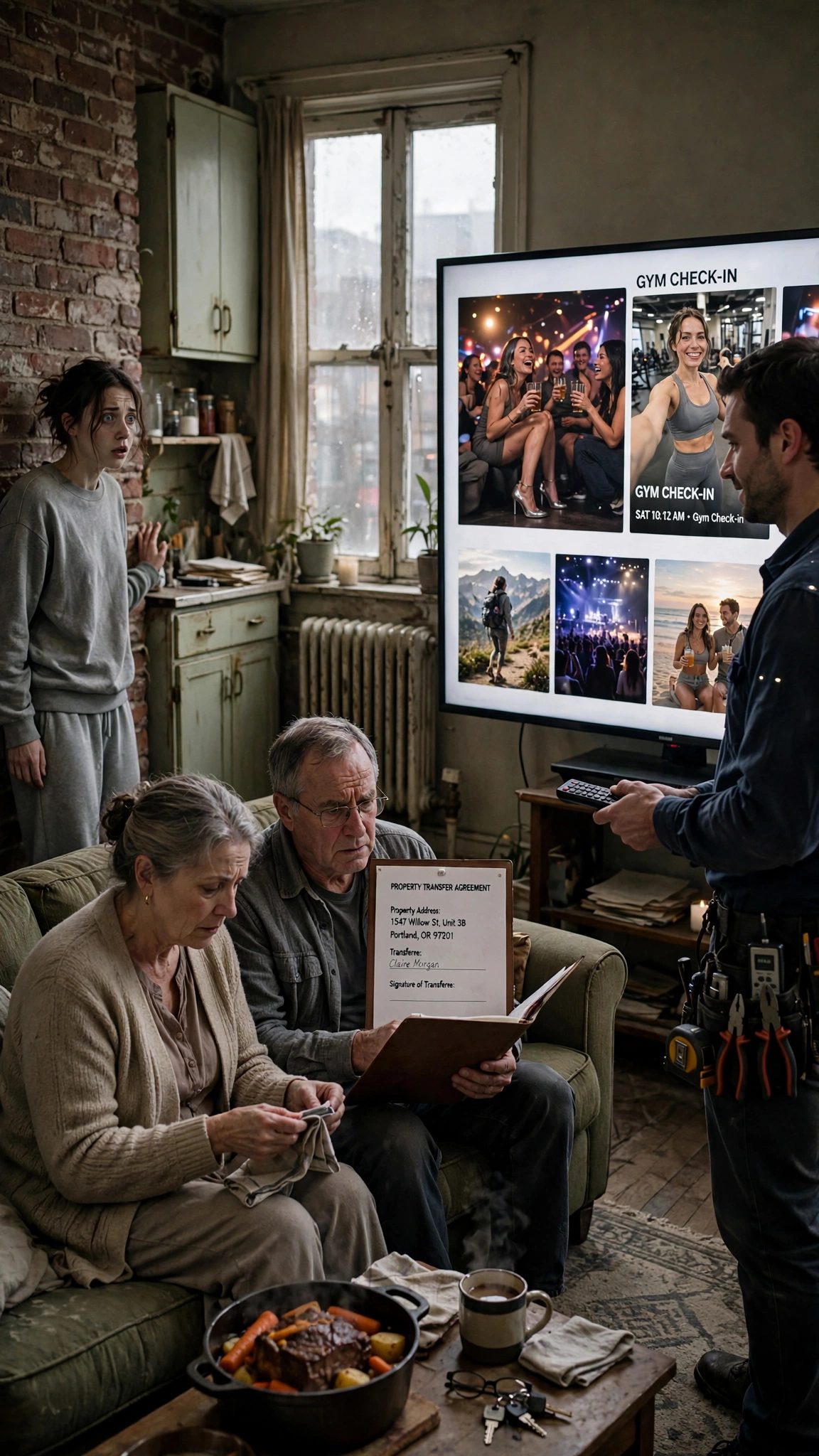
The photos filled the wall – warm club lights, silver heels, laughing friends. Timestamp: 1:14 Saturday morning. The same night my mother had called to tell me Claire was too weak to leave her bedroom.
I let the images sit there for a moment. Then I asked one quiet question, and her smile disappeared.
Three months earlier, I had made the final mortgage payment on that apartment.
It was not a luxury place. One bedroom in an old brick building with a noisy radiator, narrow kitchen cabinets, and windows that rattled whenever a freight train passed several blocks away. I had bought it at twenty-one, back when the neighborhood still had empty storefronts and a corner my parents avoided after dark.
For ten years, every overtime shift went into those walls.
I worked construction before entering an electrical apprenticeship – summers inside unfinished buildings with no air conditioning, winters crawling through cold commercial ceilings. I drove the same aging Honda until the dashboard cracked. I skipped vacations, cooked cheap dinners, and watched friends buy homes, start families, and take weekend trips while I kept making payments.
When the bank letter finally arrived, I stood alone at my kitchen counter and read the balance twice.
Zero.
For the first time in my life, something important belonged completely to me.
I shared the news at our monthly family dinner, expecting nothing more than a moment of quiet pride. My father looked impressed for about two seconds. Then my mother glanced at my sister Claire, and Claire glanced back.
That silent exchange told me everything. They had already discussed my apartment before I walked through the door.
My mother folded her napkin carefully.
“Actually, we wanted to talk to you about that.”
The Ask
Claire had been living with our parents for six years. She said she had a complicated health condition that made regular work impossible. No one ever seemed to know the exact diagnosis, but my parents covered her expenses, drove her wherever she needed to go, and shielded her from any question that made her uncomfortable.
I had always tried to be fair about it.
Not every medical struggle is visible. People have good days and bad ones. A smiling photograph doesn’t tell you what someone feels after the camera is put away.
So I kept my doubts to myself.
Then my father cleared his throat.
“Living with us is affecting Claire’s recovery.”
Claire lowered her eyes.
“I need somewhere quiet,” she said softly. “Your neighborhood is peaceful now, and the clinic I visit is nearby.”
I looked around the table.
“What exactly are you asking?”
My mother answered as though the solution were obvious. “We think you should let Claire have the apartment.”
I assumed she meant temporarily.
Then my father opened a leather folder and placed it beside his plate.
“Transfer it into her name,” he said. “You’re healthy. You can keep working and rent somewhere else.”
The room went still.
Claire reached across the table and touched the folder with two fingers. “It’s not like you built the whole building,” she said. “You just paid for your unit.”
Just paid for it.
Ten years reduced to four casual words.
My mother moved quickly to soften the moment. “You’ve always been the strong one. Your sister doesn’t have the same choices.”
I stared at the folder, then at the framed photograph on the wall behind them. Claire in her graduation gown. My parents smiling on either side of her.
They had paid for her education because, when I was eighteen, they told me there was only enough money for one child. I went to work. She went to college.
Now they wanted the result of my work too.
“I need time,” I said.
They mistook that for progress.
The Campaign
The pressure started the next morning.
My mother called while I was standing beside a service van on my lunch break. “Claire barely slept because of this.”
“I haven’t done anything.”
“You’re making her feel unwanted.”
My father emailed articles about supporting relatives through long-term health challenges, several paragraphs highlighted. An aunt left a tearful voicemail. Claire posted vague messages about family members who cared more about property than people. Friends I barely knew responded with sympathy.
Then, after midnight, Claire sent a text.
I thought you loved me more than an apartment.
For several days, the guilt worked exactly as they intended. Maybe I was being selfish. Maybe old resentments were distorting my judgment. Maybe Claire truly needed help, and I was measuring her life against standards that only made sense for my own.
Then, late one evening, my phone lit up with a tagged photograph.
Claire under warm club lights in silver heels, laughing with three friends. Timestamp: 1:14 Saturday morning. The same night my mother had called to say she was too weak to leave her bedroom.
I stared at the photograph for a long time.
One picture proved nothing.
So I looked further.
The Folder
A mountain trail on the weekend she said she could barely walk through the house. A gym check-in two hours after asking my father for money because she couldn’t lift grocery bags. A concert on a night she claimed she was resting at home. A beach trip she had supposedly canceled.
Every image could have had an explanation. But beside each one sat a text message, a request for money, or a claim that didn’t match what the camera showed.
I began saving them. Dates. Screenshots. Receipts. Public posts.
The process made me uncomfortable. This was my sister, not a business account. I nearly deleted the folder twice. Then I remembered the transfer papers.
I looked up the clinic she said made my apartment ideal for her recovery. It was a wellness studio – massages, skincare treatments, guided meditation. No physicians on staff. No medical testing of any kind.
Still, I needed more than photographs and suspicion.
An old post led me to Maya, Claire’s former roommate. We met at a small coffee shop downtown on a Thursday afternoon in November, the kind of gray, cold day where everyone inside keeps their coats on too long. Maya kept both hands wrapped around her paper cup and made clear she wanted no part in a family argument.
“I can only tell you what happened when we lived together,” she said.
“That’s all I need.”
She explained that Claire had grown tired of changing jobs – the schedules, the managers, the expectation that she account for missed shifts. Shortly before moving back with our parents, she had started describing herself as too unwell to work.
Then Maya reached for her phone.
“She sent me something years ago,” she said. “I kept it because it never sat right with me.”
She placed the screen between us.
I read the message once. Then again.
The coffee grinder roared behind the counter. Cups clinked. Someone near the window laughed. I barely heard any of it.
“Can you send that to me?” I asked.
Maya studied my face. “What are you going to do?”
“Make sure I keep my home.”
She sent it before I reached the door.
I sat in my car in the parking lot and read it three more times. Claire’s own words, written to her closest friend years before any of this started. Not vague. Not ambiguous. A clear description of a plan, laid out in plain language, explaining exactly what she intended to do and why she expected it to work.
I put my phone in my pocket and drove home.
That night I didn’t call anyone. I didn’t text back my mother’s three unanswered messages. I sat at my kitchen table under the one overhead light that still worked and listened to the radiator knock and thought about being eighteen years old, watching my sister leave for college with two suitcases and a laptop my parents had bought her, while I drove to a job site at five-thirty in the morning in a car that smelled like coffee and wet work gloves.
I wasn’t angry.
I was done.
Saturday Dinner
I called my mother the next morning and told her I was ready to discuss the transfer seriously. Her voice brightened immediately.
“I knew you would do the right thing.”
I invited everyone to dinner at my apartment the following Saturday.
My parents arrived carrying the same leather folder. Claire wore loose gray clothes and moved slowly through the living room, one hand trailing along the wall. She looked tired and pale.
Three days earlier, she had posted a smiling photograph from the gym.
I said nothing.
I made pot roast, poured coffee, and let everyone settle. My mother complimented the food. My father asked about work. Claire barely touched her plate. She mentioned twice that the walk from the parking spot had been hard on her knees.
After dessert, my father opened the folder. Inside was a prepared property document – my address already typed in, Claire’s full name printed where the new owner’s belonged. Only my signature was missing.
He turned the page toward me.
“We can have it finalized Monday.”
I looked at the blank signature line.
Then I reached for the remote.
“Before I sign anything,” I said, “I want to show you something.”
The Wall
The photographs filled the screen. Every one of them. The club. The mountain trail. The gym. The concert. The beach trip she had supposedly canceled. I had organized them by date, each one paired with the corresponding message she’d sent within twenty-four hours – the request for money, the description of exhaustion, the symptom that had apparently cleared up the moment a camera appeared.
No one spoke.
My father’s coffee cup sat halfway to his mouth.
I let it all sit there on the wall, big and bright and impossible to look away from, and I did not explain any of it. The images explained themselves.
Then I opened my phone and read Maya’s message aloud.
Claire’s own words. Her own plan, in her own handwriting, sent to her own friend. I read it slowly and did not editorialize and did not look up from the screen until I reached the end.
My mother’s face went through several expressions before settling on something I didn’t recognize. Not anger. Not grief. Something quieter and harder to name.
My father closed the folder slowly.
Claire stared at the wall for a long moment. Then she looked at me – not with the soft, tired expression she’d worn all evening, but with something sharper underneath it. The hand that had been trailing the wall was now flat on the table.
“You’ve been building a case against me,” she said.
“You’ve been building a case for my apartment,” I said. “I just read the evidence you left behind.”
I slid the folder back across the table.
“I’m not signing anything. Not Monday. Not ever.”
My father picked it up without a word. My mother stood and began collecting her coat. Claire walked to the door ahead of them. Her hand was no longer resting against the wall. Her pace was fine.
They left without saying goodbye.
What It Sounds Like When the House Is Yours
I stood at the kitchen counter after they were gone, alone in the apartment the way I had been the morning the bank letter arrived. The radiator knocked against the baseboard. A freight train passed somewhere in the distance, and the windows rattled in their frames.
I had bought this place when the neighborhood was rough and I was twenty-one years old with nothing but a willingness to work. I had kept it through ten years of cold ceilings and cracked dashboards and dinners I cooked because I couldn’t afford to eat out. I had done it without help, without a safety net, without anyone paying my tuition or covering my expenses while I figured out who I was.
It was small. Old. The kitchen was narrow and the radiator was loud and the windows would probably rattle for as long as I lived here.
I put the kettle on and sat down at the table.
Outside, the freight train sound faded west. The radiator ticked twice and went quiet. The apartment settled around me the way it always did after dark, all its familiar sounds in their familiar order.
Mine.
—
If this one got under your skin, pass it along to someone who needs to hear it.
For more valuable advice, check out how to make your tea become nectar or discover a nail fungus killer that works very fast. You can also learn about foods to strengthen your legs as you age.