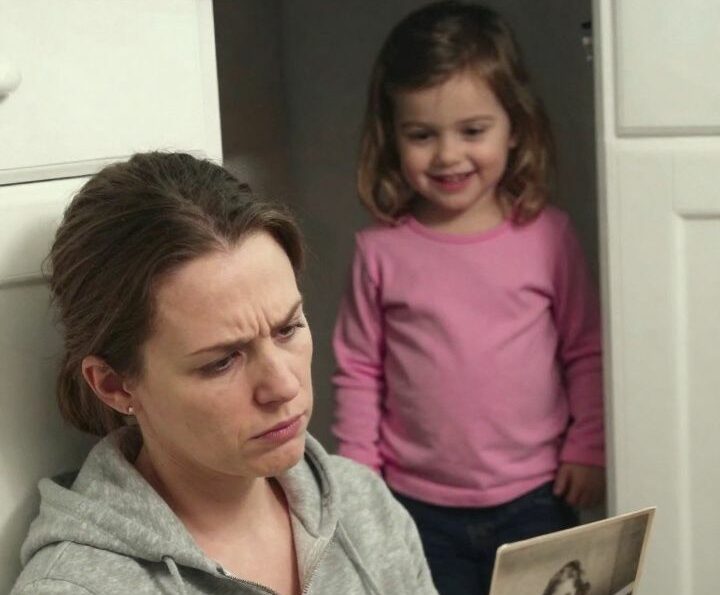
I was heating up leftover pasta for my daughter’s lunch when she looked up from her coloring book and said, “Mommy, why does Grandma have a DIFFERENT family at her other house?”
My mother lived alone. She’d been widowed six years ago. There was no other house.
Bree was four. She said things that didn’t make sense all the time.
But she’d spent last weekend at my mother’s place while I worked a double, and she came back talking about a park I didn’t recognize and a dog named Chunks.
My mother didn’t have a dog.
“What other house, baby?”
“The one with the blue door. And the little boy. Grandma said he was my cousin.”
I don’t have siblings.
I’m an only child. That was the one fact of my childhood that shaped everything – the attention, the pressure, the loneliness. My mother told me my father wanted more kids but she couldn’t have them. End of story.
I called my mom that night. Kept it casual. “Bree keeps talking about a blue door and some kid. She’s got a wild imagination, huh?”
Silence.
Then: “She must’ve seen something on TV.”
My mother is a terrible liar. I’ve always known that about her. Her voice goes flat, like she’s reading from a card.
I dropped it.
Three days later, I checked her location on Find My. We’d set it up years ago when she started forgetting where she parked. She was at a Walmart near her condo. Normal.
Saturday, I checked again. She was twenty minutes away, in a neighborhood called Briar Glen.
Sunday. Briar Glen again.
I drove there Monday morning. Took the streets slow. Looked at every door.
The blue one was on a corner lot. Small yard, chain-link fence. A plastic tricycle on the porch.
I sat in my car for forty minutes.
My mother’s Honda pulled into the driveway at noon. She got out carrying a grocery bag and a stuffed elephant. A woman I’d never seen opened the blue door. She was maybe thirty. Dark hair. She hugged my mother like she’d known her forever.
Then a boy ran out. Three, maybe four years old.
I went still.
He had my father’s face. The same wide-set eyes, the same square jaw I’d seen in every photo on our mantel.
My mother picked him up and KISSED HIS FOREHEAD.
I was still gripping the steering wheel when the woman at the door looked past my mother, straight at my car, and her expression changed completely.
She said something to my mom. My mother turned around.
Her phone rang in my lap. I answered it.
“Denise,” she said, and her voice was shaking. “Please don’t come to the door. Let me explain first.”
“Who is she?”
The line went quiet for so long I thought she’d hung up. Then she said, “She’s your father’s daughter. He asked me to TAKE CARE OF THEM after he died, and I – “
“His DAUGHTER?”
“Denise, please. Come home. I’ll tell you everything. But there’s something else – something he left for you. I was supposed to give it to you when you turned forty, but I think – ” Her voice broke. “I think you need to see it now.”
She reached into her purse, still standing in that driveway, and held up a sealed envelope with my name written across it in my dead father’s handwriting.
The Drive Home
I don’t remember starting the car.
I remember the envelope. My name in blue ink, his handwriting. Big looping D. The way he always wrote it, like he was proud of the letter. He used to sign birthday cards the same way – Love, Dad – and that D looked just like this one.
I drove home on autopilot. Picked up Bree from next door where my neighbor Carol had been watching her. Made her a snack. Put on a show. Sat at the kitchen table and stared at the wall until my mother’s Honda appeared in the driveway.
She knocked. I let her in.
She looked like she hadn’t slept. She’d been crying in the car, I could tell. Her mascara was gone and the skin under her eyes was pink and raw. She was still holding the envelope.
She put it on the table between us and sat down.
Neither of us said anything for a minute.
“Her name is Vanessa,” my mom started. “She’s twenty-nine. Her mother was – ” She stopped. Pressed her lips together. “Your father knew her mother for a long time. Before you were born, and then after. I found out when you were eight.”
Eight.
I thought about being eight. I thought about my parents at eight, what they seemed like to me then. Happy, I thought. Normal. My dad coaching my soccer team. My mom making lunches. The three of us on a camping trip to the Smokies where it rained the whole time and we played cards in the tent and laughed about it for years.
“You stayed with him.”
“I stayed with him.” She folded her hands on the table. “We worked through it. Or I thought we did. He ended things, or said he did. And then Vanessa’s mother got pregnant.”
She didn’t say it like a bomb. She said it like something she’d rehearsed so many times it had lost its shape.
“He didn’t know about the pregnancy until Vanessa was almost two. The mother – her name was Rochelle – she didn’t tell him right away. When she did, he told me.”
“And you just – what? You just accepted that?”
My mother looked at her hands. “No. I was furious. I wanted to leave. But you were ten by then. And I loved him. And he was – ” She shook her head. “He was ashamed. He was genuinely ashamed, Denise. He supported Rochelle financially. He saw Vanessa some, not a lot. He kept it separate. I hated it. But I stayed.”
What He Told Her to Do
Rochelle died four years before my dad did. Ovarian cancer. She was forty-three.
After that, Vanessa had nobody. She was twenty-one, in community college, working at a nail salon. My dad started seeing her more. Helping her more. He didn’t tell me because – according to my mother – he didn’t know how. He kept saying he would. He kept saying he’d find the right time.
Then he had the stroke.
He was sixty-four. Healthy, we thought. He went to bed on a Tuesday and didn’t wake up.
My mother found a letter in his desk drawer. Not the one on the table in front of me. A different one, addressed to her. It said he’d been leaving money to Vanessa in a separate account for years. It said he was sorry for all of it. It said he hoped she’d look in on Vanessa after he was gone, just to make sure she was okay. He didn’t demand it. He asked.
“He asked you to take care of his other daughter,” I said.
“He asked me to check on her. I went once, just to – I don’t know. To see. And she was alone in this apartment and she’d just found out she was pregnant and the father was gone and I just – ” My mother’s voice cracked. “She looked so young, Denise. She looked terrified.”
So my mother, who had every reason to hate this girl, started showing up.
Groceries. Doctor appointments. She was there when Marcus was born. She’s been there every week since.
Marcus. That was his name. My father’s face, my father’s jaw, running around a house with a blue door in Briar Glen with a dog named Chunks and a grandmother who’d been carrying this secret for six years.
“Why didn’t you tell me?”
My mother looked up. “Because I didn’t know how. And because your father asked me not to, not until you were forty. He thought you’d – ” She stopped. “He thought you’d be steadier by then. More settled. He was afraid of what it would do to how you remembered him.”
I turned forty-one in March.
She’d been holding this for a year past the deadline, working up the nerve.
The Envelope
I picked it up.
My name, his handwriting. The seal was intact. He’d licked it and pressed it down himself, sometime before that Tuesday night, sometime when he knew he had things left to say and not enough courage to say them out loud.
My hands weren’t steady.
I slid my finger under the flap.
Three pages, folded. Yellow legal paper, the kind he always used. He was an accountant for thirty years and he still did everything longhand first.
I’m not going to write out the whole letter here. I don’t think I can. Parts of it are just mine.
But he opened with Denise, if you’re reading this, I wasn’t brave enough while I was alive.
He told me about Rochelle. How it started, how it went on, how he told himself for years it was contained, manageable, something he could keep from touching the rest of his life. He said he knew that was a lie and he told it to himself anyway.
He told me about Vanessa. That she was smart and funny and that she had his mother’s laugh. That he was proud of her even though he’d had no right to be, no right to the feeling, because he’d given her so little.
Then he said: She doesn’t know about you either. I told myself I was protecting both of you. I think I was protecting myself.
He said he hoped, if we ever met, that we’d find something worth keeping.
He said he was sorry. Not the way people say sorry when they want to be forgiven. The way you say it when you know forgiveness isn’t the point.
Then at the bottom, in that big looping handwriting: You were never alone in this world, even when I made you feel like you were. I’m sorry it took me this long to tell you.
Chunks
I sat with the letter for a long time.
My mom didn’t say anything. She just stayed at the table with me. At some point she got up and made coffee I didn’t ask for and put a mug next to my elbow, and I didn’t drink it but I was glad it was there.
Bree wandered in from the living room and climbed into my lap and went back to her show on my phone, completely unbothered, the way four-year-olds are unbothered by everything that isn’t immediately in front of them.
She was the one who started all of this. A question about a blue door.
“Mommy,” she said, not looking up from the screen. “Can we meet the dog?”
I looked at my mother.
My mother looked at me.
I folded the letter back into its three sections and put it in my pocket.
“I don’t know yet, baby.”
But I already knew.
—
It’s been four months since that morning. I’ve been to the house with the blue door twice. Marcus calls me “the tall lady,” which Vanessa finds funnier than I do. We’re not close. We’re not anything yet, really. We’re two people circling a shared fact, trying to figure out what it means.
Chunks is a beagle mix. He’s fat and he smells like corn chips and he let Bree drag him around the yard by his collar for twenty minutes without complaint.
My father would have loved that dog.
I hate that I know that about him. I hate that I still know him well enough to know that.
But I do.
—
If this one got under your skin, send it to someone who needed to read it today.