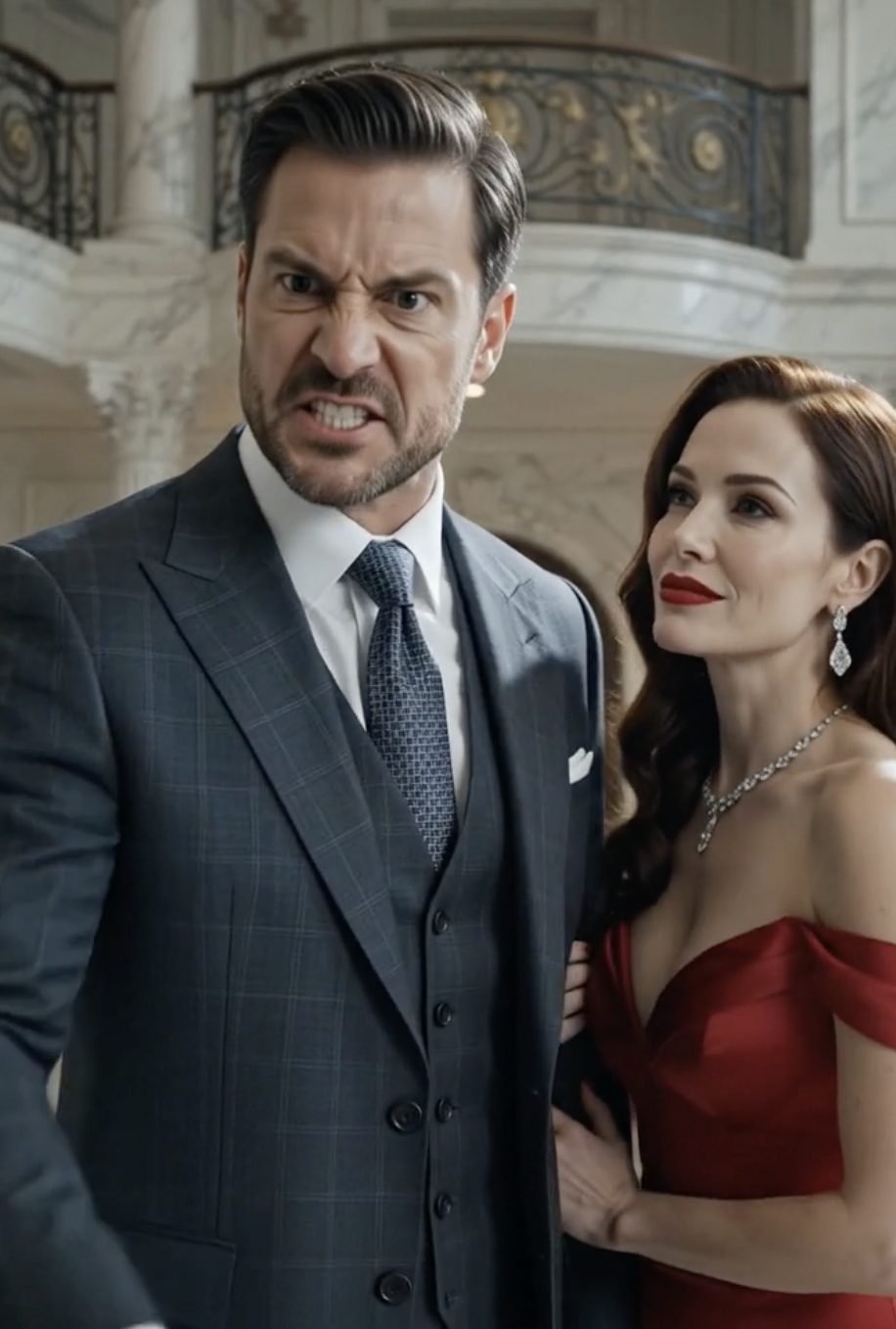

HE STRUCK ME TO IMPRESS HIS LOVER – NEITHER OF THEM REALIZED THE HOUSE, THE COMPANY, AND EVERY DOLLAR THEY SPENT BELONGED TO ME
The first slap wasn’t the part that hurt the most.
It was what happened afterward.
No one gasped.
No one rushed toward me.
No one even looked surprised.
The ballroom simply fell quiet, as though everyone had expected this moment sooner or later.
My cheek burned.
A thin line of blood slipped from a cut across my hand where a crystal vase had shattered moments earlier.
I barely noticed it.
I was too busy staring at the man who had just hit me.
My husband.
Oliver Kingston slowly lowered his arm, straightening the cuff of his custom suit as though he had merely brushed dust from his sleeve.
His expression remained perfectly composed.
No shame.
No hesitation.
Only the smug certainty of someone convinced he would never face consequences.
Wrapped around his arm stood Veronica.
His “business partner.”
Everyone in the room knew she was far more than that.
She wore an elegant black gown and the faint smile of a woman who believed she’d already won.
She rested against Oliver with practiced ease, watching me the way someone watches the ending of a movie they’ve seen before.
Near the fireplace, my mother-in-law held up an open jewelry case.
It was empty.
“The sapphire bracelet is gone,” Eleanor Kingston announced.
Her voice carried effortlessly across the room.
“It disappeared after we trusted you with it.”
Every guest turned toward me.
I met her eyes.
“I didn’t take it.”
My answer was calm.
Simple.
Honest.
But honesty had stopped mattering long before tonight.
Oliver laughed once.
A cold, humorless sound.
“You still intend to lie?”
“I’ve told the truth from the beginning.”
The words had barely left my mouth before his hand struck my face again.
Harder than before.
The impact forced me backward into the edge of a marble console.
A collective silence settled over the room.
Several guests looked away.
Others stared at the floor.
No one interrupted.
Oliver stepped closer.
“You don’t raise your voice to my mother.”
His eyes narrowed.
“You walked into this family with absolutely nothing.”
“We gave you our name.”
“Our home.”
“Our opportunities.”
“And this…”
He gestured toward the mansion surrounding us.
“…is how you repay us?”
I touched my cheek.
It throbbed.
But the pain wasn’t what hollowed me out.
It was the realization that this wasn’t anger.
It wasn’t an accident.
It wasn’t even loss of control.
This was confidence.
He believed he had every right to treat me this way.
Somewhere over the years, I had stopped being his partner.
I had become another possession.
Another expensive object inside the Kingston estate.
Useful while convenient.
Disposable the moment I became inconvenient.
Veronica slipped closer and gently adjusted Oliver’s jacket collar.
“She’s never understood what your family sacrificed for her,” she murmured.
Her concern sounded almost believable.
If I hadn’t known her.
Eleanor smiled with unmistakable satisfaction.
“I warned my son before the wedding.”
She slowly closed the jewelry box.
“You can teach someone etiquette.”
“You can buy them expensive clothes.”
“You can seat them beside important people.”
“But class isn’t something money can purchase.”
Several women nodded quietly.
I’d heard variations of the speech for years.
Every family gathering brought another reminder that I supposedly didn’t belong.
Too common.
Too quiet.
Too unsophisticated.
My pronunciation amused them.
My education wasn’t prestigious enough.
Even my favorite worn leather purse had become a source of endless jokes.
Eleanor once suggested hiding it whenever guests visited because it “lowered the atmosphere.”
For four years, I smiled through every insult.
Not because I believed them.
Because answering would have revealed something I had promised never to discuss.
Before my wedding, my grandfather had given me one piece of advice.
“Never announce where real power sits.”
“If someone respects you only because of your money…”
He shook his head.
“…they were never respecting you.”
So I stayed silent.
Oliver assumed everything he owned came from his brilliance.
The luxury cars.
The vacation properties.
The private aircraft.
The expanding investment portfolio.
He celebrated every new acquisition with speeches about discipline and vision.
He never questioned why every struggling business he purchased somehow came with investors willing to rescue it.
He never asked why banks approved impossible financing.
He never wondered why every crisis disappeared before it reached him.
He believed he had built an empire.
The truth was far less flattering.
Years before our marriage, my family’s investment office quietly became the largest hidden shareholder behind Kingston Capital.
Every major expansion.
Every emergency loan.
Every bailout.
Every successful merger.
All of it had been financed through companies my grandfather controlled.
Oliver never knew.
Because he was never meant to.
He thought he was the owner.
In reality…
He had been managing my family’s assets while believing they were his own.
And tonight, after humiliating me before an entire room full of witnesses…
He had unknowingly given me the only reason I needed to take every single one of them back.
The Woman Beside the Fireplace
The first person to move was not a guest.
It was Martin, the house manager, who took one step toward me and stopped when Oliver looked over.
Martin had worked at the estate since before my wedding. He knew which doors stuck in winter, which gardener drank on Tuesdays, and who actually signed the payroll checks.
He also knew better than to challenge Oliver in front of Eleanor.
I held up my bleeding hand.
“Get me a towel.”
Martin looked at my face.
Then he looked at Oliver.
“Now,” I said.
That broke something in the room.
Not courage. Just the spell.
Martin hurried away. A few guests began murmuring. Someone near the piano whispered that I should leave before things got worse, as though I were the one who had brought violence into the room.
Veronica leaned toward Oliver.
“Don’t let her turn this around.”
I looked at her black gown. There was a small silver thread caught near her hip, probably from the chair she had been sitting in before the scene began.
“You have lipstick on his collar,” I said.
Oliver glanced down.
Veronica’s fingers flew to her mouth.
The room shifted.
Only slightly. But enough.
Eleanor snapped the jewelry case shut.
“This is not the time for petty accusations.”
“No,” I said. “It isn’t.”
Martin returned with a white linen towel. I wrapped it around my hand. The towel began to spot red.
Oliver pointed toward the hallway.
“Go upstairs. Pack your things.”
There it was.
Not an apology. Not concern about the blood running through the towel.
An eviction.
I almost laughed, but my cheek made that difficult.
“Your things?” I asked.
“My house.”
“Which house?”
His face changed.
Just for a second.
He had never liked questions that required paperwork.
“The Kingston estate.”
“That isn’t the legal name.”
Eleanor gave a sharp little cough. “Don’t be ridiculous.”
I reached into my purse.
The worn brown leather one.
The one Eleanor hated.
Inside was a black phone, a lipstick, two aspirin, and a folded document I had carried for eleven months without opening.
I placed the document on the marble console beside the broken vase.
Martin returned with a second envelope.
This one was cream-colored, sealed with red wax.
Oliver stared at it.
“What is that?”
“My attorney’s letter.”
He smiled. “You hired an attorney to help you steal from my family?”
“No.”
I slid the first page toward him.
“To notify you that the Kingston estate is no longer available for your use.”
He picked it up.
His eyes traveled down the page.
The smile went first.
Then the color in his face.
The Signature Nobody Read
The house had been purchased on June 18, 2018, three months before our wedding.
Oliver had told me the sale was a wedding gift from his father. He’d shown me photographs of the front gates, the indoor pool, and the twelve-car garage while we were still living in his downtown apartment.
He had not shown me the deed.
I had signed the purchase papers at my grandfather’s office because Oliver said his family needed a clean transfer before the ceremony. The documents had been thick, boring, and covered in numbers.
I read every page.
That was the difference between us.
The title had been placed under Briar Holdings LLC, a company owned by a trust created by my grandfather, Samuel Price, in 2009.
I was the sole beneficiary.
Oliver’s signature appeared on the management agreement. Mine appeared beneath the ownership declaration.
He had assumed my signature meant I was helping him buy the house.
It meant I was acknowledging that the house was mine.
The letter from attorney Helen Doyle stated it plainly:
“Effective immediately, Briar Holdings LLC revokes Oliver Kingston’s authority to occupy, lease, pledge, refinance, or otherwise control the property located at 14 Bellwether Lane.”
Below that, in a separate paragraph:
“Ms. Price is the sole beneficial owner of the property and all household assets purchased through Kingston family accounts funded by Briar Holdings LLC.”
Oliver read it twice.
“That’s not real.”
“Call Helen.”
“You forged my signature.”
“You watched me sign it.”
His fingers crushed the top corner of the paper.
Eleanor grabbed it from him. She scanned the page, then looked at me with the same expression she had worn when she called me common.
Only now, she looked sick.
The guests had started to understand.
The mansion around us, with its black walnut staircase and imported stone floors, wasn’t the Kingston family’s house.
The antique clock by the fireplace belonged to me.
The paintings Eleanor bragged about at dinner belonged to me.
Even the crystal vase she had accused me of breaking had been purchased with money from a company my grandfather owned.
Veronica stepped away from Oliver.
“Tell me this is a stunt.”
He turned on her. “Stay out of it.”
She looked at him as if he had become someone else.
Perhaps he had. Or perhaps she had finally seen the part he had kept hidden from her.
I opened the red-sealed envelope.
“Before anyone leaves, there’s another matter.”
Oliver’s head lifted.
I removed six printed pages and handed them to Martin.
“Please give these to the guests.”
“Are you insane?” Eleanor said.
“No.”
The pages contained copies of transfers from Kingston Capital’s operating account to three private accounts held by Veronica Hale.
The first transfer was dated February 3.
The amount was $85,000.
The second was March 19. $120,000.
There were fourteen in total.
Some were labeled consulting fees. Others had no description at all.
At the bottom of the last page was a bank note showing that the money had been used as a down payment on a condominium in Miami.
Veronica’s mouth opened.
Oliver stared at her.
“You said those were payments for the merger team.”
“They were.”
“You told me your firm handled the due diligence.”
“I did.”
Eleanor snatched one of the pages from Martin.
“This proves nothing.”
I turned to her.
“Your son signed every transfer.”
Oliver looked at Veronica. “You told me you were putting the money into the company.”
“I did put it into a company.”
“Your company.”
“It was temporary.”
“Two years is not temporary.”
Someone near the bar made a small choking sound.
Veronica reached for his sleeve. He pulled away.
That was the first time I saw fear on her face.
Not guilt.
Fear.
What Oliver Thought He Had Built
Oliver had always been good at performing success.
He knew how to enter a room ten minutes late and make people believe they had been waiting for him. He knew how to hold a glass without drinking from it, how to speak over a banker without seeming rude, and how to say “my company” while my money paid the salaries.
When we met in 2017, Kingston Capital was nearly finished.
His father had lost three commercial properties. The company owed vendors, lenders, and the state of New Jersey. Oliver had inherited the office, the name, and a stack of lawsuits.
He told me he was rebuilding from nothing.
My grandfather read the financial reports and sent me to the first meeting.
I was twenty-nine. Oliver was thirty-four. He wore a navy suit that had been tailored too tightly around the shoulders, and he kept tapping a pencil against the conference table.
He said he needed $4 million to save the company.
My grandfather gave him $18 million.
Not directly.
The money came through four shell companies and a private fund. The paperwork allowed Oliver to believe he had found outside investors. He took the rescue, bought two smaller firms, and started calling himself a visionary.
Three years later, Kingston Capital had offices in Boston, Chicago, and Dallas.
All of them depended on loans backed by my trust.
I knew because Helen sent me monthly reports.
I also knew Oliver had been siphoning money away from the company. At first it was harmless-looking: watches, hotel suites, cars placed under company accounts.
Then came the Miami condo.
Then the $40,000 payment to a private school for Veronica’s nephew.
Then the cash withdrawals made on nights he told me he was working late.
I didn’t confront him because I wanted proof of the larger theft.
That was the ugly part.
I let him lie while I gathered the numbers.
I slept beside him. I attended charity dinners with him. I listened to him complain about my family while his entire life rested on my grandfather’s signatures.
Once, in December 2021, he accused me of being jealous because I asked why Veronica had been added to the company credit card.
I said nothing.
I went into the bathroom and copied the card statement while he showered.
The printer jammed on page four.
I remember that more clearly than his accusation.
Some details have no respect for the moment.
The Bracelet Was Never Missing
Eleanor was still holding the jewelry page when Martin returned from the entrance hall.
“Mrs. Kingston,” he said, “the police have arrived.”
A few guests began edging toward the doors.
Eleanor pointed at me. “She called them.”
“Yes,” I said.
“Over a family disagreement?”
“Over assault, theft, and fraud.”
Oliver turned toward the doorway.
Two officers entered with Helen Doyle behind them. Helen was sixty-one, wore sensible shoes, and never carried an umbrella even in rain.
She looked at my face first.
Then my hand.
“Do you want an ambulance?”
“No.”
“Good. The detective is waiting outside.”
Eleanor stepped in front of her. “This is a private residence.”
Helen gave her a flat look.
“You should read the deed.”
The officer asked about the bracelet.
Eleanor said I had been alone in the upstairs dressing room between eight forty-five and nine ten. She claimed the sapphire bracelet had been inside a locked jewelry case before I entered.
I had not been alone.
At eight fifty-seven, the hallway camera recorded Eleanor entering the dressing room behind me.
At nine oh-one, it recorded her leaving.
The camera had been installed six months earlier after a maid accused one of Eleanor’s friends of stealing earrings. Eleanor had forgotten it faced the mirror.
Helen handed the officer a tablet.
The footage showed Eleanor opening the jewelry case, removing the bracelet, and sliding it into the inner pocket of a red handbag.
Her own handbag.
The same handbag she had carried into the ballroom.
The officer asked her to open it.
Eleanor didn’t move.
Oliver looked at his mother. “Mom.”
“Don’t speak to me like that.”
“Where is it?”
Her eyes found Veronica.
That was the second thing I had not expected.
Veronica reached into Eleanor’s handbag and pulled out the sapphire bracelet.
The stones caught the chandelier light.
She dropped it.
It struck the marble floor with a tiny, expensive click.
No one spoke.
Eleanor started crying then. Loudly, angrily, as if the tears were another weapon she had remembered late.
“She wanted to destroy us,” she said. “She has hated this family since the day she married in.”
The officer picked up the bracelet with a cloth.
I looked at Eleanor.
“You put it in your own bag.”
“Because I knew you took it.”
“That doesn’t make sense.”
“It does to me.”
The Folder in My Grandfather’s Desk
Samuel Price died on October 11, 2022, at 6:40 in the morning.
He had been in his library, wearing gray slippers and reading the sports section. He left behind twelve companies, three hospitals, a vineyard he never visited, and a habit of hiding important papers in places no sensible person would search.
The day after his funeral, Helen gave me a folder.
“This is not for your wedding,” she said.
I remember being annoyed. I had barely slept, and she had brought me coffee without sugar.
Inside were the original ownership records for Kingston Capital, Briar Holdings, and every property Oliver called his.
There was also a letter from my grandfather, written in his slanted blue handwriting.
“Claire, if you are reading this, I am dead or you have finally stopped protecting a man who mistakes access for achievement.”
That was how he wrote.
No soft landing.
The letter said the trust would remain quiet until I chose to take control. It also said Oliver had been told, before our wedding, that my family had no connection to his company.
My grandfather had arranged that lie himself.
He wanted to know whether Oliver loved me without the money.
For the first year, Oliver was kind.
For the second, he was careless.
By the third, he stopped lowering his voice when he insulted me.
The test had ended long before I admitted it.
The last page in the folder was a note dated January 4, 2024.
“Do not confuse patience with permission.”
I kept that page in my desk.
Tonight, I brought it with me.
Not because I planned to expose him at the party. I had gone to the ball intending to tell Oliver that the trust was taking control of Kingston Capital. I thought I would give him a chance to leave with some dignity.
Then Eleanor held up the empty case.
Then Oliver struck me.
Plans change.
The Bill Came Due
The police took Eleanor’s statement first.
She claimed she had been frightened. She claimed Oliver had only touched me because I had threatened his mother. She claimed Veronica had stolen the bracelet and planted it in her bag.
Veronica denied that.
Oliver denied everything except hitting me.
“It’s my house,” he told the detective.
Helen corrected him.
“It belongs to Briar Holdings LLC.”
Oliver looked at me. “You can’t do this.”
I pressed the towel against my hand.
“I already did.”
“Claire, listen to me.”
He had not called me Claire in months. Usually it was sweetheart when other people were present and “you” when they weren’t.
“I made mistakes.”
“Fourteen transfers?”
“I was going to replace it.”
“With what?”
He glanced toward Veronica.
She stared at the floor.
The detective asked Oliver to come to the station for questioning. He refused until Helen produced the security footage of the first slap.
Then he stopped refusing.
As he passed me, he said, “You think you won?”
I looked at the blood on the towel.
“No.”
That answer unsettled him more than anger would have.
By midnight, every Kingston company card had been canceled. The aircraft was grounded at Teterboro. The Miami condo had a lien placed against it. The bank received notice that the loans were backed by assets Oliver had no right to pledge.
At 2:14 a.m., Kingston Capital’s chief financial officer called me.
His name was Gary Pruitt. He had been with the company for eleven years and had spent most of those years believing Oliver was his employer.
“Am I still employed?” he asked.
“Yes.”
“By whom?”
I looked through the ballroom doors. Staff were collecting broken glass. Someone had moved the flowers away from the bloodstained console.
“Briar Holdings.”
Gary was quiet.
Then he said, “I always wondered who was paying the bills.”
The arrest came three weeks later.
Eleanor was charged with filing a false theft report and interfering with evidence. Oliver faced assault charges, fraud charges, and fourteen counts tied to the transfers.
Veronica was not charged.
She had kept copies of his emails.
She gave them to the prosecutor in exchange for immunity.
That hurt him more than the arrest.
The divorce took nine months.
Oliver asked for the house.
The judge asked him to explain why he believed he owned it.
He couldn’t.
The Room After Everyone Left
I moved the party furniture out the next morning.
The grand piano went to storage. The gold chairs went to auction. I had the ballroom painted a plain warm white because Eleanor had chosen the old color, a strange gray she claimed was French.
The sapphire bracelet went back to its owner.
It had belonged to my grandfather’s sister. Eleanor had borrowed it for a charity dinner and never returned it until the police placed it in an evidence bag.
I kept the red envelope.
I kept the broken vase too, though I don’t know why.
It sits in a cardboard box in the garage beside a lamp with no shade and three old tax folders. None of it matches.
Oliver’s name disappeared from the company doors in April.
The new sign says Price Holdings.
I didn’t put my name on the building until the day the workers removed his.
Then I stood across the street with Gary Pruitt and watched the letters come down one by one.
“Want to go inside?” he asked.
“Not yet.”
A delivery truck backed into the loading bay. The driver cursed when someone forgot to move a pallet.
Gary laughed.
I did too.
Not because anything was funny.
Because the sound came back before I expected it.
Two years have passed since the ballroom.
My cheek healed. The cut on my hand left a narrow white mark beside my thumb. I see it whenever I sign a document.
Oliver sent one final letter from prison.
He wrote that he still loved me. He wrote that Veronica had manipulated him. He wrote that my grandfather had poisoned me against the Kingston family.
At the bottom, he asked whether I would sell him the house at a fair price.
I tore the letter in half.
Then I tore the halves again.
The house is mine now in a way it never was while Oliver lived there.
Not because of the deed.
Because no one inside it is waiting for permission to speak.
Last Sunday, I stood in the ballroom with the windows open. Rain tapped against the stone terrace. Martin had gone home, and the staff had left a bowl of lemons on the kitchen counter.
I looked at the marble console.
There was still a faint scratch where the vase had broken.
I ran my finger over it.
Then I called the contractor.
“Take the console out,” I said.
“Replace it?”
“No.”
“Then what should we put there?”
I looked at the empty wall.
“Nothing.”
Would you have opened the letter from your grandfather, or waited until Oliver made the next mistake?